When a freelancer searches for "Odoo reviews", they are usually in one of two situations. Either they have heard of Odoo as a powerful ERP and want to know if it fits their case, or they already received a quote from an integration partner and the number surprised them. This analysis uses the official prices verified on odoo.com on 29/09/2026 and the consistent pattern in the Capterra reviews (4.2/5 across more than 1,300 reviews) to answer honestly: Odoo is exceptional for the right profile and a serious problem for the wrong one.
Odoo is a modular open-source ERP founded in 2005 in Belgium. Instead of buying a closed ERP with rigid modules, you assemble your own by combining only the apps you need (CRM, Invoicing, Accounting, Manufacturing, Inventory, Projects, HR) on top of code you can modify. It is enormously powerful and highly configurable. It also has a steep learning curve and in Spain it usually requires an integration partner whose implementation cost sits on top of the license.
The 30-second verdict
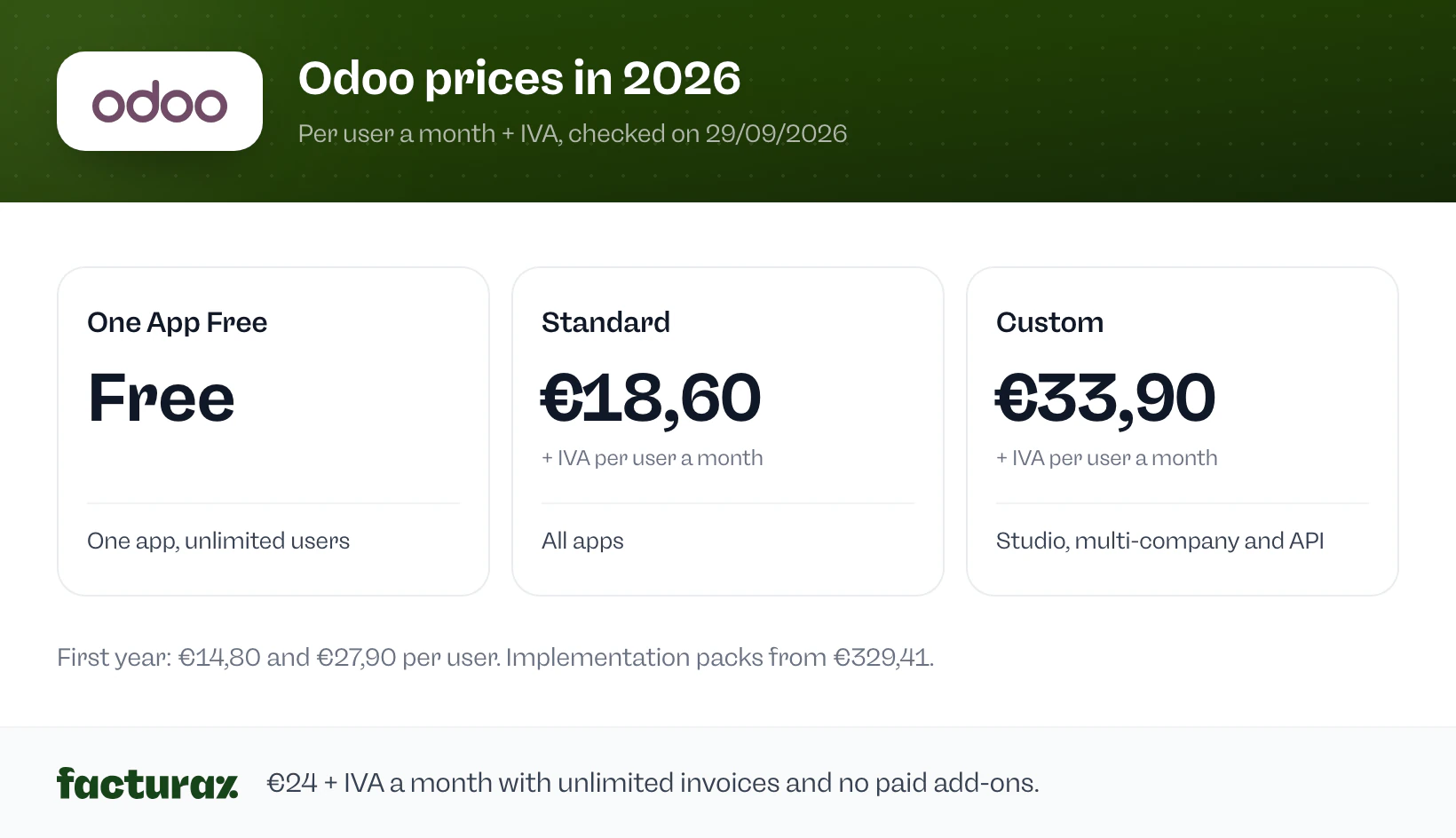
Odoo is the most complete modular ERP on the market: very powerful, very configurable, with a One App Free plan at €0 for a single application. The paid license is per user: Standard €18,60/user/mo (€14,90 on annual billing, €11,90 the first year) with every app and Custom €33,90/user/mo (€27,90 annual) with Odoo Studio, multi-company and API. The per-user price means the cost scales with your team.
Odoo wins for SMEs with a technical team (in-house IT or a partner) that need deep customization, manufacturing or multi-warehouse. If you are a freelancer or a business of up to 10 employees with no technical team, Odoo is too much: implementation with a partner can cost thousands of euros before you issue your first invoice. For that profile, Facturaz does the job with no implementation. Read on.
What Odoo is and why everyone talks about it
Odoo's proposition is radical in its simplicity: you do not buy a closed ERP, you build it by combining the apps you need. There are three ways to use it:
- Community. Full open source, free, but it requires your own installation and maintenance (you need a development team or a partner).
- Standard / Custom (Odoo Online and Enterprise). Commercial SaaS versions with official support, updates and cloud integrations.
- One App Free. A single app free permanently, with unlimited users, hosted on Odoo Online.
People talk so much about Odoo because it offers big-ERP functionality (production planning, complex multi-warehouse, integrated e-commerce, analytical accounting) at a license price far below SAP, Microsoft Dynamics or NetSuite. For a technical SME that knows what it is doing, it is a real opportunity. The reviews polarize for one specific reason: the license price is not the real total cost and for profiles without a technical team the rest of the cost becomes dominant.
How much does Odoo cost in 2026?
Odoo charges the license per user, not per company. These are the official prices excluding VAT, verified on odoo.com on 29/09/2026:
| Plan | Annual billing (€/user/mo) | Monthly billing (€/user/mo) | What it includes |
|---|---|---|---|
| One App Free | €0 | €0 | A single app, unlimited users, Odoo Online |
| Standard | €14,90 | €18,60 | Every app |
| Custom | €27,90 | €33,90 | Every app plus Odoo Studio, multi-company, API, choice of hosting |
Prices excl. VAT, verified on odoo.com on 29/09/2026. The first year is discounted (Standard at €11,90 on annual billing). The price is per user, so the total cost scales with team size. The One App Free plan lets you use a single application (for example, only Invoicing or only Accounting) free and permanently.
The key point almost no comparison explains well: because the price is per user, the real cost depends on the size of your team. A team of 5 users on the Standard annual plan comes to €74,50/mo excl. VAT (€14,90 times 5; €59,50 the first year). On the Custom annual plan it would be €139,50/mo excl. VAT. And that is only the license.
The real total cost: license plus implementation
Here is the point almost nobody sees on the official website: in Odoo there are several cost components, not just one.
Component 1: the license. What you see on the website (€0, €14,90 or €27,90 per user per month on annual billing). For an SME of 5 users on Standard annual that is €894/yr excl. VAT (€714 the first year). On Custom annual, €1.674/yr.
Component 2: the implementation. In Spain, setting up Odoo seriously usually requires an integration partner. This does not appear on the official website, but it is the consistent pattern in the reviews. A basic implementation for a micro-business starts at a few thousand euros. An implementation with manufacturing, multi-warehouse and deep customization can reach tens of thousands. It is a one-off startup cost, but it is real and usually several times the first-year license.
Component 3: hosting and ongoing support. If you choose managed hosting or technical maintenance, add a further recurring cost. Annual maintenance is often estimated as a percentage of the initial implementation.
The result is that a business that saw "€11,90 per user per month" and budgeted a few hundred euros a year in licenses can end up paying several thousand in the first year across license, partner implementation, hosting and support. It is not an Odoo trick: it is the real cost of a tailored ERP. But it pays to calculate the whole thing before deciding. For comparison, Facturaz costs €24/mo (€240/yr excl. VAT with 2 months free on annual billing, €290,40 incl. VAT) and you issue your first invoice on day one, with no implementation or partner.
Comparison with alternatives
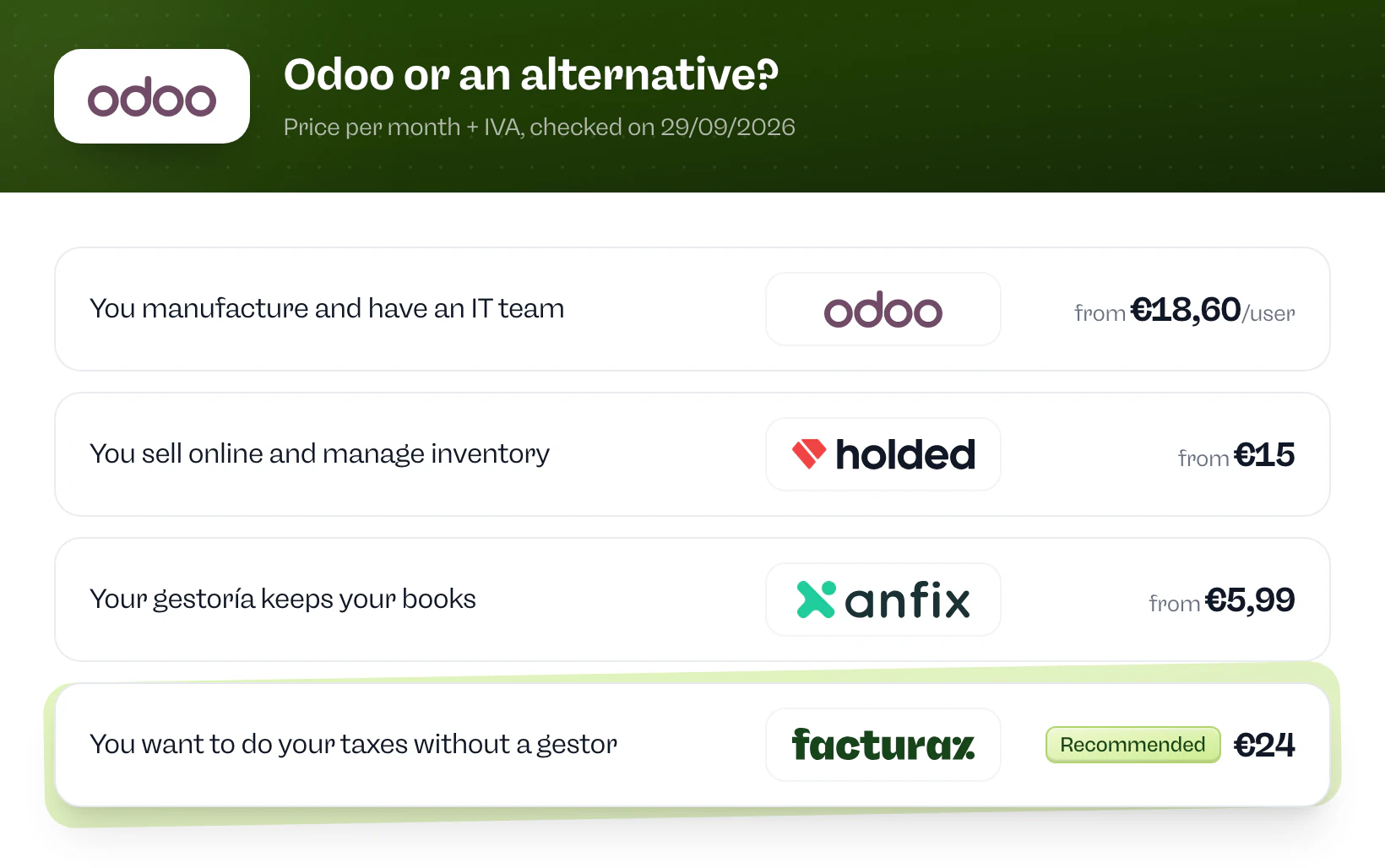
Here is how Odoo compares with three relevant alternatives. To keep it fair, for each tool we use the typical plan for a small SME or an active freelancer, on annual billing and excluding VAT.
| Criterion | Odoo Standard | Holded Plus | Anfix Avanzado | Facturaz |
|---|---|---|---|---|
| Price (€/mo, annual, excl. VAT) | 14,90 per user | 15 | 12,49 | 20 |
| Partner implementation | Yes (separate cost, thousands of €) | No | No | No |
| Technical team required | Yes (IT or partner) | No | No | No |
| Deep customization | Yes (unique) | Limited | Limited | Limited |
| Manufacturing and multi-warehouse | Yes | Inventory, not manufacturing | No | No |
| Verifactu | Via localization with a partner | Native | Native | Native |
| Proactive AI | No | No | No | Yes (GestorIA) |
| Learning curve | Very high | Medium | Low with an accountant | Zero (premise) |
| Designed for | SME with a technical team | SME with inventory or e-commerce | Freelancer with an accountant | Freelancer and SME 0-10 without a team |
Prices excl. VAT, verified on 29/09/2026 on the official websites. Holded has no free plan (14-day trial). Anfix and Holded offer TicketBAI for the Basque foral territories. Odoo's implementation cost is separate and depends on the complexity of the project.
Honest reviews: what users say
Odoo scores 4.2/5 on Capterra across more than 1,300 reviews. That is a good score, not an exceptional one. More interesting than the average is the pattern: the distribution is bimodal. Technical users in SMEs with their own IT team give 5 stars. Freelancers who tried to implement Odoo on their own, with no partner, give 1 or 2 stars. The average hides that polarization.
The most representative comment, which appears in many reviews with different wording: a very powerful and flexible product, but the real total cost is hard to predict. Excellent for technical SMEs, complicated for solo freelancers.
Strengths according to the reviews
- Real modularity. You pay only for what you use and the One App Free plan with one application and unlimited users is genuinely useful for anyone who needs only CRM or only Invoicing. It is not a trial, it is permanent.
- Open-source Community. For SMEs with a development team, the code is open, modifiable and self-hostable. You are not locked into a vendor.
- Unlimited customization with Odoo Studio. On the Custom plan you can build interfaces and business logic without programming. It is among the deepest on the market accessible to non-programmers.
- Powerful API. For businesses with a technical stack (their own e-commerce, legacy systems, industrial integrations), the Odoo API is more complete than most alternatives.
- Big-ERP functionality in an SME. Real production planning, complex multi-warehouse and analytical accounting that would cost five figures in traditional ERPs.
- Active global community. Thousands of certified partners, third-party modules and abundant documentation.
Frequent criticisms in the reviews
- Implementation requires a developer or partner. This is the most repeated complaint. Without a technical team, implementing Odoo is very hard. The implementation cost surprises anyone who looked only at the license price.
- Very steep learning curve. Reviews from non-technical users agree: it takes months to master. For anyone coming from simple software, the jump is enormous.
- Spanish localization dependent on modules. Part of the tax localization relies on community-maintained modules, with slower updates than fully Spanish products.
- Verifactu requires partner configuration. Compliance with RD 1007/2023 (amended by RD 254/2025) is not plug-and-play in Odoo. In Holded, Anfix or Facturaz it is native from day one.
- Real cost far above the license. The most documented pattern. Anyone who budgeted only the license ended up paying considerably more with implementation, hosting and support.
- Too much for a pure freelancer. A recurring comment: for a solo service freelancer with a handful of invoices a month and a couple of tax forms, Odoo is oversized.
Who Odoo is worth it for
Odoo is the right choice for profiles where its strengths are decisive:
- SMEs with their own IT team or a certified partner that can maintain Odoo long term.
- Manufacturing businesses that need MRP, production planning and multi-warehouse with complex rules.
- Advanced e-commerce with a technical stack that requires API integrations with their own stores or dynamic pricing logic.
- Growing SMEs with a 3-to-5-year horizon that prefer to invest now in a system that scales to dozens of employees without changing software.
- Businesses that value open source and want real ownership of their software with Community.
Who Odoo is NOT worth it for
Odoo is not the optimal option if your profile falls into one of these cases:
- You are a solo service freelancer. The real total cost is not justified for a few dozen invoices a month. Look at Anfix, Quipu or Facturaz.
- You are a small SME with no IT team or budget for a partner. Without someone to maintain Odoo, the promise of customization turns into an operational problem.
- Your business is standard. If you only need invoicing, accounting, tax forms and some basic CRM, a specialized product does it better and cheaper.
- You want Verifactu working without technical work. In Odoo it requires partner configuration.
- You need an AI that prepares your taxes and answers your questions. Odoo is a very powerful traditional ERP, but it does not include an assistant like GestorIA.
- You have no patience for a months-long learning curve. If you need to be productive within a week, look at other options.
Alternatives by profile
Three options that cover the profiles where Odoo is not the optimal choice.
Holded, for SMEs with inventory or e-commerce
Holded, from €15/mo on the Plus plan (excl. VAT, half price the first 3 months). A full cloud ERP (invoicing, accounting, CRM, inventory, HR and projects), owned by Visma. It is broader than a pure invoicing product and needs no partner to get started. Choose it over Odoo if your SME has between 5 and 30 employees, needs stock management or connected e-commerce, but not industrial manufacturing or an in-house IT team. It has no free plan (14-day trial) and Verifactu is native from day one.
Anfix, for freelancers and SMEs with an accountant
Anfix, from €12,49/mo on the Avanzado plan (excl. VAT, annual billing). Software optimized to collaborate with your accounting firm, with a real-time connection between you and your accountant. It is certified for TicketBAI in the three Basque foral territories, on top of meeting Verifactu in common territory. Choose it over Odoo if you are a freelancer or small SME with no need for a full ERP, work with an external accountant or operate in the Basque Country. Bear in mind that its model assumes an accountant: the real cost combines the software fee with the accountant's fees.
Facturaz, for freelancers and SMEs 0-10 with no technical team
Facturaz, 14 days free and €24/mo after that. An AI CFO for freelancers and businesses with up to 10 employees. Here is the underlying contrast with Odoo: the two products serve opposite visions.
Odoo says: build your ERP by combining modules with unlimited customization. Partner implementation, thousands of euros and then you have every tool to do whatever you want.
Facturaz says: your goal is not to build an ERP. It is to have your taxes run themselves. You register, connect your bank, Facturaz prepares your tax forms and GestorIA answers your questions. No developers, no partner, no learning curve.
The zero-knowledge angle is especially strong here. Odoo's reviews confirm it frequently: a very steep learning curve for users without IT. And it is structural, because Odoo requires you to understand modules, configurations and customizations. Facturaz flips the proposition: zero accounting or technical knowledge. You do not need to know what a Modelo 303 is, or which box the input VAT goes in. You invoice, Facturaz does the accounting and prepares the Modelo 303, 130, 111, 115, 349, 390 and 347 forms so you only have to file them. And it tells you how much to set aside for the quarter's VAT, instead of you discovering it when payment is due.
The cost contrast, for a small SME of 5 users:
| Real year-1 cost | Odoo Standard (5 users) | Facturaz |
|---|---|---|
| Annual license (excl. VAT) | €714 | €240 (2 months free) |
| Partner implementation | Thousands of € (separate cost) | €0 |
| Hosting and support | Additional recurring cost | €0 (included) |
| Verifactu | Partner configuration | Native from day 1 |
| Proactive AI | No | Yes (GestorIA) |
| Learning curve | Months | Zero (premise) |
The contrast is not only financial. The two products do not compete for the same customer. Odoo serves technical SMEs with an IT team that need deep customization, manufacturing or multi-warehouse. Facturaz serves freelancers and SMEs 0-10 with no technical team who want their taxes solved, with GestorIA for their questions.
Honest about limitations: Facturaz is a new product (2025) and has no advanced inventory module, warehouse management, manufacturing or multi-company. It covers common territory (national AEAT), without TicketBAI. If you need manufacturing, multi-warehouse or deep customization, Odoo is the right option. If you operate in the Basque Country, Anfix fits better.
Verdict: is Odoo worth it in 2026?
The verdict in one sentence
Odoo is the most powerful modular ERP on the market and the right choice for SMEs with their own IT team or a certified partner that need deep customization, manufacturing or multi-warehouse. The license starts at €0 (One App Free) and €14,90 per user per month on Standard annual (€11,90 the first year), but the real cost includes a partner implementation that is separate and usually costs thousands of euros. For freelancers and SMEs 0-10 with no technical team, that cost and that complexity are not justified.
Product rating: 4.2/5 (Capterra) for its ideal profile · Real cost: far above the visible license · Learning curve: high, months long · For solo freelancers: oversized
The pattern across more than 1,300 reviews is clear: Odoo is an exceptional product for technical SMEs and a problem for solo freelancers. The choice depends almost entirely on your profile, not on the features. If your SME has an IT team or a partner and needs manufacturing, multi-warehouse or deep customization, Odoo is the right option and the investment in implementation pays off with the power you will have. If you are a freelancer or a business of up to 10 employees with no technical team, Odoo is too much and Facturaz does exactly what you need with no implementation or partner.
Next step
If your SME needs manufacturing, multi-warehouse or deep customization, get three quotes from certified Odoo partners before deciding. If you are a freelancer or a business of up to 10 employees with no technical team, you can try Facturaz free for 14 days.