If you run a business in Spain, you have probably heard the word Verifactu by now. Maybe from your gestor, maybe from a worried message in a freelancer group, maybe from Hacienda itself. And maybe you are not entirely sure what it means for you, what you actually have to do about it, or when.
Here is the short version: Verifactu is the set of rules for how invoicing software has to create and keep invoices, so that nobody can quietly change an invoice after it has been issued. The dates are in the law. The simplest way to be ready is to invoice with software built for it.
That is what Facturaz does. This article explains what Verifactu is, which dates apply and what Facturaz does for you on every invoice.
What Verifactu actually is
Verifactu is the name everyone uses for Real Decreto 1007/2023, the regulation that sets the requirements for invoicing software in Spain. Under it, every invoice you issue with software gets three things:
An invoicing record. A small signed file with the invoice's key data.
A chained fingerprint. Each record carries a hash of the one before it, so an invoice cannot be slipped in, taken out or changed without the chain showing it.
A QR code on the invoice. Anyone can scan it to check the invoice against Hacienda.
The law allows two ways of keeping those records. The software can send each record to Hacienda the moment the invoice is issued, which is the "Veri*Factu" sending mode. Or it can sign the records, keep them and log its own events, without sending anything unless Hacienda asks. Both are compliant. What you cannot do is invoice from a spreadsheet or a Word template once the obligation applies, because neither produces the records or the QR code.
When it applies
The dates in force today come from Real Decreto-ley 15/2025, published in the BOE on 3 December 2025:
| Who | Date that applies today |
|---|---|
| Companies (SL, SA and other corporate income tax payers) | 1 January 2027 |
| Autónomos and all other taxpayers | 1 July 2027 |
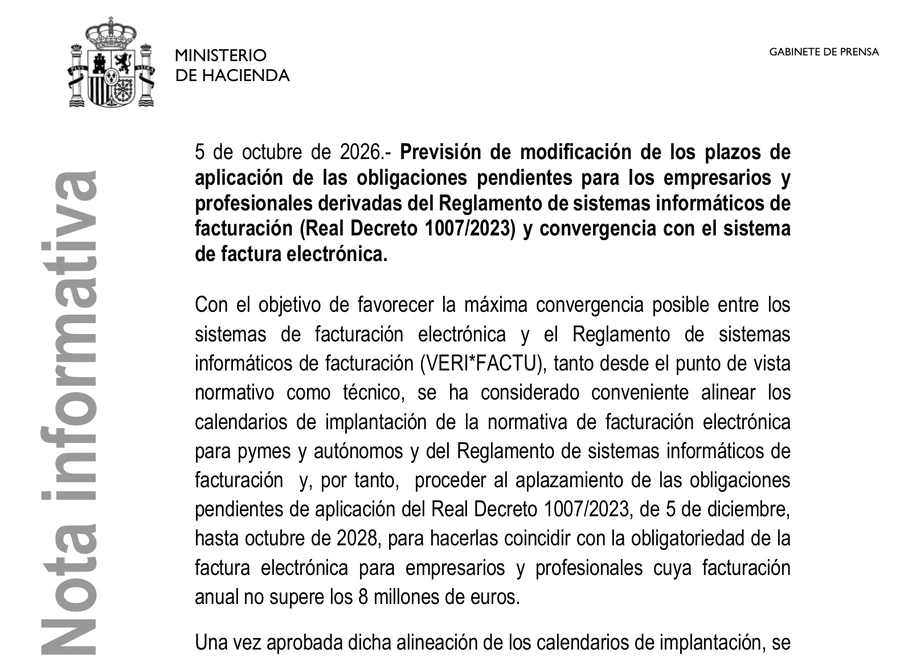
On 5 October 2026 Hacienda announced that it wants to move both dates to October 2028, so that Verifactu arrives together with mandatory e-invoicing between businesses. That is an announcement, not law yet: until it is published in the BOE, the 2027 dates are the ones that count. We cover the announcement in detail in Verifactu postponed to October 2028: what changes.
Either way the direction is set. The businesses that get caught out are the ones that wait for the last month and then switch systems under pressure. The ones who move early simply forget about it.
What Facturaz does on every invoice
With Facturaz you do not manage Verifactu. You make invoices and the compliance happens underneath.
You create an invoice in seconds
Pick a client, add your items and you are basically done. Facturaz fills in your IVA and, where it applies, your IRPF withholding. Invoice numbering is handled for you, in order, with no gaps. You get a clean PDF you can email straight from the app.
Every invoice gets its record, its chain and its QR code
The moment you issue an invoice, Facturaz creates its invoicing record, signs it, chains it to the previous one and prints the QR code on the invoice, as Real Decreto 1007/2023 requires. There is no special "make this compliant" button, because every invoice is compliant by default. You can check and download your records at any time, in case Hacienda asks for them.
Sending to Hacienda is a switch
By default Facturaz keeps the signed records for you and sends nothing. If you would rather have every invoice reported to Hacienda the moment you issue it, you turn on Verifactu sending in Settings, by signing an authorisation with your digital certificate. On a computer that is one click with Autofirma. Once it is on, it stays on. If sending becomes mandatory, we will let you know and help you turn it on.
If something is wrong, you know before Hacienda does
With sending turned on, Hacienda can reject a record, for example if a client's details are not right. Facturaz flags that clearly. And before a deadline, the AI audit scans your invoices, expenses and contacts and points you straight at anything that needs fixing, whether sending is on or off.
"Do I have to understand all of this?"
No. That is the point.
You do not need to know how the chain works, what a hash is or which article applies to you. You need your invoices to be correct, compliant and easy to send. Facturaz handles the technical side so you can stay focused on your actual work.
Think of it like a card terminal. You do not need to understand how it talks to the bank to take a payment. You tap, it works. Invoicing in Facturaz is the same. You invoice, it complies.
Switching is easier than you think
If you are coming from a gestor, another tool or a folder full of spreadsheets, you do not lose your history. You can bring your existing invoices into Facturaz and the AI reads the details and builds your client list as it goes. Imported invoices are kept apart from your live invoices and never get a Verifactu record, so nothing is double-counted.
Most people are up and running the same day.
The bottom line
Verifactu is the standard for invoicing software in Spain, with dates in the law: 1 January 2027 for companies, 1 July 2027 for autónomos and a postponement to October 2028 announced but not yet published. You can treat that as a headache, or you can let it quietly make your invoicing cleaner without doing any of the technical work yourself.
With Facturaz, compliant invoicing is not a feature you switch on. It is just how invoicing works. You create the invoice; Facturaz signs its record, chains it and prints the QR code. Whether the records are also sent to Hacienda is your call.
Get ahead of Verifactu while there is no rush. Try Facturaz free for 14 days and send your first compliant invoice today.
This article is general information about invoicing rules in Spain and how Facturaz works, as of 22 October 2026. It is not professional tax advice. For advice about your specific situation, speak to a qualified professional.