
What everyone calls the digital nomad visa has another name in the law: the visado para teletrabajo de carácter internacional (visa for international teleworking). It was created by Ley 28/2022 on startups, which added articles 74 bis to 74 quinquies to Ley 14/2013 on support for entrepreneurs. It lets you live in Spain while you work remotely for companies based abroad.
It is one of the residence routes we cover in foreigners in Spain: NIE, Social Security and tax. Here you have who can apply, what the law requires, how long it lasts, what happens with your family and where you stand on Social Security and tax.
Who can apply
It is for nationals of countries outside the European Union. If you are an EU citizen or have an equivalent free movement right, you do not need it (article 61.2 of Ley 14/2013). The law defines it like this (article 74 bis.1):
- You work remotely for companies based outside Spain, using only computer, online and telecommunication means.
- If you are an employee, you can only work for companies based outside Spain.
- If you are a freelancer (profesional), you can also work for a company located in Spain, as long as that work is no more than 20% of your professional activity.
You must also be a qualified professional: a graduate or postgraduate of a university, vocational training centre or business school of recognised prestige, or someone with at least three years of professional experience (article 74 bis.2).
Requirements
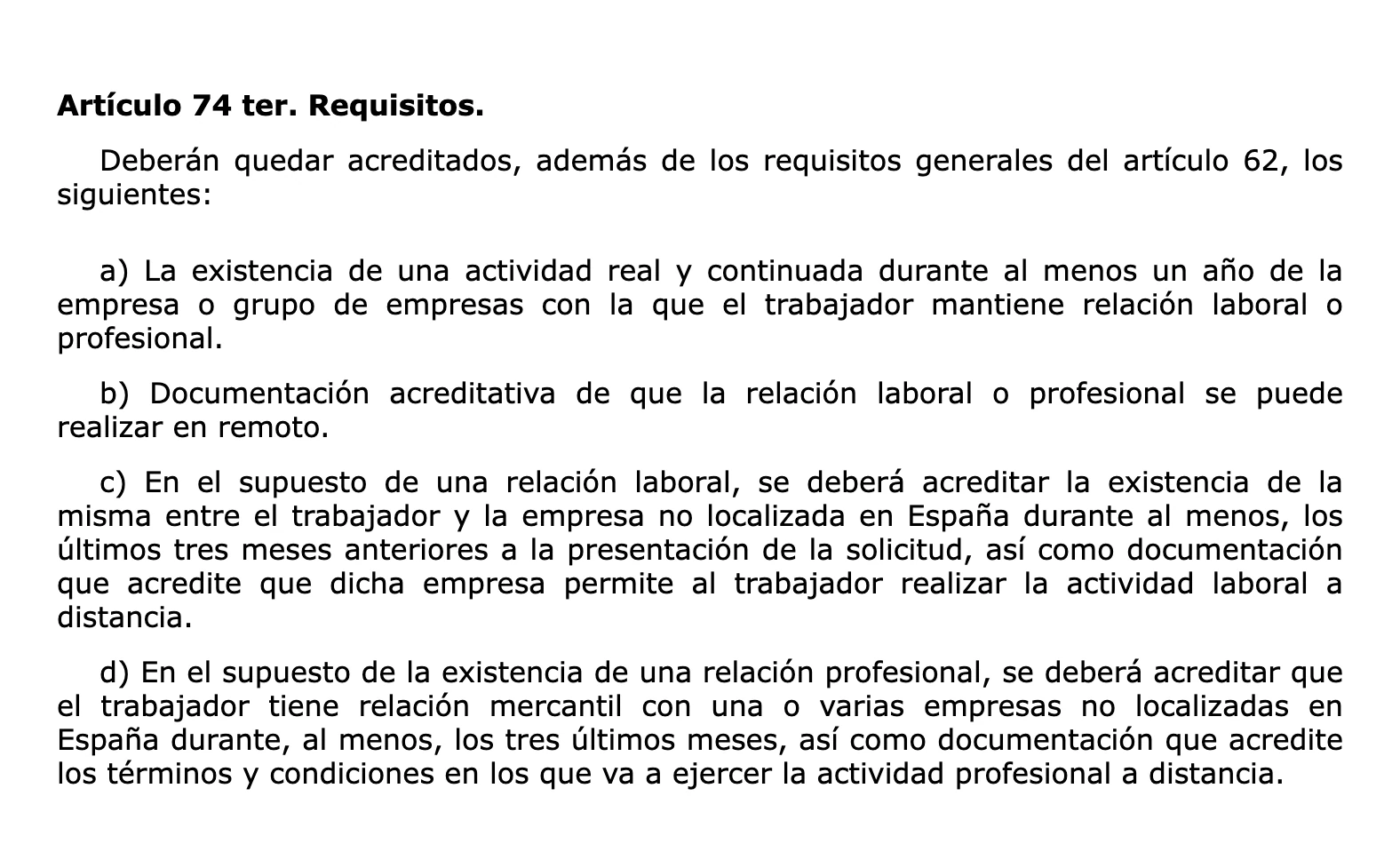
On top of the teleworking requirements (article 74 ter) come the general ones for every authorisation under this law (article 62.3):
| Requirement | Article of Ley 14/2013 |
|---|---|
| The company or group you work for has had real and continuous activity for at least one year | 74 ter.a |
| Documents showing that your work can be done remotely | 74 ter.b |
| As an employee: an employment relationship with the foreign company for at least the three months before applying and a document from the company allowing you to work remotely | 74 ter.c |
| As a freelancer: a commercial relationship with one or more foreign companies for at least the last three months and the terms on which you will work remotely | 74 ter.d |
| Not being in Spain irregularly and being over 18 | 62.3.a and b |
| No criminal record in Spain or in the countries where you have lived in the last two years, plus a sworn statement of having none in the last five | 62.3.c |
| Not being listed as someone to be refused entry in countries with which Spain has an agreement | 62.3.d |
| Health insurance, public or private with an insurer authorised in Spain | 62.3.e |
| Sufficient financial means for you and your family during your residence | 62.3.f |
| Paying the fee | 62.3.g |
On financial means: the law requires them to be sufficient but does not set a figure. We do not give an amount because it is not in any rule published in the BOE (the Official State Gazette). Check the figure the consulate or the Large Companies and Strategic Groups Unit (Unidad de Grandes Empresas y Colectivos Estratégicos) asks for before you apply.
Visa or residence authorisation
These are two different documents, applied for in different places:
- The visa is applied for from outside Spain, at the Spanish consulate that covers you (article 75.1). It lasts up to one year, or less if your work period is shorter. While it is valid, it is enough on its own to live and telework in Spain (article 74 quater). The consulate has 10 working days to decide, except in cases subject to prior consultation under the Visa Code (article 75.5).
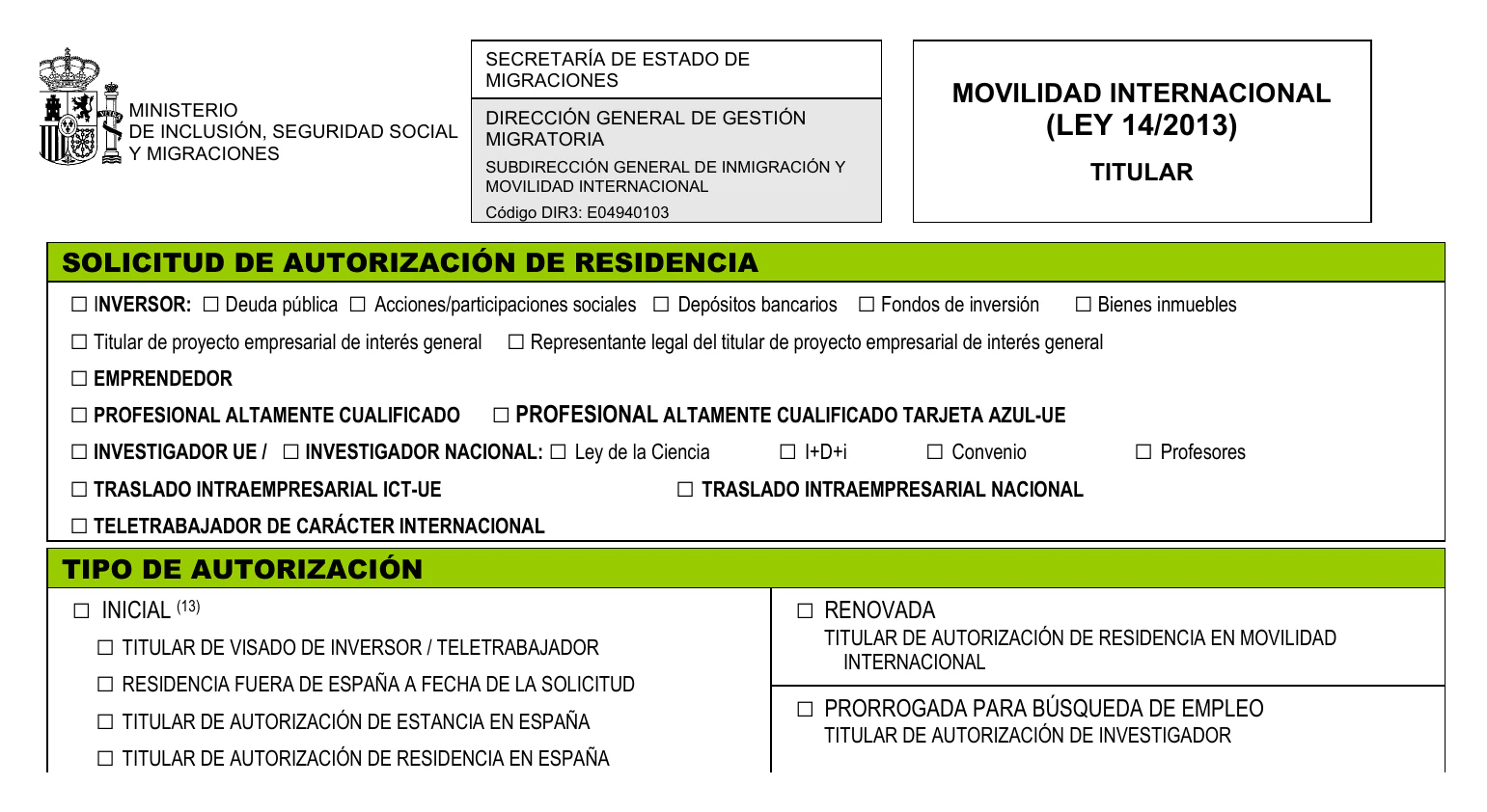
- The residence authorisation is applied for from Spain if you are here lawfully or if you arrived with the visa. In that case you apply in the 60 calendar days before the visa expires. It lasts up to three years and is renewed for two-year periods as long as you still meet the conditions (articles 74 quater.3 and 74 quinquies).
The authorisation is processed online by the Large Companies and Strategic Groups Unit and granted by the Directorate-General for Migration (Dirección General de Migraciones). It has 20 days to decide and, if it does not reply, the application is deemed granted. While it is being processed, your previous status stays valid. If it is granted for more than six months, you apply for your foreigner identity card (TIE) (article 76.1 and 76.2). If you apply for renewal, your authorisation is extended until you get an answer, also if you apply within 90 days after it expires, although in that case you may face penalty proceedings (article 76.3).
Your family
Your spouse or partner, your minor children, your adult children who depend on you financially and have not started their own family and your dependent parents can come with you or join you. Each of them must meet the general requirements of article 62.3. They can apply at the same time as you or later. If they apply at the same time, the applications are decided together (article 62.4).
Social Security
The General Social Security Law includes in the Spanish system foreigners who live in Spain lawfully and work in Spanish territory, remote workers included (article 7.1). There are two situations:
- You stay in your home country's system if a bilateral Social Security agreement between your country and Spain allows it. You prove it with the certificate your country issues under that agreement.
- You contribute in Spain in all other cases: in the Régimen General if you are an employee or in the RETA (the self-employed scheme) if you are a freelancer. During your first six months you can register with your passport, even if you do not have an NIE yet (article 76.5 of Ley 14/2013). You will need your Social Security number, which we explain in the Social Security number.
Tax
Your residence permit does not decide where you pay tax. You are tax resident in Spain if you spend more than 183 days of the calendar year here or if your main centre of activities or economic interests is here (article 9.1 of Ley 35/2006 on IRPF, personal income tax). As a resident you pay IRPF on everything you earn worldwide, even if a foreign company pays you. We cover it in when you are tax resident in Spain and in tax residence vs legal residence. If your country also treats you as resident, the tax treaty decides: we explain it in what a double tax treaty is.
The Beckham law
Since Ley 28/2022, the special regime for people moving to Spain is expressly open to employees who hold the visa for international teleworking (article 93.1.b.1.º of Ley 35/2006). If you choose it, you pay 24% on your employment income up to €600.000 in the year you arrive and the following five. You must not have been resident in Spain in the previous five years and you must apply with modelo 149 within six months of starting your activity. That start is the date of your registration with Spanish Social Security or the date of the document that keeps you in your home country's system. If you telework as a freelancer, this route does not cover you: for the self-employed the law only provides for entrepreneurial activity with a report from ENISA and for highly qualified professionals working for startups or in training, research, development and innovation. All the details are in the Beckham law.
If you are a freelancer
If you telework on your own account and are tax resident, you register as an autónomo (self-employed) with the tax agency and with Social Security, unless an agreement keeps you in your home system. Then you file your modelos like any autónomo. The steps are in foreign autónomo in Spain. Invoicing companies in other countries has its own IVA (VAT) rules, which we cover in how to invoice a foreign client.
At Facturaz we do not handle visas or residence authorisations. If you already have your authorisation and your NIE and are going to work as an autónomo, our team prepares your registration with the tax agency and Social Security for €49 + IVA: you have it in autónomo registration with Facturaz.