
When you invoice someone in another country, what matters is not the country but who your client is (a business or a private individual) and what you sell (services or goods). That tells you whether the invoice carries Spanish IVA (VAT) and which mention it needs. This is the international side of how to invoice as an autónomo, the guide with every invoicing rule.
The rules come from Ley 37/1992 on IVA (articles 21, 25, 68 to 70 and 73), the Invoicing Regulation (Real Decreto 1619/2012) and the IVA Regulation for modelo 349. Here is the summary:
| Client | Services | Goods |
|---|---|---|
| Business in another EU country | No Spanish IVA: reverse charge | Exempt intra-community supply |
| Private individual in another EU country | Spanish IVA, except electronic services above €10.000 | Spanish IVA up to €10.000 of distance sales a year |
| Business outside the EU | Not subject to Spanish IVA | Exempt export |
| Private individual outside the EU | Spanish IVA, except the services in article 69.Dos | Exempt export |
Business clients in another EU country
Services: the reverse charge
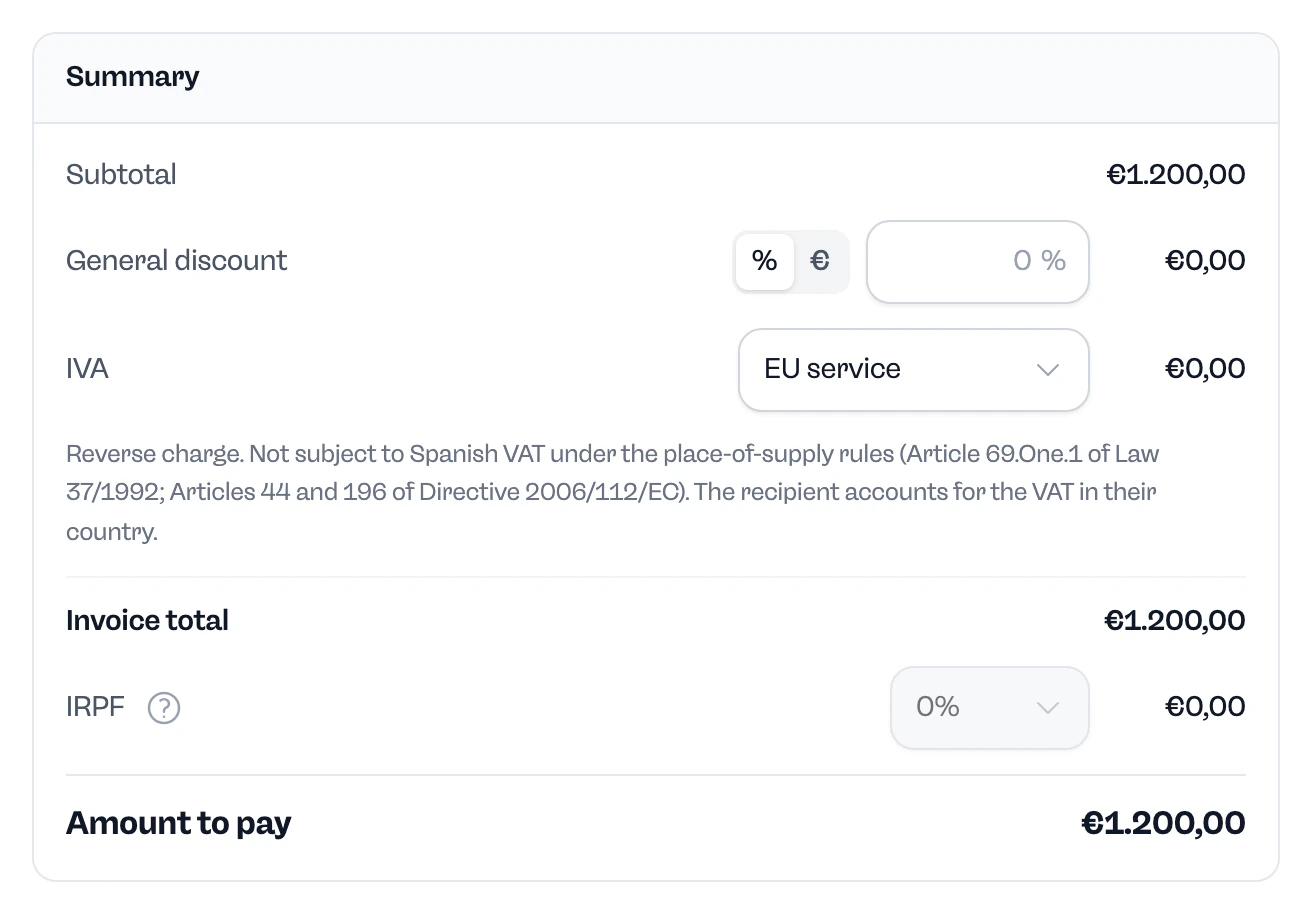
A service to a business is treated as supplied where that business is established (article 69.Uno.1.º of the IVA Law). If your client is a French company, the service does not take place in Spain: your invoice carries no Spanish IVA and your client declares the VAT in its own country.
The invoice must show your client's VAT number (article 6.1.d of the Invoicing Regulation) and the words "inversión del sujeto pasivo", Spanish for reverse charge (article 6.1.m). An example: Pablo, a developer in Valencia, invoices a Lisbon agency €3.000. His invoice is for €3.000, with no IVA and no withholding.
Goods: the exempt intra-community supply
If you sell goods to a business in another EU country and ship them there, the sale is exempt from IVA when your client has a VAT number from another Member State and has given it to you (article 25.Uno of the IVA Law). The exemption also depends on you including the sale in modelo 349.
The invoice shows the client's VAT number (article 6.1.d) and the exemption with its article, for example "entrega intracomunitaria exenta, artículo 25 de la Ley 37/1992" (exempt intra-community supply) (article 6.1.j). You must issue it before the 16th of the month after the one in which transport starts (article 11.2). It can never be a simplified invoice (article 4.4.a).
The ROI and the VIES check
For these operations you need your NIF (tax ID) with the ES prefix, assigned when you register in the Registro de Operadores Intracomunitarios (ROI, the register of intra-community operators) through the census return. The register covers those who sell goods to other EU countries and those who supply services declared in another Member State under the reverse charge (articles 3.3 and 25 of Real Decreto 1065/2007). If the tax office does not decide within three months, you can treat the application as refused (article 25.1). The steps are in how to register in the ROI.
Before invoicing without IVA, check that your client's number is valid in VIES, the EU database of VAT numbers, or ask the Agencia Tributaria to confirm it (article 25.5 of Real Decreto 1065/2007). The guide on intra-community operations covers more.
Modelo 349
Exempt intra-community supplies of goods and services to businesses in other EU countries under the reverse charge are declared in modelo 349 (article 79 of the IVA Regulation). It is filed quarterly, in the first twenty days of the following month, unless those operations exceed €50.000 in the quarter or in any of the previous four: then it is monthly. The last period of the year is filed in the first thirty days of January (article 81). Details are in the modelo 349 guide.
Private clients in another EU country
If your client is a private individual, the general rule is the opposite: a service you supply from Spain is treated as supplied in Spain and carries Spanish IVA, as if the client lived here (article 69.Uno.2.º).
There are two exceptions with a shared limit of €10.000 a year, excluding IVA, across all EU countries (article 73):
- Electronically supplied, telecommunications and broadcasting services, such as selling a downloadable template or a software subscription (article 70.Uno.8.º).
- Distance sales of goods, when you ship goods to a private buyer in another EU country (article 68.Tres.b).
While those sales stay at or below €10.000 in both the previous year and the current one, you charge Spanish IVA. Once you go over, you charge the VAT of the client's country, which you can declare from Spain through the One Stop Shop (ventanilla única), the Union scheme (article 163 unvicies onwards). You can also choose the client's country VAT below the limit, for at least two years (article 73.Dos).
Clients outside the EU
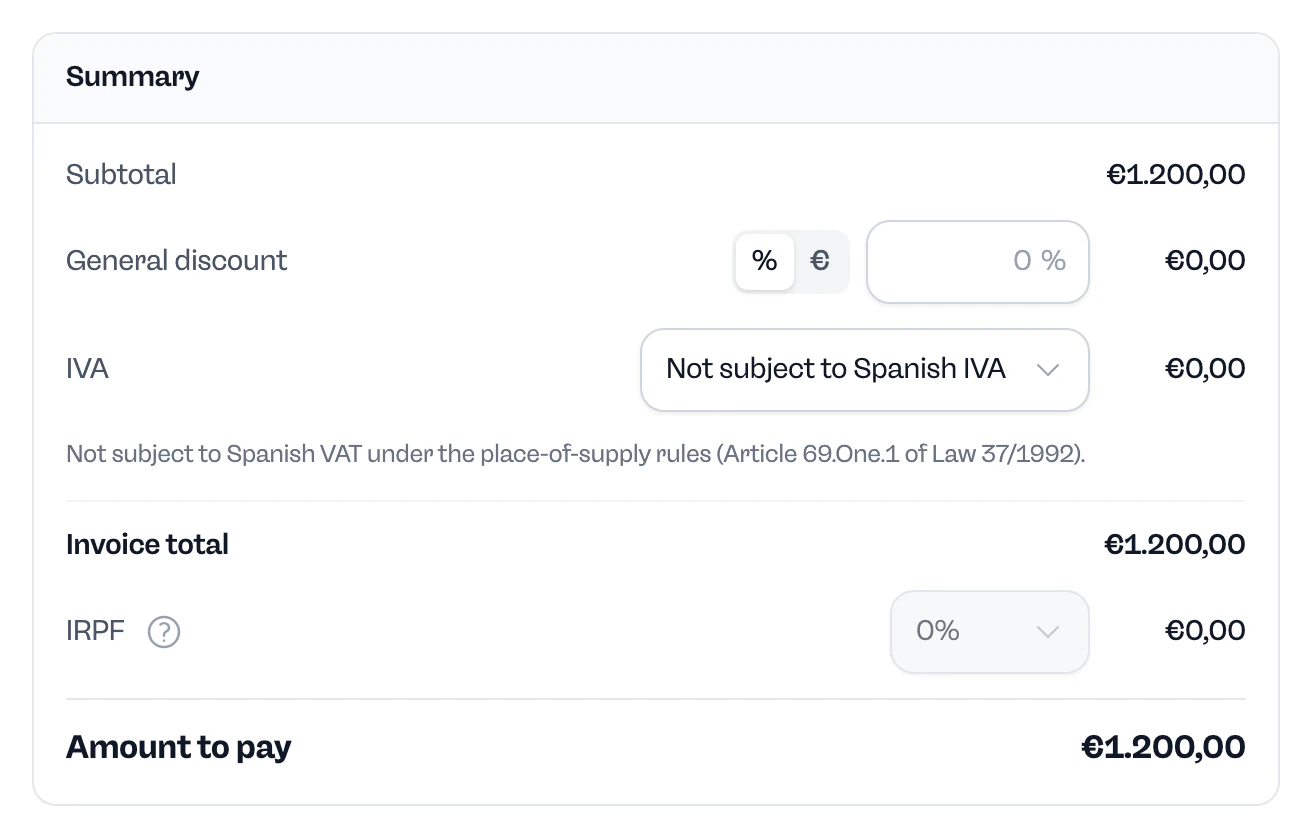
A service to a business established outside the EU does not take place in Spain, so it is not subject to Spanish IVA (article 69.Uno.1.º). That covers a company in the United States, Switzerland or the United Kingdom. The law requires no specific mention, but it is good practice to state on the invoice that the operation is not subject and the article.
If the client is a private individual outside the EU, the general rule is still Spanish IVA (article 69.Uno.2.º). Only the services listed in article 69.Dos are excluded, among them:
- Assignment of copyright, patents, licences and trademarks.
- Advertising.
- Advice, consultancy, engineering, legal services and accounting or tax services.
- Data processing and supply of information.
- Translation and proofreading.
When you sell goods and ship them outside the EU, the sale is an exempt export (article 21 of the IVA Law). The exemption requires the goods to actually leave the EU. Keep the invoices, contracts or orders, transport documents and the documents proving the exit (article 9 of the IVA Regulation). The invoice carries the exemption with its article (article 6.1.j of the Invoicing Regulation).
When you do charge Spanish IVA to a foreign client
Some services are taxed in Spain even when your client is a foreign business (article 70.Uno):
- Services connected with property located in Spain: renting, building work, architects' and engineers' services on that work, property management and hotel accommodation.
- Passenger transport, for the part of the journey in Spain.
- Admission to fairs, conferences and other events held in Spain, when the client is a business.
- Restaurant and catering services supplied in Spain.
- Short-term hire of a means of transport handed over in Spain.
For example, if you are an architect and a German company commissions the design of a house in Málaga, your invoice carries Spanish IVA.
Invoices in another currency or language
You can show the invoice amounts in any currency, as long as the IVA, if any, appears in euros (article 12.1 of the Invoicing Regulation). The conversion uses the selling exchange rate set by the Banco de España on the date the tax accrues (article 79.Once of the IVA Law). In your returns, such as the 303 or the 349, amounts always go in euros.
The language is free too, although the tax office can ask for a translation during an audit (article 12.2).
No IRPF withholding
Only payers in Spain withhold IRPF (income tax): companies, autónomos paying you within their activity and non-residents operating in Spain through a permanent establishment (article 99.2 of the IRPF Law and article 76.1 of its Regulation). A foreign client with no presence in Spain does not withhold, so your invoice carries no IRPF withholding.
That income is still taxed in your IRPF. If you are a professional and less than 70% of your income had withholding in the previous year, you must file modelo 130 every quarter (article 109.2 of the IRPF Regulation). If your client's country applies its own withholding, what you can do depends on the double taxation treaty.
How Facturaz does it
In Facturaz each invoice has one IVA treatment, filled in from the client: with IVA, exempt with its article, reverse charge in Spain, EU service, EU supply of goods, export of goods or not subject because the client is outside the EU. The PDF prints the legal mention. It checks the client's VAT number in VIES and your ROI registration. It also prepares the 349. If you invoice in another currency, the invoice shows the euro amounts. Autónomo Go costs €24 + IVA a month and Autónomo Plus €44 + IVA a month, with 14 days free: see pricing.