
If you invoice businesses in other European Union countries or buy goods or services from them, modelo 349 tells Hacienda, the Spanish tax agency, who you deal with and for how much. It is the recapitulative statement of intra-community transactions: a list of your European clients and suppliers with their EU VAT number, the type of transaction and the base for each one. It involves no payment. It is one of the returns in autónomo taxes in Spain.
This guide is part of What are tax modelos?, which explains every modelo one by one.
What these transactions are and how they are invoiced is covered in intra-community operations explained. Here we deal with modelo 349.
Who files modelo 349
It is filed by businesses and professionals who carry out any of these transactions (article 79.1 of the IVA Regulation, Real Decreto 1624/1992; article 2 of Orden EHA/769/2010, which approves the form):
- Supplies of goods to another EU country exempt under article 25 of the IVA Act.
- Intra-community acquisitions of goods subject to IVA: you buy goods from a supplier in another EU country who ships them to Spain.
- Intra-community supplies of services: services that, under the place-of-supply rules, are made in another EU country, subject to VAT and not exempt there, when your client is a business or professional established in that country who accounts for the tax.
- Intra-community acquisitions of services: services a business in another EU country provides to you, which are made in Spain and on which you declare the IVA, the Spanish VAT, under the reverse charge (article 84.Uno.2.º of the IVA Act).
- Triangular transactions and call-off stock shipments, which are less common.
Sales of goods to anyone without a VAT number from another EU country are left out (article 79.1.1.º.b of the Regulation), as are services to private individuals, because the client must be a business or professional (article 79.1.3.º.c). If you have none of these transactions in a period, you do not file modelo 349 for that period.
Before modelo 349: the ROI
Anyone who carries out these transactions must be in the Registro de operadores intracomunitarios, the ROI, the register of intra-community operators (article 3.3 of Real Decreto 1065/2007). When you join, Hacienda assigns you the NIF (tax ID) with the ES prefix, the one you give your European clients and suppliers. You apply with the census return (modelo 036). If Hacienda does not answer within three months, it counts as refused (article 25.1 of the same Real Decreto). How to apply is covered in how to register in the ROI.
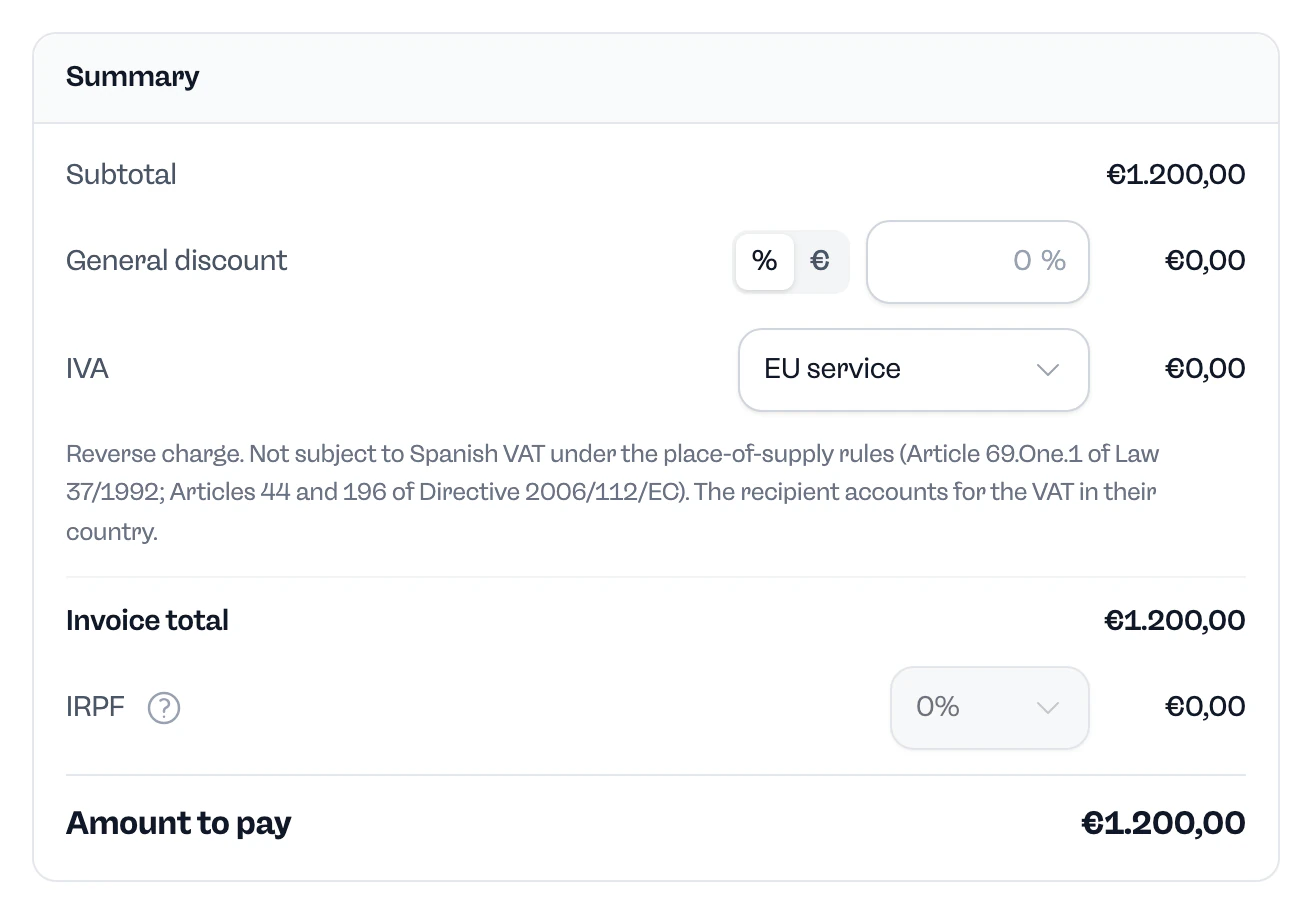
Modelo 349 is tied to the exemption. A sale of goods to another EU country is only exempt if the buyer has a VAT number from another member state, has given it to you and you include the transaction in modelo 349 (article 25.Uno of the IVA Act).
What data it carries
It carries one line per European operator and type of transaction, with the total base for the period (article 80.1 of the IVA Regulation and the annex of Orden EHA/769/2010):
- The other operator's EU VAT number: their country code, such as DE or FR, followed by their number.
- Name or company name.
- Transaction code: E for exempt supplies of goods, A for acquisitions of goods, S for services you provide, I for services you receive, T for triangular transactions. There are other codes (M, H, R, D and C) for exempt imports and call-off stock.
- Taxable base: the sum of the bases for that operator under that code, in euros.
If you invoiced in another currency, the base is converted to euros at the date the tax became chargeable (article 80.1.1.º of the Regulation). Each transaction goes in the modelo 349 for the period in which the tax becomes chargeable (article 80.3).
Monthly or quarterly: the deadlines
The general rule is monthly: in the first twenty calendar days of the following month, except July, which can be filed until 20 September (article 81.2.1.º of the Regulation).
It is quarterly when neither in the quarter nor in any of the four previous ones the sum of your supplies of goods that go in modelo 349 plus the services you provide to EU businesses exceeds €50.000, excluding IVA (article 81.2.2.º). Only your sales count: purchases from European suppliers do not. Quarterly returns are due by 20/04, 20/07 and 20/10.
If at the end of a month of the quarter you go over €50.000, you file within the following twenty days a 349 for the months since the start of the quarter (article 81.2.2.º, second paragraph). From then on you continue monthly.
In both cases, the 349 for the last period of the year is filed in the first thirty days of January (article 81.3). The dates are in the tax calendar.
An example
Lucía is a self-employed developer registered in the ROI. In the second quarter of 2026 she:
- Invoices €3.000 and €2.000 to a German company for two projects.
- Invoices €1.500 to a French agency.
- Buys a €300 software licence from an Irish company.
- Buys a €400 monitor from an Italian supplier, which ships it from Italy.
Her second-quarter 349 has four lines: the German company with code S and a €5.000 base, the French agency with code S and €1.500, the Irish company with code I and €300, the Italian supplier with code A and €400. Her services to the EU add up to €6.500, so she files quarterly, by 20/07/2026.
How to correct it
If the base of a transaction already declared changes, for example through a corrective invoice or a wrong amount, the old 349 stays as it is. The correction goes in the 349 for the period in which it is notified to the recipient, which is your client when the sale is yours (articles 80.2 and 80.3 of the Regulation), as a correction line with the period you correct, the new base and the base you had declared (annex of Orden EHA/769/2010).
Following the example: in September Lucía issues the German company a €500 corrective invoice on the April project. In her third-quarter 349 she adds a correction line with code S, year 2026, period 2T, a corrected base of €4.500 and a previously declared base of €5.000.
If you left out transactions from a period or got an operator's details wrong, you file a supplementary or replacement return for that period (article 1.2 of Orden EHA/769/2010 and article 122.3 of the Ley General Tributaria, the General Tax Law).
How to file it
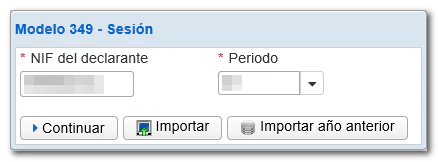
Modelo 349 is an electronic-format form (article 1.1 of Orden EHA/769/2010) filed on the Agencia Tributaria's electronic site. You enter your NIF and the period, then fill in the lines by hand or import a file you already have. Then you sign and keep the receipt.
If you file it late
With no payment there is no surcharge under article 27 of the Ley General Tributaria, but filing late is a minor offence. As it is a return reporting your transactions with third parties, the fine is €20 for each item or set of items about the same person or entity, with a minimum of €300 and a maximum of €20.000. If you file before Hacienda asks you to, everything is halved (article 198 of the Ley General Tributaria).
How Facturaz helps
In Facturaz, when you invoice a business in another EU country with its VAT number or record a purchase from a European supplier, the transaction gets its code. That data feeds each quarter's modelo 349, including the correction lines when you issue a corrective invoice on a period already declared. On Autónomo Go (€24 + IVA a month) it prepares the official file for you to file yourself with a step-by-step guide. On Autónomo Plus (€44 + IVA a month) our team files it for you. Facturaz prepares the quarterly 349: if your EU sales go over the monthly limit, it tells you. You can try it free for 14 days from pricing.