
If you rent premises, an office or a warehouse for your business, you usually do not pay your landlord the whole rent. You withhold 19% and pay it to Hacienda, the Spanish tax agency, yourself every quarter with modelo 115. It is one of the quarterly returns in autónomo taxes in Spain, the guide with the rest of the calendar.
This guide is part of What are tax modelos?, which explains every modelo one by one.
In January you summarise the year landlord by landlord in modelo 180. Here we deal with modelo 115: who files it, when you must withhold, the deadlines and what happens if you file late.
Who files modelo 115
Rent on urban property carries withholding whatever its classification (article 75.2.a of the IRPF Regulation, Real Decreto 439/2007). It is withheld by whoever pays that rent and is required to withhold: companies and other entities (including comunidades de propietarios, owners' associations) as well as autónomos (self-employed people) when they rent as part of their business (article 76.1). They are the ones who file modelo 115 (section two of Orden de 20 de noviembre de 2000, which approves modelos 115 and 180).
Withholding is 19% of everything you pay the landlord, excluding IVA, the Spanish VAT (article 100 of the IRPF Regulation). It makes no difference whether the landlord is a person or a company: rent collected by a company also carries withholding (article 60.1.e of the Corporate Tax Regulation), at the same 19% (article 66.a). If you rent your home as a private person, outside your business, you do not withhold.
When there is no withholding
In these cases you do not withhold and that rent does not go in modelo 115 (article 75.3.g of the IRPF Regulation and article 61 of the Corporate Tax Regulation):
- What you pay one landlord in the year does not exceed €900.
- It is a home a company rents for its employees.
- The landlord is registered for IAE (the business activity tax) under a property rental heading that does not come out at a zero charge. They prove it with an Agencia Tributaria certificate, valid for the calendar year in which it is issued (section three of Orden de 20 de noviembre de 2000).
- It is a finance lease (leasing) of an urban property.
- The landlord is an entity exempt from Corporate Tax, such as the State, a regional government or a town council (article 9.1 of Ley 27/2014).
If your landlord does not live in Spain and has no permanent establishment here, withholding goes through another route: modelo 216 of the non-resident income tax (Orden EHA/3290/2008).
The deadlines
Modelo 115 is filed and paid in the first twenty calendar days of the month after each quarter (section seven of Orden de 20 de noviembre de 2000 and article 108.1 of the IRPF Regulation):
- First quarter: 1 to 20 April.
- Second quarter: 1 to 20 July.
- Third quarter: 1 to 20 October.
- Fourth quarter: 1 to 20 January of the following year.
If the 20th falls on a Saturday or a non-working day, the deadline moves to the next working day (section seven of the Orden). For example, 20/01/2029 is a Saturday: the fourth-quarter 115 for 2028 can be filed until Monday 22/01/2029. If you pay by direct debit, the window is 1 to 15 of those months (annex II of Orden EHA/1658/2009). The dates are in the tax calendar.
What goes in modelo 115
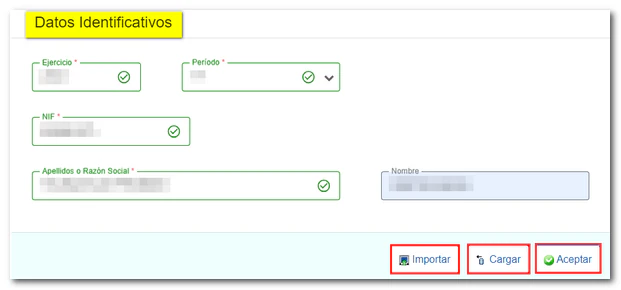
Besides your details, the year and the quarter, it carries five boxes (annex II of Orden de 20 de noviembre de 2000):
- Box 1: the number of payees, that is, how many landlords you withheld from in the quarter.
- Box 2: the withholding base, what you paid them without IVA.
- Box 3: the withholding, 19% of that base.
- Box 4: only in a supplementary return, what you already paid for that same quarter.
- Box 5: the amount to pay, box 3 minus box 4.
Three details that often throw the figures off:
- What you pay on top of the rent. The base is everything you pay the landlord for any item, excluding IVA. If you pay the building's community charges to the landlord, they carry withholding too.
- The payment date. Withholding arises when you pay (article 78.1 of the IRPF Regulation). March rent paid in April goes into the second-quarter 115.
- If you did not withhold, you still owe it. Anyone required to withhold must pay the withholding even if they did not deduct it (article 99.4 of the IRPF Law, Ley 35/2006).
Quarters with no rent to declare
If you paid no rent subject to withholding in a quarter, you do not file modelo 115 for that quarter (article 108.1 of the IRPF Regulation and article 68.1 of the Corporate Tax Regulation). This happens, for example, if you paid the whole year's rent in January: all the withholding goes into the first-quarter 115 while the other three are not filed.
How to file and pay it
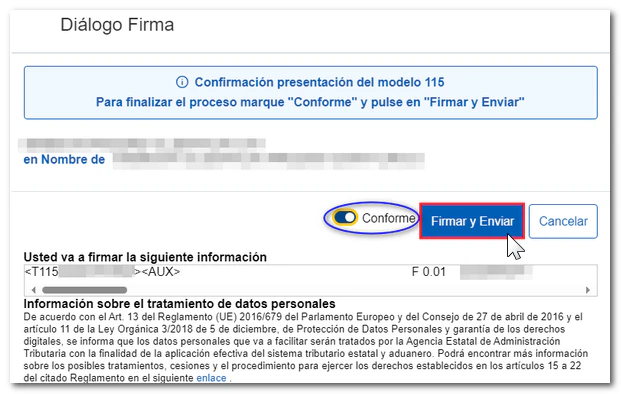
Public and private limited companies must file it online with a digital certificate (article 3.1 of Orden HAP/2194/2013). As an autónomo you can also use Cl@ve or print the form from the Agencia Tributaria site to file it at your bank (article 2 of the same Orden). On the site, once it is filled in, you tick Conforme and press Firmar y Enviar.
The site lets you file with an acknowledgement of debt. However, withholding cannot be deferred or paid in instalments: such requests are rejected (article 65.2.b of the Ley General Tributaria, the General Tax Law).
If you file late
If you file modelo 115 late before Hacienda asks you to, there is no penalty: you pay a surcharge of 1% plus another 1% for each full month of delay. After 12 months it is 15% plus late-payment interest (article 27 of the Ley General Tributaria). The surcharge drops by 25% if you pay the tax when you file and pay the surcharge within the period you are given (article 27.5). If Hacienda asks you first, the surcharge no longer applies and it can fine you.
If you find an error in a 115 already filed that made you pay too little, you file a supplementary return by ticking that box. If it is late, it carries a surcharge too (article 122 of the Ley General Tributaria). We explain it in surcharges for filing late.
A worked example
You rent an office for €1.200 a month plus IVA. Each month your landlord's invoice adds €252 of IVA and subtracts €228 of withholding: you pay them €1.224. Each quarter you enter one payee in modelo 115, a base of €3.600 and withholding of €684, which you pay by the 20th.
If you had filed the first-quarter 115 for 2026 on 25/05/2026 instead of 20/04/2026, there would be one full month of delay: a 2% surcharge, €13,68, or €10,26 with the reduction.
Over the year that is a base of €14.400 with €2.736 of withholding. Your four 115s add up to that €2.736.
How it links to modelo 180
Modelo 180 repeats the year landlord by landlord and is filed from 1 to 31 January (article 108.2 of the IRPF Regulation). Its withholding must add up to the same as your four 115s. You also give each landlord a certificate with what you paid and what you withheld before their own return period opens (article 108.3 of the IRPF Regulation and article 68.3 of the Corporate Tax Regulation).
How Facturaz helps
In Facturaz you record the rent invoice with its withholding. That data feeds each quarter's modelo 115 and modelo 180 in January. On Autónomo Go (€24 + IVA a month) it prepares the official modelo 115 file for you to file yourself with a step-by-step guide. On Autónomo Plus (€44 + IVA a month) our team files it for you. You can try it free for 14 days from pricing.