An invoice (factura) is the document that proves a sale: who sells, to whom, what, for how much and with which taxes. For you it is the record of your income. For your client, if they are a business, it is what lets them deduct the cost and the IVA (Spanish VAT). That is why the law sets what it must contain, when it is issued and how it is corrected.
This guide brings all those rules together, with the article each one comes from. The main rule book is the Invoicing Regulation, approved by Real Decreto 1619/2012. If you are about to issue your first invoice, there is a step-by-step version in how to create your first invoice as an autónomo.
When you have to issue an invoice
As an autónomo (self-employed in Spain) you must issue an invoice (and keep a copy) for every sale or service within your activity. The same goes for advance payments you receive before doing the work (article 2.1 of the Invoicing Regulation).
Some cases always require one: when your client is a business or a professional, when it is a public body or when the client asks for it to exercise a tax right (article 2.2). Only a few situations are exempt, such as some IVA-exempt operations for private individuals or sales by a shop under the equivalence surcharge scheme (article 3).
Deadline to issue it
The general rule is to issue the invoice when the operation takes place. If your client is a business or a professional, you have until before the 16th of the month after the IVA became due (article 11.1). For example, for work finished on 20/03/2026 for a company, the invoice had to be issued by 15/04/2026 at the latest.
That deadline is for issuing it, not for getting paid. The payment term between businesses is a separate rule: if you agreed nothing, 30 calendar days from delivering the work. Even if you agree otherwise, never more than 60 days (article 4 of Ley 3/2004 on late payment).
What an invoice must contain
Article 6.1 of the Invoicing Regulation lists the details of a full invoice (factura completa). These are the ones almost any autónomo needs:
- Number and, if you use several, series. Numbering within each series must be consecutive, with no gaps.
- Date of issue.
- Your full name or company name and your client's.
- Your NIF (tax ID) and your client's. On a full invoice for an operation carried out in Spain, the client's NIF is required even if they are a private individual (article 6.1.d).
- Your address and your client's.
- A description of what you sell, with the unit price before tax and any discount.
- The IVA rate applied and the IVA amount, shown separately.
- The date of the operation, if it differs from the invoice date.
- If the operation is exempt, a statement of the exemption and the article behind it.
- If your client accounts for the IVA, the words «inversión del sujeto pasivo» (reverse charge).
If the invoice has several IVA rates, or mixes exempt operations with others that are not, the base of each must be shown separately (article 6.2). IRPF (Spanish personal income tax) withholding is not on this list because the income tax law governs it, but when it applies it should appear, because your client needs to know how much to withhold.
Numbering and series
You can use separate series when you have a reason, such as different premises or types of operation. Corrective invoices must always go in their own series (article 6.1.a). A common format is the year plus a number, such as 2026-0001, but the law does not impose one: what it requires is no gaps or jumps within each series.
Full invoice or simplified invoice
The simplified invoice (factura simplificada) is what many people call a receipt or ticket. You can issue one when the amount is no more than €400, IVA included, or when it is a corrective invoice. The limit rises to €3.000 for certain activities, such as retail, hospitality, hairdressing or passenger transport (article 4). It cannot be used for deliveries of goods to another EU country.
It carries fewer details than a full invoice: number, date, your NIF and name, what you sell, the IVA rate and the total (article 7.1). If your client is a business and asks for it, you must add their NIF, their address and the IVA amount shown separately, because without that they cannot deduct the IVA (article 7.2).
IVA on your invoices
Normally you apply 21%, the standard rate (article 90 of Ley 37/1992, the IVA Act). Certain goods and services carry 10% or 4% (article 91). Some activities are exempt, such as healthcare by doctors and health professionals or certain teaching services (article 20): in that case the invoice carries no IVA and must say why.
If your client is a business established in another country, as a general rule services are treated as supplied where your client is (article 69.Uno.1.º of the IVA Act). Your invoice carries no Spanish IVA. If the client is in the EU, the invoice says «inversión del sujeto pasivo» and you also need to be on the register of intra-community operators. What that means for your returns is covered in the guide to autónomo taxes in Spain. To choose the right rate in each case, read how to choose IVA and IRPF rates for your invoices.
IRPF withholding on the invoice
If you are a professional and you invoice a company or another autónomo, your client withholds 15% of the base and pays it to the tax agency in your name (article 101.5 of Ley 35/2006, the IRPF Act, plus article 95.1 of its Regulation). In the year you start and the two following years the withholding is 7%, if you had no professional activity in the year before you started; you must tell your client in writing.
There is no withholding when you invoice private individuals, because only businesses and autónomos paying within their activity withhold (article 99.2 of the IRPF Act). Nor, in general, is there any in business activities such as retail: the 15% withholding is for professional activities (article 95 of the IRPF Regulation).
The invoice total is the base plus IVA minus withholding:
| Item | Amount |
|---|---|
| Taxable base | €1.000,00 |
| IVA 21% | €210,00 |
| IRPF withholding 15% | −€150,00 |
| Total to collect | €1.060,00 |
Your client pays you €1.060. You hand the €210 of IVA to the tax agency on your quarterly return. Your client pays in the €150, which counts as an advance on your IRPF.
Correcting an invoice: the corrective invoice
An issued invoice is never deleted or edited. If it has a mistake, if the amount changes because of a discount or a return, or if the IVA was wrong, you issue a corrective invoice (factura rectificativa, article 15.1 and 15.2). It must identify the invoice it corrects and what changes, go in its own series and be issued as soon as you notice, always within four years of the IVA becoming due (articles 15.3 and 15.4).
The corrective invoice can show just the difference, positive or negative, or the figures as they stand after the correction while also stating the difference (article 15.5). One corrective invoice can correct several invoices if it identifies them all.
Quotes and proforma invoices
A quote or a proforma invoice tells your client what they will pay, but it is not an invoice: the Invoicing Regulation does not cover it and your client cannot deduct IVA with it, because that requires the invoice (article 97 of the IVA Act). When you do the work or get paid, you issue the real invoice.
This matters if you take payments through platforms that generate their own documents. If you use Stripe, read how to set Stripe to proforma to avoid duplicate invoices. To turn an accepted quote into an invoice without retyping it, see quotes in Facturaz.
How long to keep your invoices
You must keep the invoices you issue and receive for the limitation period of the Ley General Tributaria, the General Tax Act (article 19 of the Invoicing Regulation). That period is four years and starts the day after the deadline to file the return those invoices belong to (articles 66 and 67 of Ley 58/2003).
Veri*Factu: requirements for your invoicing software
Veri*Factu is the everyday name for the Regulation approved by Real Decreto 1007/2023. It does not change what an invoice contains but the software you make it with. It applies to autónomos who invoice with a computer system, even if they only use it for part of their activity (article 3.1 of the Regulation). It does not affect those who keep their books through the Immediate Supply of Information system, SII (article 3.3).
What it requires, in plain words:
- Each invoice creates an invoicing record with a digital fingerprint, chained to the previous record so it cannot be altered without it showing (articles 8 and 12 of the Regulation).
- The invoice carries a QR code with some of its data (article 6.5 of the Invoicing Regulation).
- The software can send each record to the Agencia Tributaria (the Spanish tax agency) at once or keep it signed. Sending is voluntary (article 15). If the software sends every record, the invoice also carries the phrase «Factura verificable en la sede electrónica de la AEAT» or «VERI*FACTU» (article 6.5.b of the Invoicing Regulation).
The dates that bind today, 05/11/2026, are those of Real Decreto 1007/2023 as amended by Real Decreto-ley 15/2025 of 2 December: corporate income tax payers must have compliant software before 01/01/2027. Everyone else, autónomos included, before 01/07/2027 (fourth final provision).
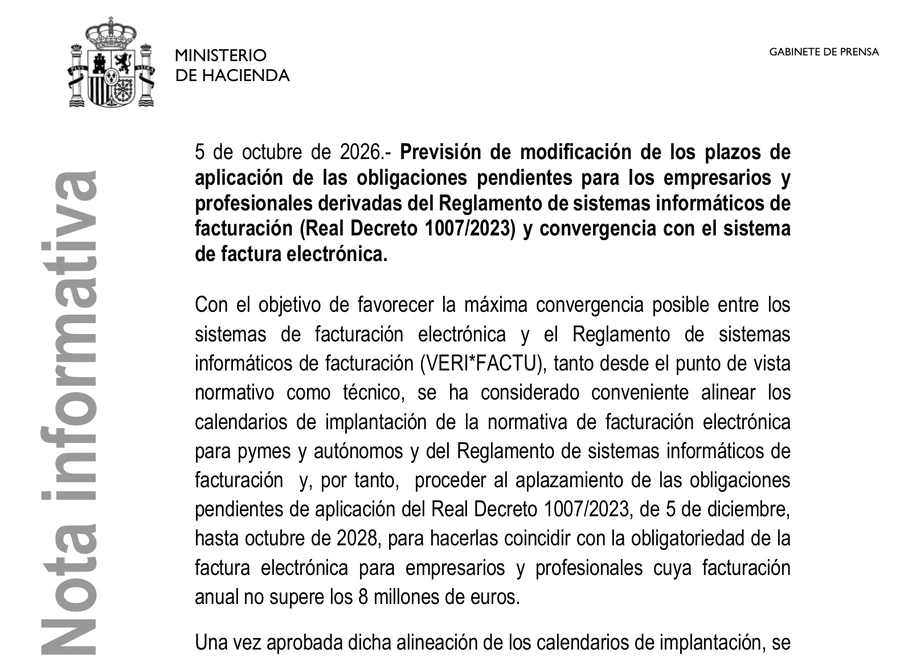
On 05/10/2026 the Ministry of Finance announced it wants to postpone these obligations to October 2028. As of today that postponement has not been published in the BOE (the Official State Gazette), so the 2027 dates are still the legal ones. We cover it in Veri*Factu postponed to October 2028: what changes.
The General Tax Act fines holding software that is not certified as the regulation requires, or that has been altered, with €50.000 per year (article 201 bis). More detail in what Veri*Factu is and how to comply and in what Veri*Factu compliant invoicing means. How Facturaz complies is on its Veri*Factu page.
Electronic invoicing between businesses
This is a separate obligation from Veri*Factu. Real Decreto 238/2026 regulates mandatory electronic invoicing between businesses and professionals: invoices to other businesses will be sent in electronic format through the tax agency's public solution or through private platforms. Invoices to private individuals are left out.
The dates run from the entry into force of Orden HAC/1028/2026 on 06/10/2026. Businesses whose volume of operations exceeded €8 million the year before have twelve months. All other businesses and professionals have twenty-four months, which means October 2028 for almost every autónomo (fourth final provision of Real Decreto 238/2026).
If you sell online
Every payment you take online needs its invoice, like any other sale. If you sell through Stripe, one way to avoid duplicates is for each payment to create its invoice in your invoicing software while Stripe only issues information documents. This is explained in how to auto-invoice your Stripe sales and in the Stripe proforma guide linked above.
How Facturaz helps
You tell Facturaz your activity and your IVA scheme once. From then on it applies the IVA, IRPF or exemption that fits, prints the article of law when there is no IVA and numbers each invoice in its series. Corrective invoices are made from the original. Simplified invoices cover sales of up to €400. Each invoice carries its invoicing record and QR code. Sending to the tax agency stays off until you switch it on: Facturaz is Veri*Factu compliant. Autónomo Go costs €24 + IVA a month and Autónomo Plus €44 + IVA a month, with 14 days free. It is all in invoicing in Facturaz.