Verifactu is the short name of the regulation that sets how invoicing software must work in Spain: Real Decreto 1007/2023. It comes from the Ley Antifraude (the anti-fraud law), which added to the Ley General Tributaria (General Tax Law) the duty for invoicing software to guarantee that records are complete, kept, accessible, readable, traceable and unalterable (article 29.2.j). This article is part of the guide to invoicing as an autónomo.
This guide is part of How to invoice as an autónomo: IVA, IRPF and Veri*Factu, with everything you need to invoice correctly.
In practice it means two things for you: every invoice you issue creates an invoicing record chained to the previous one that cannot be deleted or changed, and the invoice carries a QR code your client can use to check it with the Agencia Tributaria (the tax agency).
Who it applies to
To anyone with a business activity who invoices with software or a computer system, even if only for part of the activity (article 3.1 of the regulation):
- Companies and other Impuesto sobre Sociedades (corporate tax) taxpayers.
- Autónomos (self-employed people) taxed under IRPF (income tax) for their activity.
- Non-residents with a permanent establishment in Spain.
- Comunidades de bienes and other pass-through entities.
It does not apply to anyone keeping their books through the Suministro Inmediato de Información, the SII (article 3.3), nor to anyone whose tax residence is in the Basque Country or Navarra, which have their own rules (article 1.3). Nor to anyone who writes invoices by hand, because the regulation governs computer systems.
From when it is mandatory
The dates in the BOE (the official gazette) today are those of the fourth final provision of Real Decreto 1007/2023, as amended by Real Decreto-ley 15/2025:
| Who | From |
|---|---|
| Impuesto sobre Sociedades taxpayers (SL, SA) | 01/01/2027 |
| Autónomos and everyone else | 01/07/2027 |
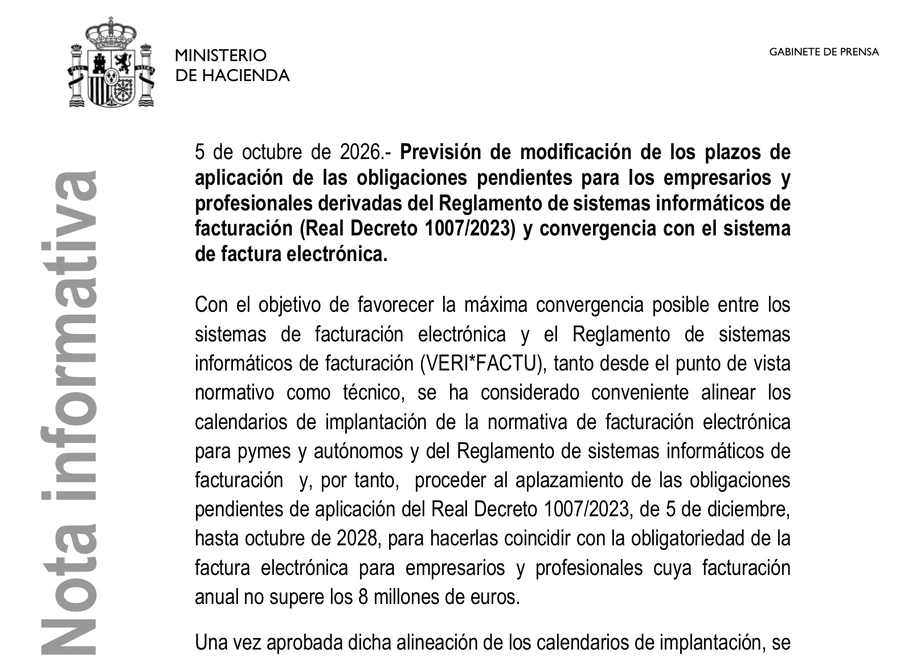
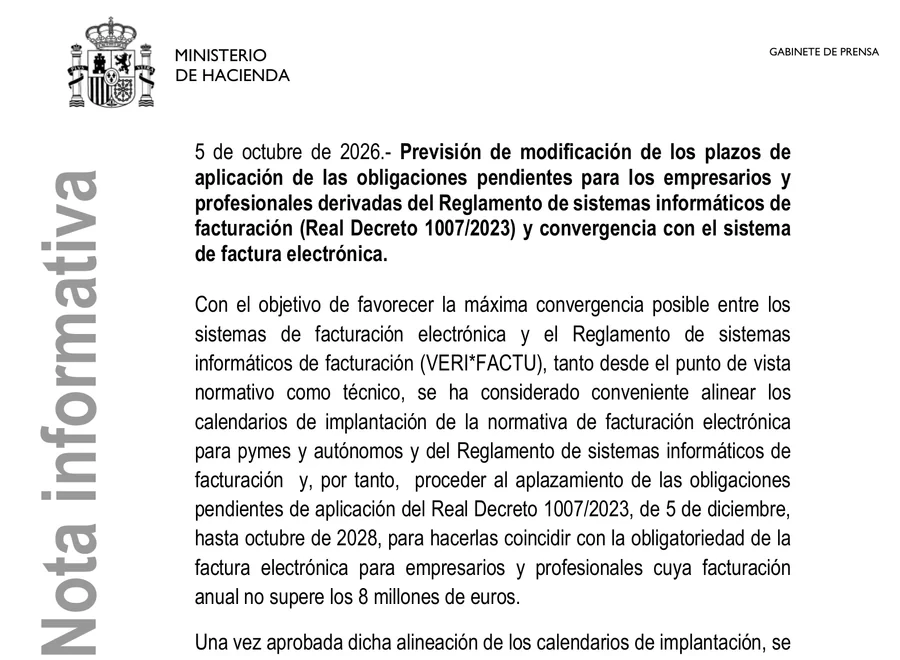
On 05/10/2026 Hacienda announced in an information note that it plans to postpone Verifactu to October 2028, to match electronic invoicing between businesses. On 07/11/2026 that change has not been published in the BOE: the consolidated text of Real Decreto 1007/2023 still shows its last change on 03/12/2025. Until it is published, the 2027 dates apply. We follow it in the Verifactu delay to 2028.
What your invoicing software must do
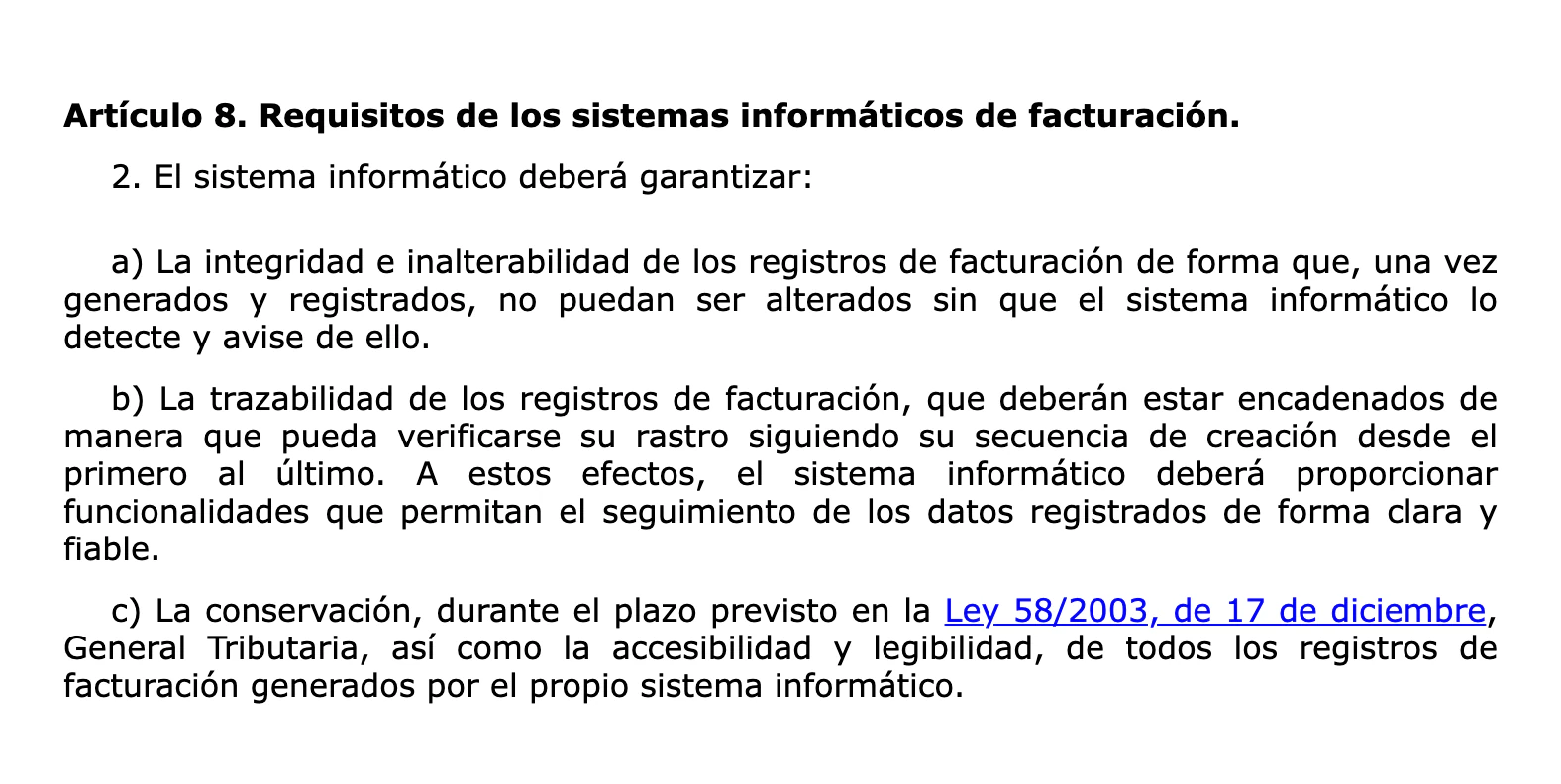
The software must guarantee that invoicing records are complete, kept, accessible, readable, traceable and unalterable (article 8 of the regulation). In detail:
- One record per invoice. Issuing an invoice creates its registration record, and cancelling it creates a cancellation record (articles 9 to 11).
- Chained. Each record includes the fingerprint of the previous one, so the sequence can be checked from the first to the last (article 8.2.b).
- No deleting or editing. Any correction is made with a new record and the original data stays as it was (article 8.2.a). That is why an issued invoice is corrected with a factura rectificativa (credit note).
- Fingerprint and signature. Each record carries its fingerprint or hash and, if the software does not send the records to Hacienda, an electronic signature too (articles 12 and 16.3).
- QR code on the invoice. The invoice includes a QR code so the client can check it on the Agencia Tributaria's website (article 20 of Orden HAC/1177/2024).
- Statement of compliance. The software maker declares in writing that it complies with the regulation, and that statement must be visible in the software (article 13).
Sending to Hacienda or not
The regulation allows two ways to comply (article 7):
- Sending, the VERI*FACTU mode. The software sends each record to the Agencia Tributaria as it happens. It is presumed compliant by design and does not need to sign the records, the fingerprint is enough (article 16). The invoice shows the VERI*FACTU legend. Once you start sending, you stay in this mode at least until 31/12 of that year (article 16.5).
- Not sending. The software creates, signs and keeps the records, and Hacienda can request or inspect them at any time (article 14). The invoice still carries its QR code.
Both comply with the law. The difference is whether Hacienda receives your records as they happen or only when it asks for them.
The fines
The Ley General Tributaria mainly targets the software maker: making or selling software that allows sales to go unrecorded, be altered or that does not meet the requirements is fined €150.000 per year and per type of software (article 201 bis.1 and 4). For the user, having software that does not comply or has been altered is fined €50.000 per financial year (article 201 bis.2 and 4).
Verifactu is not electronic invoicing
They are two different obligations. Verifactu governs how your software creates and keeps invoices. Electronic invoicing between businesses and professionals governs how the invoice is sent to the client, in a structured format. Its calendar was set by Real Decreto 238/2026 with Orden HAC/1028/2026, in force since 06/10/2026: twelve months later for anyone who invoiced more than €8.000.000 the year before and twenty-four months for everyone else.
How Facturaz does it
Facturaz meets the Ley Antifraude: every invoice gets its invoicing record and QR code, and an issued invoice is never deleted or edited, it is corrected with a credit note. You decide when to turn on Verifactu so your records are sent to the Agencia Tributaria. Autónomo Go costs €24 + IVA a month and Autónomo Plus €44 + IVA a month, with 14 days free.