On 5 October 2026 the Spanish Ministry of Finance (Hacienda) published an informative note with news many freelancers were waiting for: Verifactu is delayed to October 2028. The idea is for it to arrive together with mandatory e-invoicing between businesses, so you don't have to change the way you invoice twice in two years.
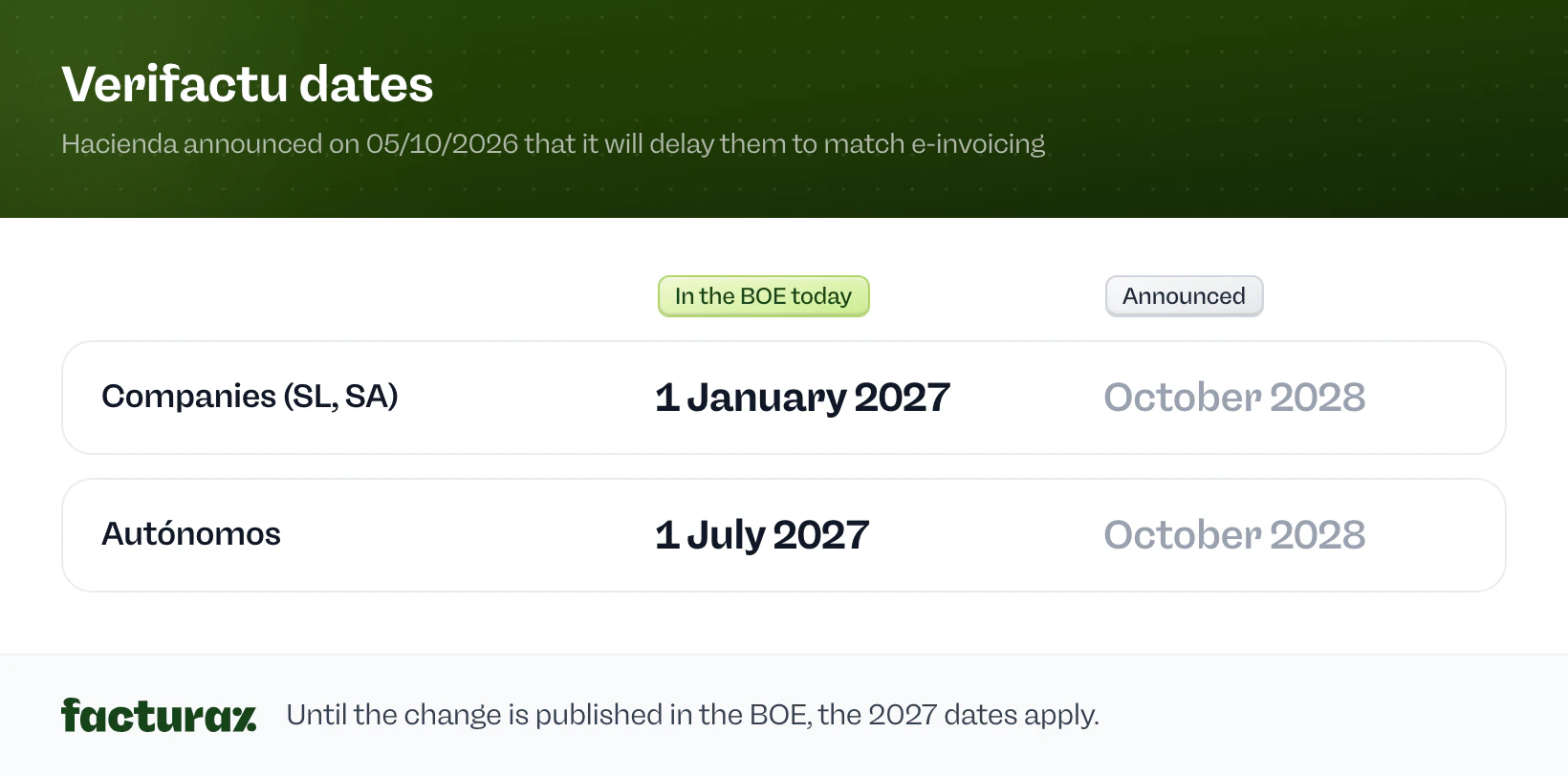
There is one important detail. For now it is an announcement. The note itself calls it a "planned modification". Until the change is published in the BOE (Spain's official gazette), the dates that apply are the 2027 ones. Here is what was announced, what applies today and what you should do.
What Hacienda announced
Hacienda wants to postpone the pending obligations of Real Decreto 1007/2023, the regulation everyone knows as Verifactu, to October 2028. That date matches mandatory e-invoicing for businesses and professionals with an annual turnover of up to €8 million, which covers almost every autónomo (self-employed person) and small business.
The goal is to avoid two changes in a row: adapting your invoicing software to Verifactu in 2027 and to e-invoicing a year later. Tax advisors and freelancer associations had asked for it.
The note also announces a second step. Once the calendar is aligned, Hacienda will amend the regulation to bring it closer to e-invoicing and to the upcoming EU ViDA requirements (VAT in the Digital Age). The core stays the same: the requirements for integrity, retention, traceability and immutability of the records will remain "substantially equivalent".
Which dates apply today
A press note does not change the law. The dates in the BOE are the ones set by Real Decreto-ley 15/2025, which amended Real Decreto 1007/2023 in December 2025:
| Who | Date that applies today | Announced date |
|---|---|---|
| Companies (SL, SA and other corporate income tax payers) | 1 January 2027 | October 2028 |
| Autónomos and all other taxpayers | 1 July 2027 | October 2028 |
The note does not say which legal instrument will make the change or when it will be published. What we do know is that it has to be in the BOE before 1 January 2027, because that is the first date that applies. It may come close to the wire: the previous postponement was published on 3 December 2025, four weeks before the date that then applied to companies.
Until then, the safe approach is to treat the 2027 dates as the ones that count.
Verifactu and e-invoicing are not the same thing
They are often mentioned together, but they are two separate obligations with different goals.
Verifactu makes sure nobody can alter an invoice after it is issued. If you invoice with software, every invoice you issue (to consumers too) creates a record with a fingerprint chained to the previous one. The invoice also carries a QR code so anyone can check it. The software can send those records to Hacienda straight away or keep them signed: the law allows both.
E-invoicing is about businesses getting paid on time. It covers invoices between businesses and professionals, not the ones you issue to consumers. They will have to be issued in a structured electronic format (a PDF does not count), sent through the Tax Agency's public solution or a private platform, with their status reported, payment included.
For e-invoicing the calendar is already official. Orden HAC/1028/2026 was published in the BOE on 5 October 2026 and came into force the next day. That starts the countdown set by Real Decreto 238/2026:
Businesses with a turnover above €8 million in the previous year: twelve months later, in October 2027.
All other businesses and autónomos: twenty-four months later, in October 2028.
That is why Hacienda wants to move Verifactu to October 2028. If the postponement is confirmed, an autónomo who invoices businesses will have to comply with both in the same month.
What it means for you
If you already invoice with adapted software
Nothing changes. Keep invoicing as you do now. If Hacienda adjusts a technical detail later on, it is your software that has to adapt, not you.
If you invoice with Word, Excel or a template
You have more time, but the change is still coming. A spreadsheet does not create the chained records or the QR code the regulation asks for, so once the obligation applies you will need adapted software. If you also invoice businesses, from October 2028 you will have to issue e-invoices too. Switching in a quiet month is much easier than doing it in September 2028, when everyone is in a rush.
If you have a company
Your date is the closest one: 1 January 2027. Until the postponement is in the BOE, that is the date that counts. If your software is not adapted yet, don't leave it until December waiting for the publication.
What changes in Facturaz
Nothing for you. Every invoice you issue in Facturaz already comes with its invoicing record, its fingerprint chained to the previous one and its QR code, as Real Decreto 1007/2023 requires. You don't need to install anything or change the way you work because of this postponement.
When the postponement is published in the BOE we will update this article. If Hacienda changes any technical requirement, we will adapt Facturaz and let you know what changes.
If you still invoice with Word or Excel, you can try Facturaz free for 14 days and send your first invoice today.
This article is general information about invoicing rules in Spain as of 6 October 2026. It is not tax advice. For your specific situation, talk to a qualified professional.