
If a modelo 303, a 130 or your Renta falls due and you do not have the money, you do not have to leave it unpaid. You can ask Hacienda (the Spanish tax authority) for an aplazamiento, paying the whole debt later, or a fraccionamiento, paying it in instalments. The law allows it when your financial situation temporarily prevents you from paying on time (article 65.1 of Ley 58/2003, the General Tax Law). This article is part of taxes for autónomos, the guide to all your taxes and deadlines.
In short: up to €50.000 of debt you give no guarantee, the interest in 2026 is 4,0625% and withholdings cannot be deferred. Each rule cites its article.
Which debts you can defer and which you cannot
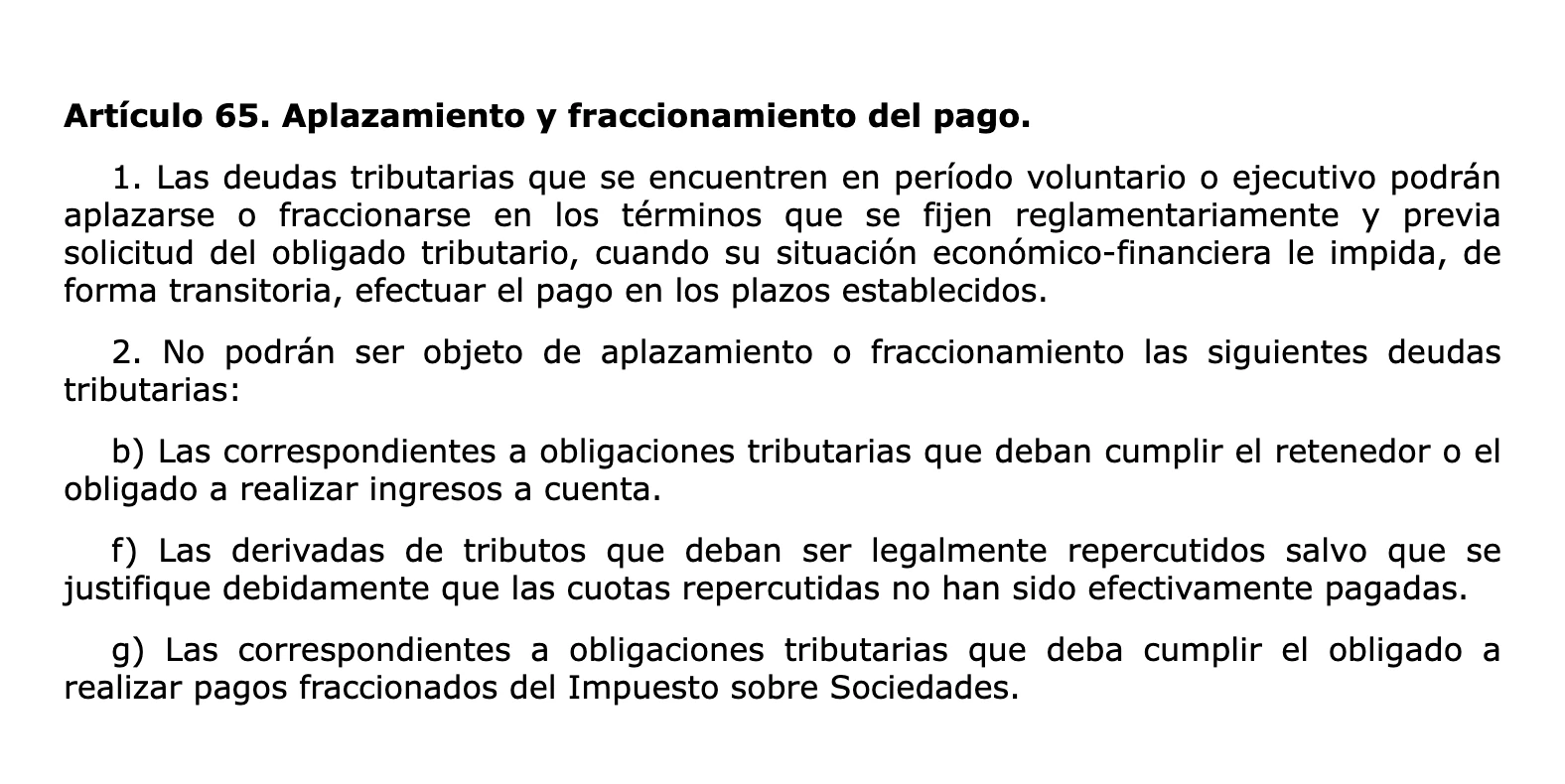
You can ask for it on debts still in the voluntary payment period or already in the enforcement period (article 65.1 of the General Tax Law). Article 65.2 excludes, among others, these debts:
- Withholdings. What you pay in as the withholder, or as someone obliged to make payments on account, cannot be deferred. That includes modelo 111 and modelo 115.
- The IVA you charged. Debts from taxes that must be charged on to customers cannot be deferred unless you show that those amounts of IVA (Spanish VAT) have not been paid to you. So you can defer the IVA on an invoice a client has not paid, if you prove it.
- Corporate tax instalments. That is the modelo 202 of an SL.
- Other rare cases, such as repaying State aid.
A request for those debts is rejected. The list does not name IRPF (personal income tax) instalments, so modelo 130 and the Renta (the annual income tax return) can be deferred.
No guarantee up to €50.000
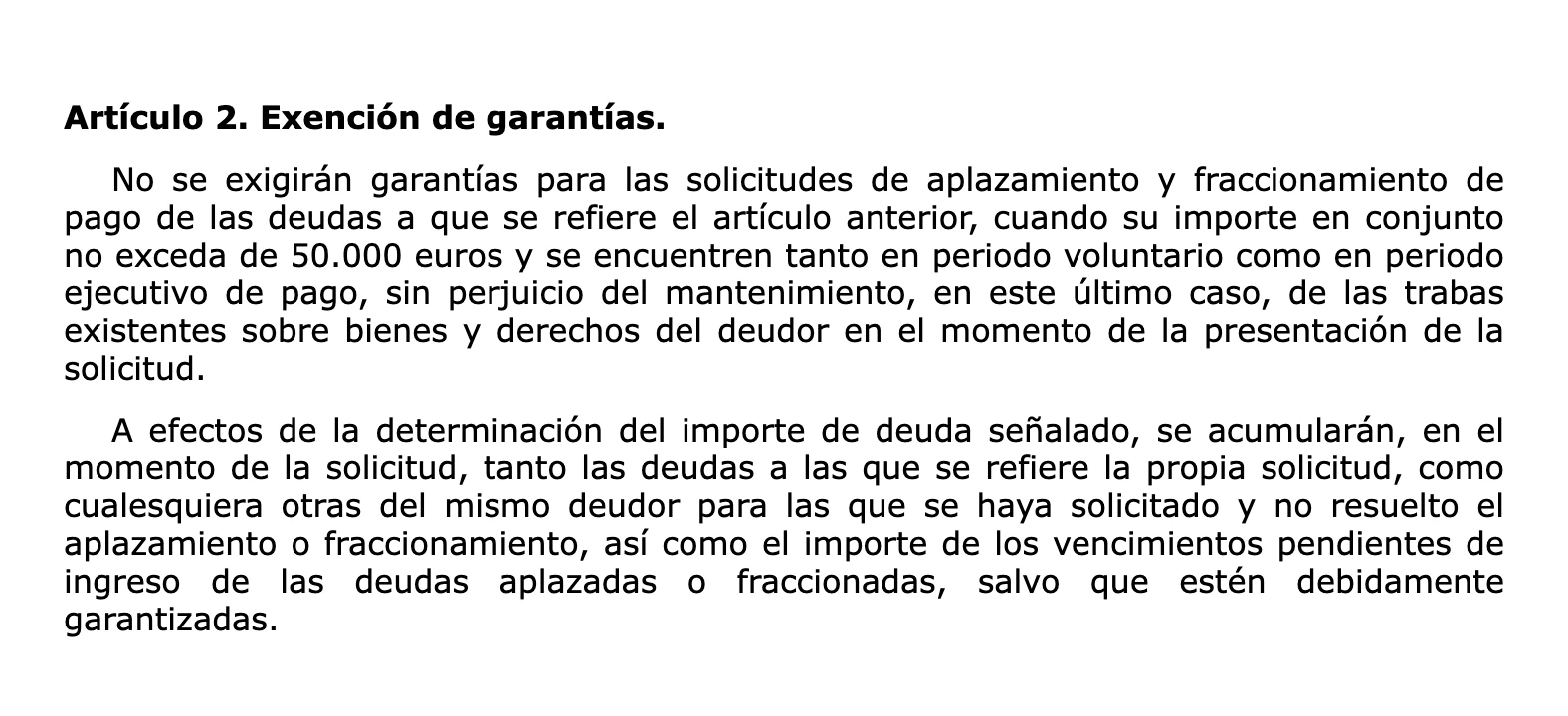
A deferred debt is guaranteed, in principle with a guarantee from a bank or a mutual guarantee society or with surety insurance (articles 65.3 and 82.1 of the General Tax Law). The law allows waiving guarantees below an amount set by regulation (article 82.2.a). Today that amount is €50.000: Orden HFP/311/2023 requires no guarantee when the debt as a whole does not exceed that figure, in the voluntary period as well as in enforcement (article 2). It has been in force since 15/04/2023 and repealed Orden HAP/2178/2015, which set €30.000.
The debt you want to defer is added to your undecided requests and to what is pending from earlier unguaranteed deferrals. Above €50.000 you need a bank guarantee or, if you cannot get one, to offer other guarantees or ask to be exempted (article 46.4 and 46.5 of the Reglamento General de Recaudación, Real Decreto 939/2005, the tax collection regulation).
What it costs: late payment interest in 2026
Deferring is not free. You pay interés de demora (late payment interest) from the day after the voluntary period until each due date (article 53 of the collection regulation). Late payment interest is the legal interest rate plus 25% unless the Budget Law sets a different one (article 26.6 of the General Tax Law).
There is no Budget Law for 2026, so the 2023 one, Ley 31/2022, is still extended (article 134.4 of the Constitution, recalled in the preamble of Real Decreto-ley 3/2026). That law set the legal interest rate at 3,25% and late payment interest at 4,0625% (forty-second additional provision). The AEAT applies them in 2026 until there is a new budget law. They match the general rule: 3,25% plus 25% gives 4,0625%.
Example: deferring a Renta of €4.000 for six months costs about €81,25 (€4.000 × 4,0625% × 6/12). If you guarantee the whole debt with a bank guarantee or surety insurance, you pay the legal interest rate of 3,25% instead of late payment interest (article 65.4 of the General Tax Law).
How to request it
If the debt comes from a self-assessed return, such as the 303, the 130 or the Renta, you have to file it before or together with the request. Otherwise the request is rejected (article 47.1.a of the collection regulation). When filing it you choose the deferral option. Filing is not the request: you then make it in the AEAT Sede electrónica (the tax agency's online office) with the receipt of that return (article 9 of Orden HAP/2194/2013).
The deadline is the voluntary payment period of the return. If you file late, the request only counts as made in the voluntary period if it goes with that return (article 46.1.a of the collection regulation). In the request you state the debt, the reasons, the instalments you propose and the guarantee you offer. You also show your temporary financial difficulties (article 46.2 and 46.3).
- It stops enforcement, not interest. Asked in the voluntary period, enforcement does not start while it is processed, but interest keeps running (articles 65.5 and 161.2 of the General Tax Law).
- Meanwhile, pay what you proposed. If you miss the instalments you proposed, Hacienda can refuse the request (article 51.2 of the collection regulation).
- Instalments fall due on the 5th or the 20th of the month. The decision can set different instalments from the ones you asked for (article 52.1).
- Six months to decide. If you are notified of nothing in that time, you can treat the request as refused in order to appeal or wait for the answer (article 52.6).
- If it is refused after you asked in the voluntary period, a new payment deadline opens with interest up to that day. If you do not pay, the enforcement period starts (article 52.4.a, which refers to article 62.2 of the General Tax Law).
The Renta has its own interest-free split
For the Renta there is an option that costs nothing: pay 60% when you file and the remaining 40% by the second deadline set each year by the Renta order, with no interest or surcharge (article 62.2 of Real Decreto 439/2007, the IRPF Regulation). It only applies if you file the return on time and it does not cover supplementary returns. If you do not pay the 60% on time, enforcement starts for the whole amount. We explain it in the Renta for autónomos.
What happens if you miss an instalment
In a deferral requested in the voluntary period, the enforcement period starts the day after the instalment you missed. You are charged the debt, the interest up to that due date and the enforcement surcharge on the sum of both (article 54.1.a of the collection regulation).
In an instalment plan without guarantees per instalment, if you miss an instalment of a debt that was in the voluntary period, you are charged that instalment with its interest and the surcharge. If you do not pay that either, all the remaining instalments fall due (article 54.2.b).
The surcharge is 5% if you pay before the enforcement order (providencia de apremio), 10% if you pay within the deadline it gives you and 20% plus interest otherwise (article 28 of the General Tax Law). Filing late has other surcharges: they are in surcharges for filing late with Hacienda.
How Facturaz handles it
Facturaz prepares your 303 and your 130 every quarter from your invoices and expenses, so you see the amount in time to decide whether to ask for a deferral. You file the request yourself in the AEAT Sede: Facturaz does not process it. Autónomo Go costs €24 + IVA a month and Autónomo Plus €44 + IVA a month, with 14 days free, on Facturaz pricing.