
Once a year, your SL (sociedad limitada, the Spanish limited company) has to set out in official documents what it owns, what it owes and how much it has made or lost. These are the cuentas anuales (annual accounts). They are prepared from the year's bookkeeping, approved by the shareholders and filed with the Registro Mercantil (Companies Register), where anyone can look them up. It is one of the obligations that most sets a company apart from an autónomo.
If you are still deciding whether a company suits you, start with autónomo vs SL: when a limited company makes sense. Here you have which documents make up the accounts, the three deadlines set by the Capital Companies Law (Ley de Sociedades de Capital or LSC), what happens if you do not file them and how they fit with the legalisation of the books and modelo 200.
Which documents make up the annual accounts
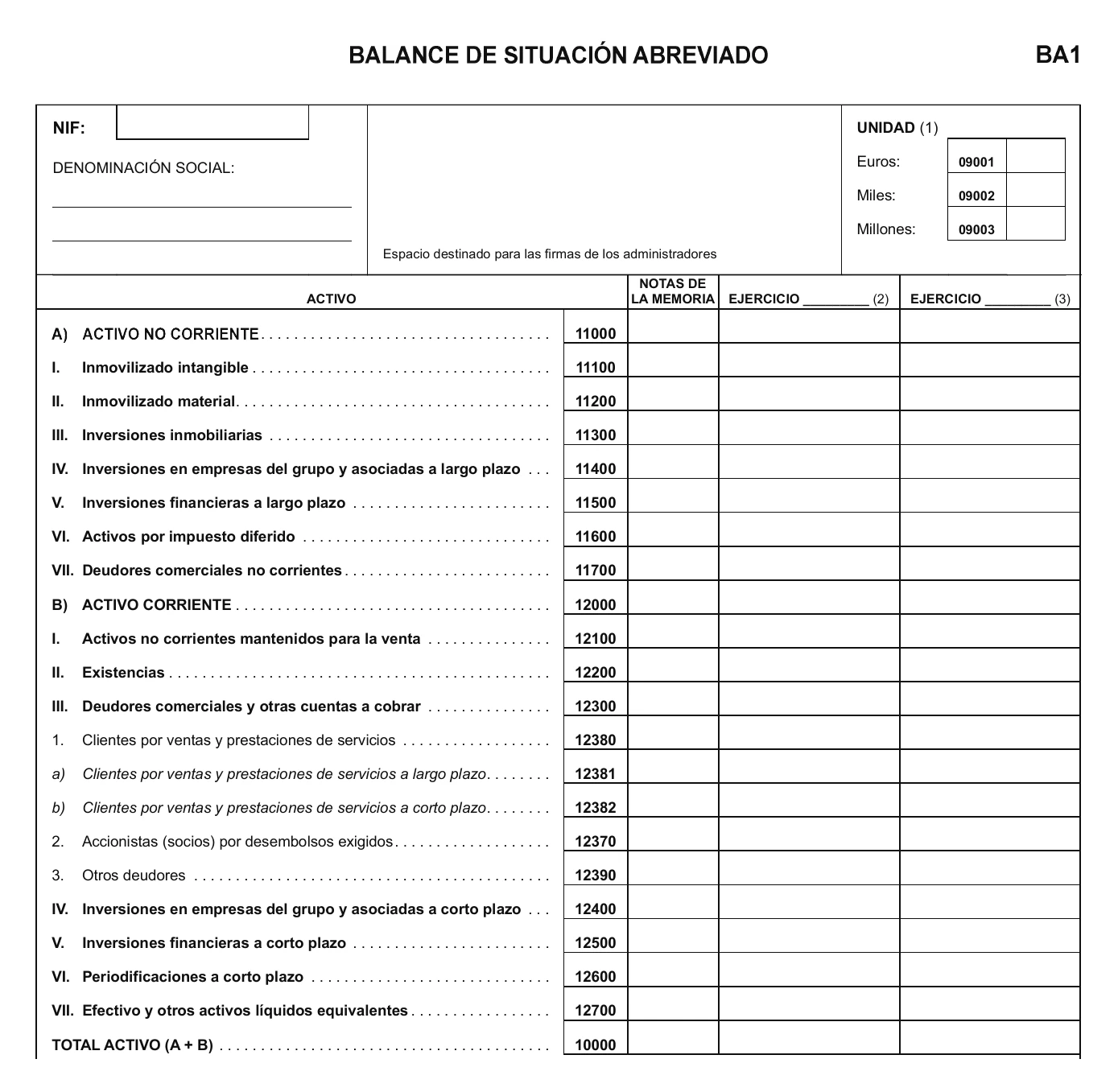
The annual accounts consist of five documents that form a single whole (article 254 LSC):
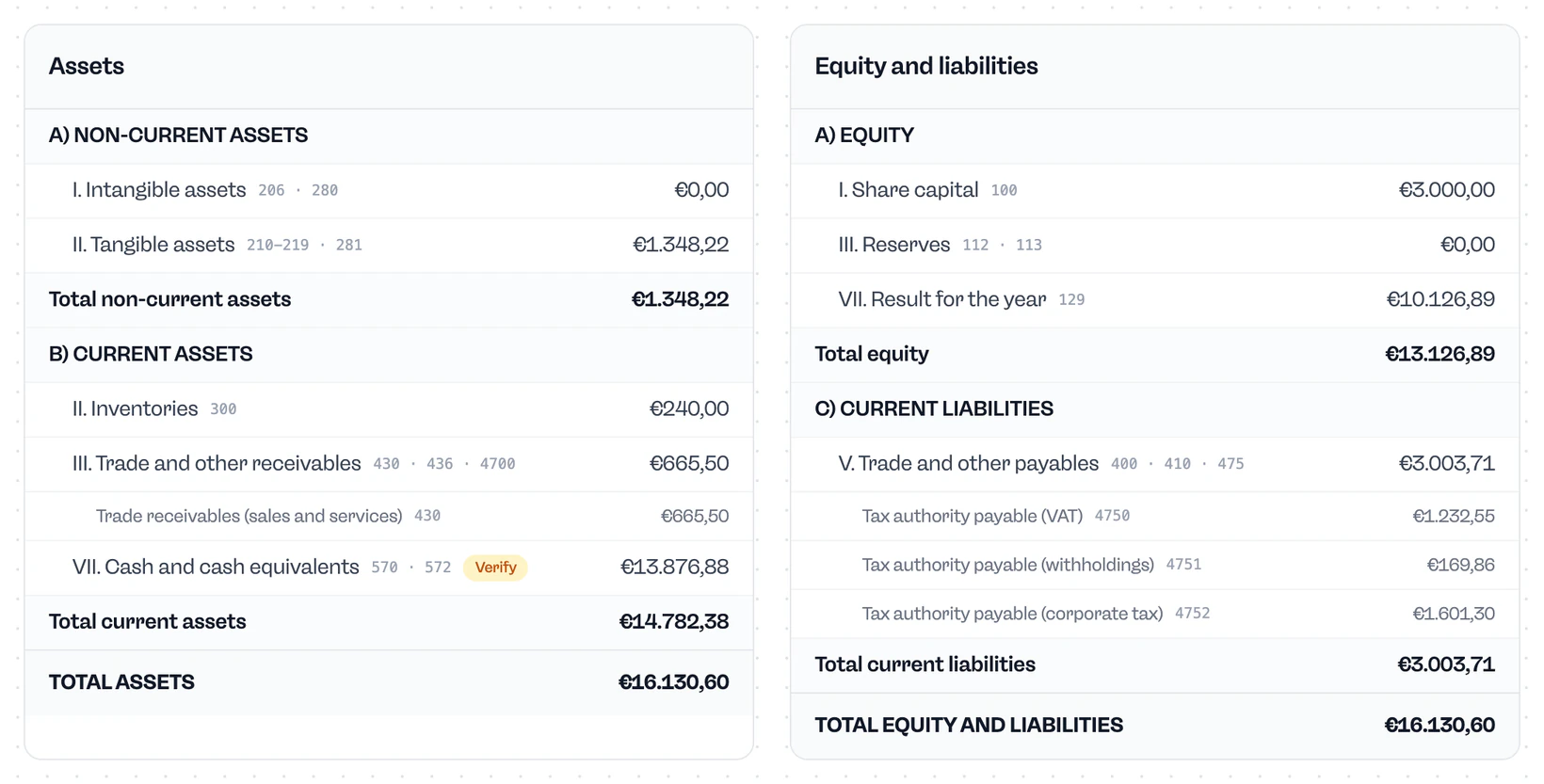
- The balance sheet (balance): what the company owns and owes at the year end.
- The profit and loss account (cuenta de pérdidas y ganancias): the year's income and expenses and the result.
- The statement of changes in equity (estado de cambios en el patrimonio neto): how the company's own funds have changed.
- The cash flow statement (estado de flujos de efectivo): where money came in from and where it went.
- The notes (memoria): the explanations that complete the figures.
They must give a true and fair view of the company's assets, financial position and results. Their structure follows the models approved by regulation (article 254.2 and 254.3). How to read the first two is in the P&L and balance sheet for your SL.
The abridged formats
Almost every small SL can file its accounts in abridged format. The test is whether for two consecutive years, at each year end, the company meets at least two of these three conditions:
| What you can do | Total assets | Annual turnover | Average employees | LSC article |
|---|---|---|---|---|
| Abridged balance sheet and statement of changes in equity | Up to €4.000.000 | Up to €8.000.000 | Up to 50 | 257 |
| Abridged profit and loss account | Up to €11.400.000 | Up to €22.800.000 | Up to 250 | 258 |
| No audit | Up to €2.850.000 | Up to €5.700.000 | Up to 50 | 263 |
In the first year it is enough to meet two of the three conditions at that year end (articles 257.2, 258.2 and 263.3). If you can prepare an abridged balance sheet, the statement of changes in equity and the cash flow statement are no longer compulsory (article 257.3), the notes can also be abridged (article 261) and you do not have to prepare a management report (article 262.3). In practice a small SL files a balance sheet, a profit and loss account and notes, all three abridged.
The three deadlines: prepare, approve and file
- Prepare (formular). The directors prepare the accounts and the proposal for the allocation of the result within three months of the year end at the latest. All directors sign them. If a signature is missing, each document says so and gives the reason (article 253).
- Approve (aprobar). The ordinary shareholders' meeting (junta general) meets within the first six months of the year to approve the previous year's accounts, the management and the allocation of the result (articles 164.1 and 272.1). Once the meeting is called, any shareholder can ask for the documents immediately and free of charge (article 272.2). If you are the sole shareholder, you exercise the meeting's powers yourself and your decision is recorded in signed minutes (article 15).
- File (depositar). Within the month after approval, the directors file with the Registro Mercantil of the registered office the certificate of the meeting's resolutions with a copy of the accounts, plus the management report and the auditor's report where compulsory (article 279). The registrar reviews the documents within 15 days and, if there are no defects, records them as filed (article 280).
Unless the articles of association say otherwise, the financial year ends on 31 December (article 26). For the 2026 financial year the calendar looks like this:
| Obligation | Deadline | Rule |
|---|---|---|
| Prepare the accounts | 31/03/2027 | Article 253 LSC |
| Legalise the books | 30/04/2027 | Article 18 of Ley 14/2013 |
| Approve the accounts at the meeting | 30/06/2027 | Article 164 LSC |
| File modelo 200 | 25/07/2027 | Article 124 of Ley 27/2014 |
| File the accounts with the Register | One month after approval: if the meeting is on 30/06/2027, by 30/07/2027 | Article 279 LSC |
A meeting called or held late is still valid (article 164.2). The month for filing always runs from the approval.
What happens if you do not file them
- Register closure. As long as you have not filed, the Registro Mercantil will not register any document of the company. The only exceptions are the removal or resignation of directors, the revocation or waiver of powers of attorney, the dissolution and appointment of liquidators and anything ordered by a court or the authorities (article 282). You could not, for example, register a new director or a change of registered office.
- Fine. The Accounting and Audit Institute (Instituto de Contabilidad y Auditoría de Cuentas) can fine the company between €1.200 and €60.000. If annual turnover exceeds €6.000.000, the limit rises to €300.000 for each year of delay. The amount depends on the size of the company and, if you file before the proceedings start, the fine is set at its minimum level and halved. The offence becomes time-barred after three years (article 283).
Legalising the books
This is a separate obligation from filing the accounts, with its own deadline. All compulsory books are legalised online with the Registro Mercantil, completed in electronic form, within four months of the year end (article 18 of Ley 14/2013). For an SL they are at least:
- The journal (libro Diario) and the inventory and annual accounts book (libro de Inventarios y Cuentas anuales) (articles 25 and 28 of the Commercial Code, Código de Comercio).
- The minutes book for shareholders' meetings and other collective bodies (article 26 of the Commercial Code).
- The register of shareholders (libro registro de socios) (article 104 LSC).
- If your company has a sole shareholder, the register of contracts between the sole shareholder and the company (article 16 LSC).
How they relate to modelo 200
Corporate income tax (Impuesto sobre Sociedades) starts from your bookkeeping. The tax base is worked out by adjusting the accounting result with the rules of the tax law (article 10.3 of Ley 27/2014). That is why the profit and loss account approved at the meeting and modelo 200 have to tell the same story. Modelo 200 is filed within the 25 calendar days following the six months after the year end (article 124.1), which means by 25 July if your year ends on 31 December. We explain it in modelo 200 for corporate income tax and, for the payments on account during the year, in modelo 202.
With Facturaz Empresa Plus (€84 + IVA a month) our team files every modelo for your SL, including 200 and 202, legalises the books and files the annual accounts (the external fees for those two steps are billed separately) (the external fees for those two steps are billed separately). With Empresa Go (€44 + IVA a month) you have everything ready and file it yourself. You have 14 days free on the plans for companies.