
Almost everyone starts out as an autónomo (self-employed): it is quicker, cheaper and involves less paperwork. The question comes later, as the business grows: should I set up a sociedad limitada (SL), the Spanish limited company? No turnover figure forces you to switch and there is no magic threshold that works for everyone. There are four things to compare: what you put at risk, what you pay in tax, what you pay to Social Security and what it costs to set up and run the company. This guide goes through them one by one with the 2026 figures and the article of the law behind each.
This guide is part of How to become an autónomo in Spain, step by step, which takes you through the whole process from start to finish.
The difference in one sentence
As an autónomo, you are the business: an individual working on your own account (article 1 of Ley 20/2007, the Self-Employment Statute). With an SL, the business is a separate legal person with its own tax number (NIF), its own accounts and its own taxes. You are its shareholder (socio) and usually its director (administrador). Everything else follows from this.
If you have not taken the first step as an autónomo yet, start with how to register as an autónomo in Spain.
Liability: what you put at risk
As an autónomo
You answer for your business debts with everything you own, now and in the future (article 1911 of the Civil Code). If the business cannot pay a supplier, Hacienda (the tax agency) or a bank, they can come after your personal account, your car or your home.
With an SL
Shareholders are not personally liable for the company's debts (article 1.2 of the Companies Law, Ley de Sociedades de Capital). In principle, what you risk is what you put in. But the protection has limits worth knowing:
- If the share capital is under €3.000 and the company is wound up without enough money to pay its debts, the shareholders are jointly liable for the difference between €3.000 and the capital they put in (article 4.1 of the Companies Law).
- Directors are liable for damage caused by acts against the law or the articles of association or by failing in their duties (article 236).
- If the company falls into a legal cause for dissolution and the director does not call the shareholders' meeting within two months, the director becomes liable for the debts that arise afterwards (article 367).
- Personal guarantees you sign for a bank or a landlord bind you personally, company or not.
Tax: IRPF versus Corporate Tax
As an autónomo: income tax in brackets
Your business profit is taxed in your IRPF (personal income tax) together with your other income, on a progressive scale: the more you earn, the higher the rate on the part above each bracket. The scale has two halves, the state one and your region's (comunidad autónoma). The state half is this (article 63 of Ley 35/2006, the IRPF Law):
| Taxable base | State rate |
|---|---|
| Up to €12.450 | 9,5% |
| €12.450 to €20.200 | 12% |
| €20.200 to €35.200 | 15% |
| €35.200 to €60.000 | 18,5% |
| €60.000 to €300.000 | 22,5% |
| Over €300.000 | 24,5% |
Each region passes its own scale, so your final rate depends on where you live. We explain it in Spain's IRPF tax bands for 2026.
With an SL: Corporate Tax
The company pays Corporate Tax (Impuesto sobre Sociedades) on its profit. The general rate is 25%, but small companies have lower rates that are coming down each year (article 29 of Ley 27/2014 and its forty-fourth transitional provision). For tax periods starting in 2026:
| Type of company | Rate |
|---|---|
| Previous year's turnover under €1 million | 19% on the first €50.000 and 21% on the rest |
| Small company (turnover under €10 million) | 23% |
| Newly created company, in its first profitable period and the next | 15% |
| Everyone else | 25% |
A warning about the 15% new-company rate if you are coming from self-employment: it does not apply when, in the year before the company was set up, the same activity was carried on by an individual who owns more than 50% of the new company (article 29.1.b of Ley 27/2014). If you move your autónomo business into your own SL, you will normally not get that rate.
The money still belongs to the SL
This is the key to the comparison. An SL's profit is not yours: it belongs to the company. To use it in your personal life you have to take it out. When you do, it is taxed again:
- As a director's salary. Only if the articles of association say the post is paid, because otherwise it is unpaid (article 217 of the Companies Law). That salary is taxed in your IRPF and the company withholds 35%, or 19% if its turnover in the last year was under €100.000 (article 80.1.3.º of the IRPF Regulation). The company pays that withholding with modelo 111.
- As dividends. They are taxed in the savings part of your IRPF: 19% up to €6.000, 21% up to €50.000, 23% up to €200.000, 27% up to €300.000 and 30% above, state and regional parts combined (articles 66 and 76 of the IRPF Law).
That is why an SL pays off mainly when you earn more than you need to live on: what you leave in the company pays Corporate Tax and nothing more until you take it out. If you will take everything out each year, the advantage shrinks a lot.
An example with numbers
Imagine a 2026 profit of €80.000 that you do not need to spend this year.
- As an SL with turnover under €1 million: €50.000 at 19% is €9.500 and €30.000 at 21% is €6.300. That is €15.800 of Corporate Tax in total. The remaining €64.200 stays in the company.
- As an autónomo: the state part of your IRPF alone on a €80.000 base is already €13.450,75 before your personal and family allowance. The regional part comes on top and depends on your region.
This example leaves out the difference in Social Security contributions, the cost of running the company and what you will pay when you take the money out. Run the numbers with your own figures before you decide.
IVA does not change
Autónomo or SL, you charge IVA (Spanish VAT) on your invoices and declare it the same way, with the quarterly modelo 303. What changes is the tax on profit and the returns that go with it.
Social Security: the director's RETA
Setting up an SL does not take you out of the RETA, the Social Security scheme for self-employed workers. If you run the company or work in it, are paid for it and have effective control, you are still self-employed, as what is called an autónomo societario (article 305.2.b of the General Social Security Law). The law treats you as in control if you hold at least half the capital. It also presumes control, unless you prove otherwise, if you hold a third of the capital. The same applies if you hold a quarter and also manage the company. It also applies if half the capital is held by relatives you live with.
The differences from a regular autónomo:
- A higher minimum base. You cannot contribute below the minimum base of group 7 of the general scheme (article 308.1.a, rule 4, of the General Social Security Law). In 2026 that is €1.424,40 a month (articles 3 and 18.4 of Orden PJC/297/2026). At the 31,5% contribution rate, that is at least €448,69 a month.
- Your earnings include what you receive from the company. Your salary counts. So do the company's dividends if you hold at least 33% of the capital, or 25% as a director (article 308.1.c, rule 1).
- The general expenses allowance is 3% instead of 7% (article 308.1.c, rule 2).
- The tarifa plana (reduced flat rate) also applies to you if it is your first registration or you have not been registered for two years: the law extends it to shareholders of capital companies (article 38 ter.9 of Ley 20/2007).
How the bracket system works is in Social Security contributions for autónomos.
What it costs to set up an SL
The capital
Since Ley 18/2022, the business creation and growth law, the minimum capital for an SL is €1 (article 4.1 of the Companies Law). While the capital is below €3.000, the company must put at least 20% of its profit into a legal reserve until reserve and capital add up to €3.000. If it is wound up, the shareholders answer for the difference up to that figure.
Notary, Registry and taxes
- Notary and Mercantile Registry. If you set it up online with standard articles of association (estatutos tipo) and capital of up to €3.100, the fees are fixed: €60 for the notary and €40 for the registrar (article 5.Dos.c of Real Decreto-ley 13/2010). With your own articles or more capital, the general fee scales apply.
- A name certificate (certificación negativa de denominación) from the Central Mercantile Registry, proving that no other company has the name you choose.
- No tax on setting it up. Forming a company is exempt from the capital duty part of the transfer tax (article 45.I.B.11 of the consolidated Transfer Tax Law).
The steps
- You reserve the name at the Central Mercantile Registry. Online you can propose up to five names (article 15.3.b of Ley 14/2013).
- You pay in the capital. Online, the bank certificate can be replaced by a statement that the shareholders answer for the contribution being real (article 15.4.a of Ley 14/2013).
- You sign the deed of incorporation before a notary (article 20 of the Companies Law).
- Hacienda gives the company a provisional NIF.
- The Mercantile Registry registers the company. On registration the SL exists as a legal person (article 33) and gets its final NIF.
- You register the company with Hacienda on modelo 036 and the director with the RETA.
What it costs to run: books and yearly obligations
This is the difference you feel most day to day. As an autónomo under direct assessment you keep record books (libros registro) of income, expenses and capital assets (article 68 of the IRPF Regulation). An SL keeps full accounts and has its own calendar:
- Orderly accounts with a Journal and an Inventory and Annual Accounts book (articles 25 and 28 of the Commercial Code), following the Spanish General Accounting Plan.
- Legalise the books online at the Mercantile Registry within four months of the year end (article 18 of Ley 14/2013).
- Prepare the annual accounts within three months of the year end (article 253 of the Companies Law).
- Approve them at a shareholders' meeting within the first six months of the year (article 164).
- File them at the Mercantile Registry within a month of approval (article 279).
- Corporate Tax return, modelo 200, within the 25 calendar days after the six months following the year end (article 124.1 of Ley 27/2014). If your financial year is the calendar year, from 01/07 to 25/07.
- Advance payments, modelo 202, in the first 20 calendar days of April, October and December (article 40.1 of Ley 27/2014).
- IVA and withholdings, the same as an autónomo: modelos 303 and 390 for IVA; 111 and 190 if you pay salaries or invoices with withholding.
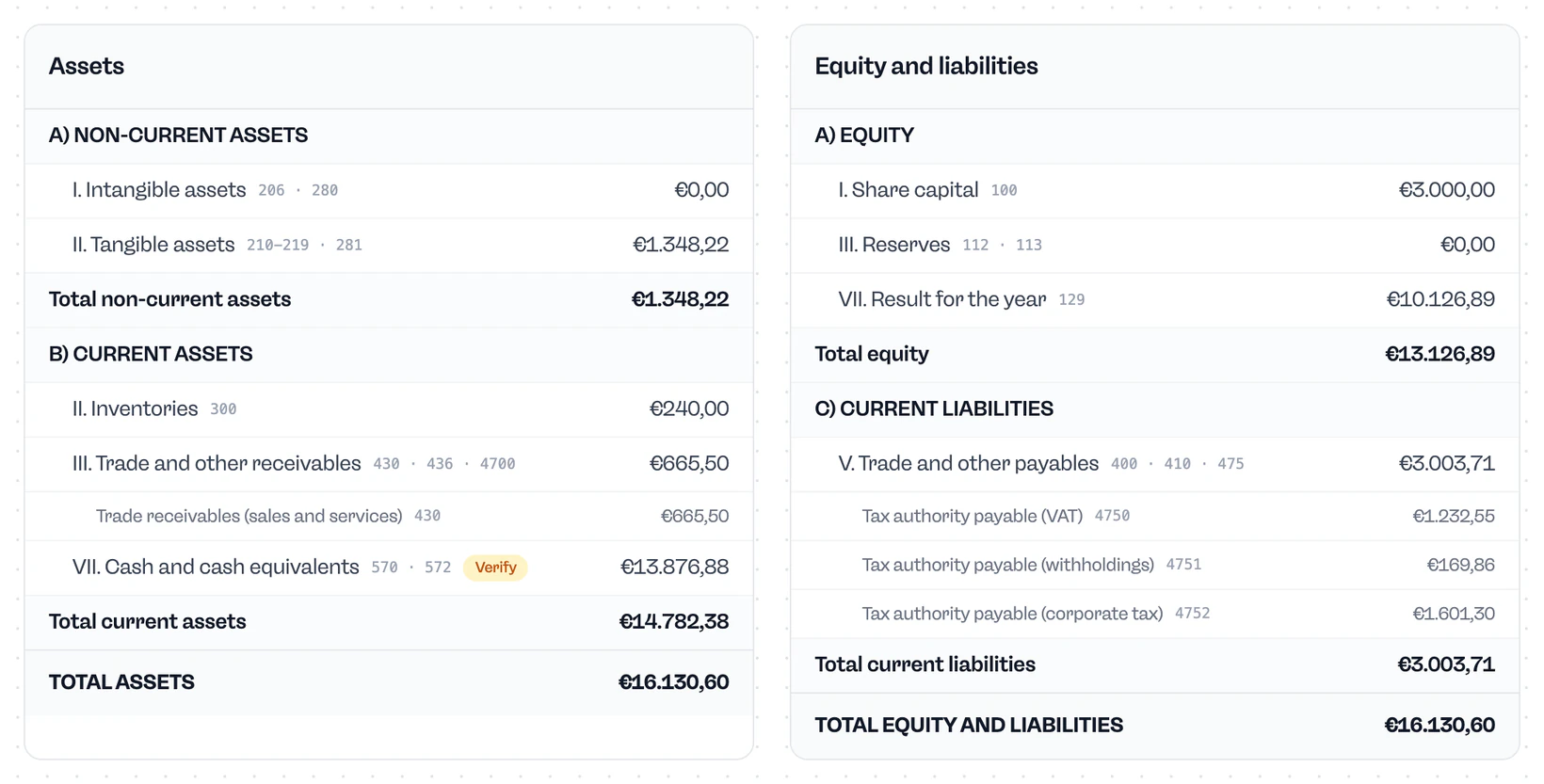
What your company's profit and loss account and balance sheet are, with an example, is explained in P&L and balance sheet for your SL.
When an SL makes sense
There is no single rule, but these are the signs that weigh most:
- You earn well above what you need to live on and want to reinvest or save inside the business. That is where the gap between your marginal IRPF rate and Corporate Tax really shows.
- Your activity carries a risk of large debts: big contracts, employees, stock or loans.
- You will have partners or want someone to invest. In an SL the capital is split into shares (participaciones), which do not exist for an autónomo.
- Your clients ask for it. Some businesses prefer to contract with companies.
And these are the signs that say not yet:
- You need almost everything you earn to live on, so you would take it out of the company every year.
- Your profit is moderate and the higher minimum contribution plus the cost of keeping the accounts would eat the saving.
- You are just starting and do not yet know whether the business will work.
Moving from autónomo to SL
It is not a conversion: you create a new company and move your activity into it. You set up the SL with the steps above, the company registers with Hacienda on its own 036, you deregister your activity as an individual on your own 036. At Social Security you are then recorded as the company's director through a change of details (article 46.3 of Real Decreto 84/1996). Plan the date: the cleanest move is at the start of a quarter, so your autónomo returns and the company's do not overlap.
If you decide to set up your SL
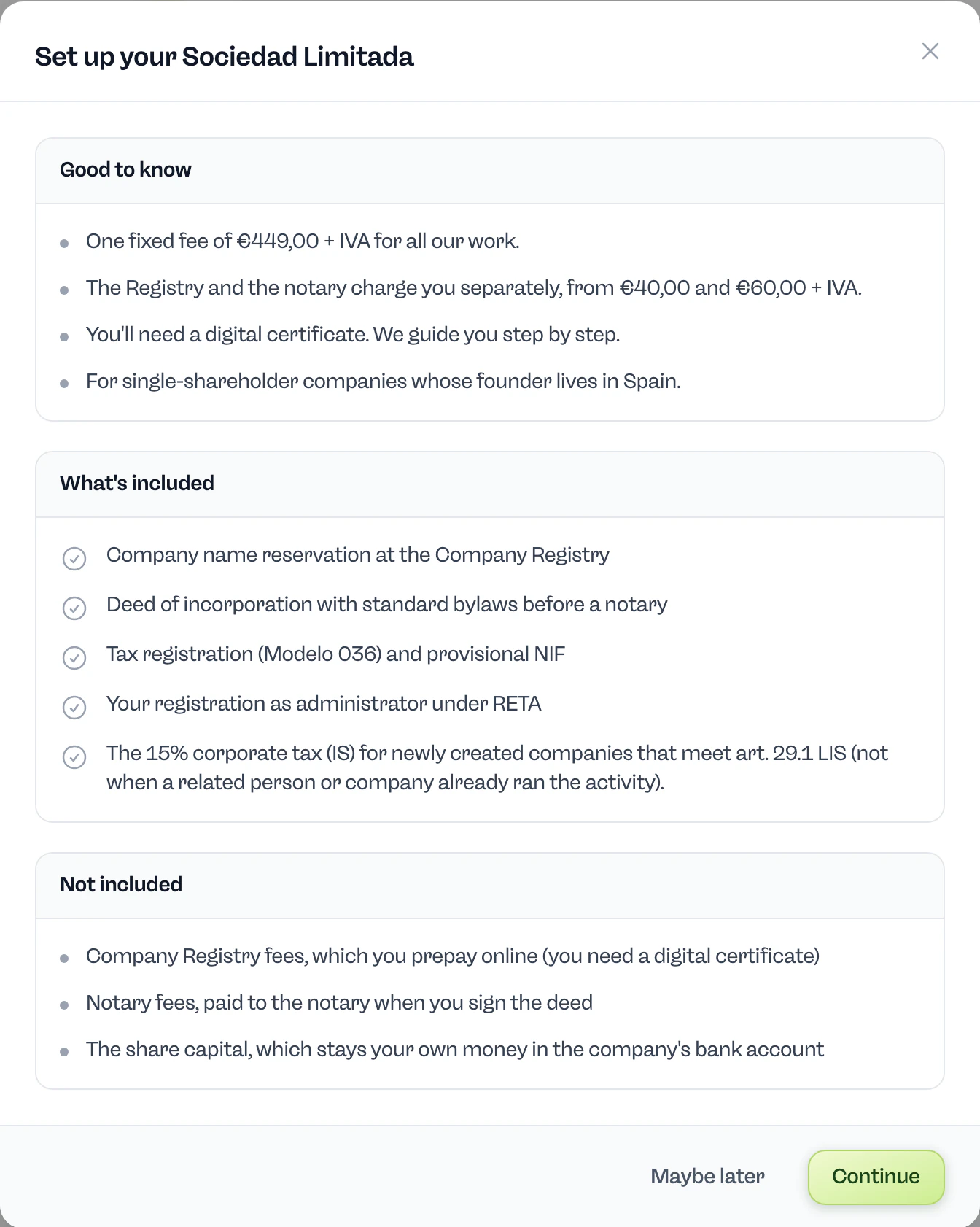
At Facturaz our team sets up your SL for €449 + IVA: we reserve the name, prepare the deed with standard articles, book the notary appointment, file modelo 036 and register you as director with the RETA. You pay the notary (€60 + IVA) and the Mercantile Registry (€40 + IVA), with capital of up to €3.100. It is all in setting up an SL with Facturaz. Once registered, the app keeps the company's books and has the annual accounts ready to download: with Empresa Go (€44 + IVA a month) you file the returns yourself with everything calculated. With Empresa Plus (€84 + IVA a month) our team files Corporate Tax, legalises the books and files the accounts. Both plans are on pricing for SLs.