
Becoming an autónomo (a self-employed worker) in Spain comes down to two registrations and one decision: you register with the tax agency (Hacienda), you register with Social Security and you choose how much to contribute based on what you expect to earn. Both registrations are done online and both must be in place before you start working. This guide takes you from the decision to your first invoice, with the article of the law behind each step.
The contribution figures are the 2026 ones and change every year.
What an autónomo is
Spanish law defines a self-employed worker as someone who works habitually, personally and directly, on their own account and outside anyone else's organisation, for profit (article 1 of Ley 20/2007, the Self-Employment Statute). Social Security uses the same idea to decide who must join the RETA, the special Social Security scheme for self-employed workers (article 305.1 of the General Social Security Law).
If you will sell your services or products regularly and in your own name, you are an autónomo, with no company needed. If you later consider a company, we explain it in autónomo or SL: when a company makes sense.
Before you start: what you need
- An identity document with a tax number. Spanish nationals use their DNI. Foreign nationals use their NIE, the identification number for foreigners in Spain. If you are not an EU citizen, you also need a residence authorisation that allows self-employed work.
- A Social Security number. If you have worked in Spain before, you have one. If not, you request it on the same portal where you register.
- A way to identify yourself online. A digital certificate or Cl@ve. We cover it in step 5, but it is worth having before you start because every step uses it.
- A bank account for the Social Security direct debit.
- A clear idea of your activity and of what you expect to earn each month. The first gives you your activity code with Hacienda. The second sets your contribution.
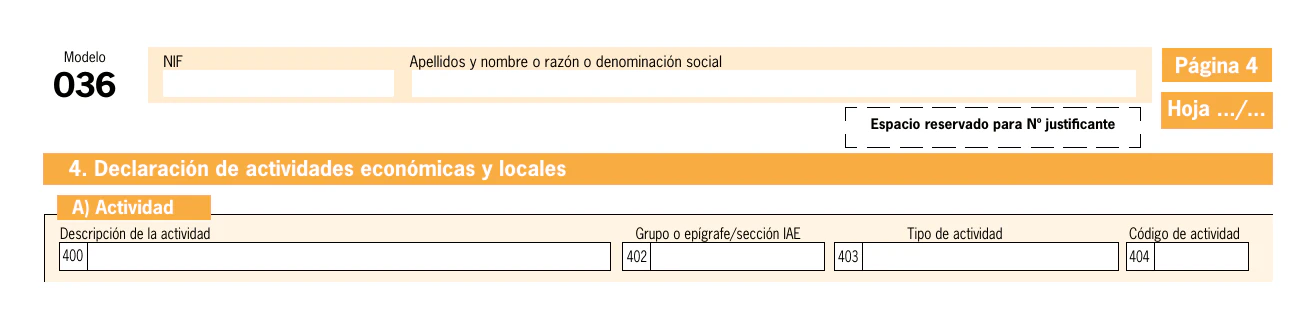
Step 1: register with Hacienda using modelo 036
The first step is the census registration in the Register of Businesses, Professionals and Withholders. It is how you tell the Agencia Tributaria (the Spanish tax agency) that you are starting an activity. You must file it before you start (article 9.4 of Real Decreto 1065/2007). And starting is not only invoicing: the same rule counts any purchase, sale, payment or collection made for the activity as the start. Hiring someone counts too.
Since 03/02/2025 there is a single form for this, modelo 036. The old modelo 037, the simplified version, was abolished by Orden HAC/1526/2024. If a guide sends you to the 037, it is out of date. We explain the form section by section in modelo 036 to register as an autónomo.
What you decide on modelo 036
- Your activity and its IAE code (epígrafe). The Business Activities Tax (IAE) gives every activity a code. As an individual you do not pay this tax (article 82.1.c of the Local Finances Law), but the code matters: it says whether you are a professional or a business. That decides, for example, whether your clients withhold income tax from your invoices.
- Your VAT scheme. Most autónomos are in the general scheme: you charge IVA (Spanish VAT) on your invoices and declare it every quarter.
- How you calculate your profit for income tax (IRPF). The usual method is simplified direct assessment (estimación directa simplificada): income minus deductible expenses. Some activities can use fixed modules (estimación objetiva).
- Whether you will trade with businesses in other EU countries. If so, you apply on the same 036 to join the Register of Intra-Community Operators, the ROI (article 9.3.g of Real Decreto 1065/2007).
- Your tax address and where you work.
You file the 036 on the Agencia Tributaria's online office with a digital certificate or Cl@ve.
Step 2: register with Social Security (RETA)
The second step is joining the RETA. From that day you contribute and you are covered: healthcare, sick leave, retirement and a benefit if your business stops (cese de actividad).
How it is done today
Self-employed registration is done electronically (article 46.1 of Real Decreto 84/1996, the regulation on Social Security registrations). In practice you do it on Import@ss, the online portal of the Social Security Treasury (TGSS), identifying yourself with a digital certificate, Cl@ve or the other methods the portal accepts. The official form behind it is the TA.0521, the RETA registration request. We go through it field by field in modelo TA.0521.
There is also a route that does both registrations at once: the Single Electronic Document (DUE) of the CIRCE system, which sends your details to Hacienda and to Social Security in one go (Real Decreto 368/2010). It is processed through a Business Support Point (PAE).
The deadline
You file the request before you start and never more than 60 calendar days before the planned start date (article 32.3.1.º of Real Decreto 84/1996). If you file on time, your registration takes effect from the day you start, up to three registrations per calendar year under this rule (article 46.2.a). If you file late, it counts from the 1st of that month, Social Security claims the missed contributions with a surcharge and reports it to the Labour Inspectorate (article 46.2.c).
That is why the usual order is Hacienda first and Social Security second, on the same day or on consecutive days. Both go in before your first working day.
The mutua
When you register you name the mutua (a non-profit insurer that works with Social Security) that will cover your sick leave, work accidents and cese de actividad (article 83.1 of the General Social Security Law). You choose it on the same request.
Step 3: ask for the tarifa plana when you register
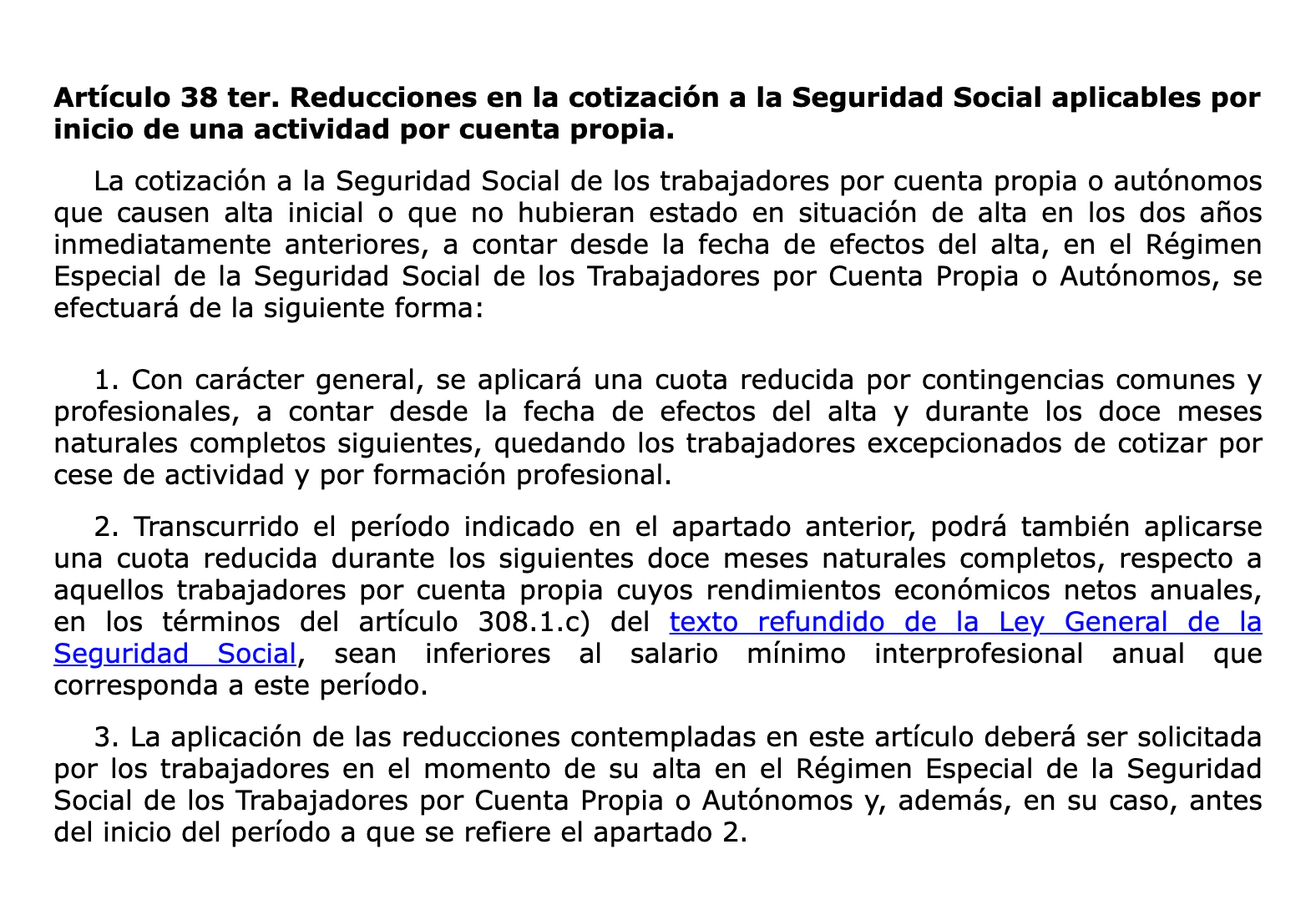
If this is your first registration as an autónomo, or you have not been registered in the previous two years, you are entitled to a reduced contribution for the first 12 full calendar months. Everyone calls it the tarifa plana, the flat rate (article 38 ter of Ley 20/2007). If you already had it in an earlier registration, the period without being registered rises to three years (article 38 ter.4).
- You ask for it when you register. The law requires the request at that moment (article 38 ter.3). If you do not tick it on the request, you lose it.
- Those 12 months are not adjusted afterwards. You pay the reduced amount even if you earn more than expected (article 38 ter.6).
- It can last 12 more months if your net earnings for the year will stay below the minimum wage (salario mínimo interprofesional). You apply before the first period ends, with a statement that you will not exceed it (article 38 ter.2 and 3). If you do exceed it, that second period is adjusted.
- The periods are 24 and 36 months if you have a disability of 33% or more, or are a victim of gender violence or terrorism (article 38 ter.10).
On the amount: from 2023 to 2025 the reduced contribution was €80 a month, set by the fifth transitional provision of Real Decreto-ley 13/2022. The same provision says that from 2026 each year's State Budget Law sets it. As of 05/11/2026 no Budget Law for 2026 has been passed and we have not found another rule in the BOE (the official gazette) that sets this year's figure, so confirm the amount on Import@ss when you apply. The full detail is in what the tarifa plana is and how to apply for it.
Step 4: your contribution, based on what you earn
Since 2023 the autónomo contribution (cuota) depends on your net earnings (article 308 of the General Social Security Law, as worded by Real Decreto-ley 13/2022). It works like this:
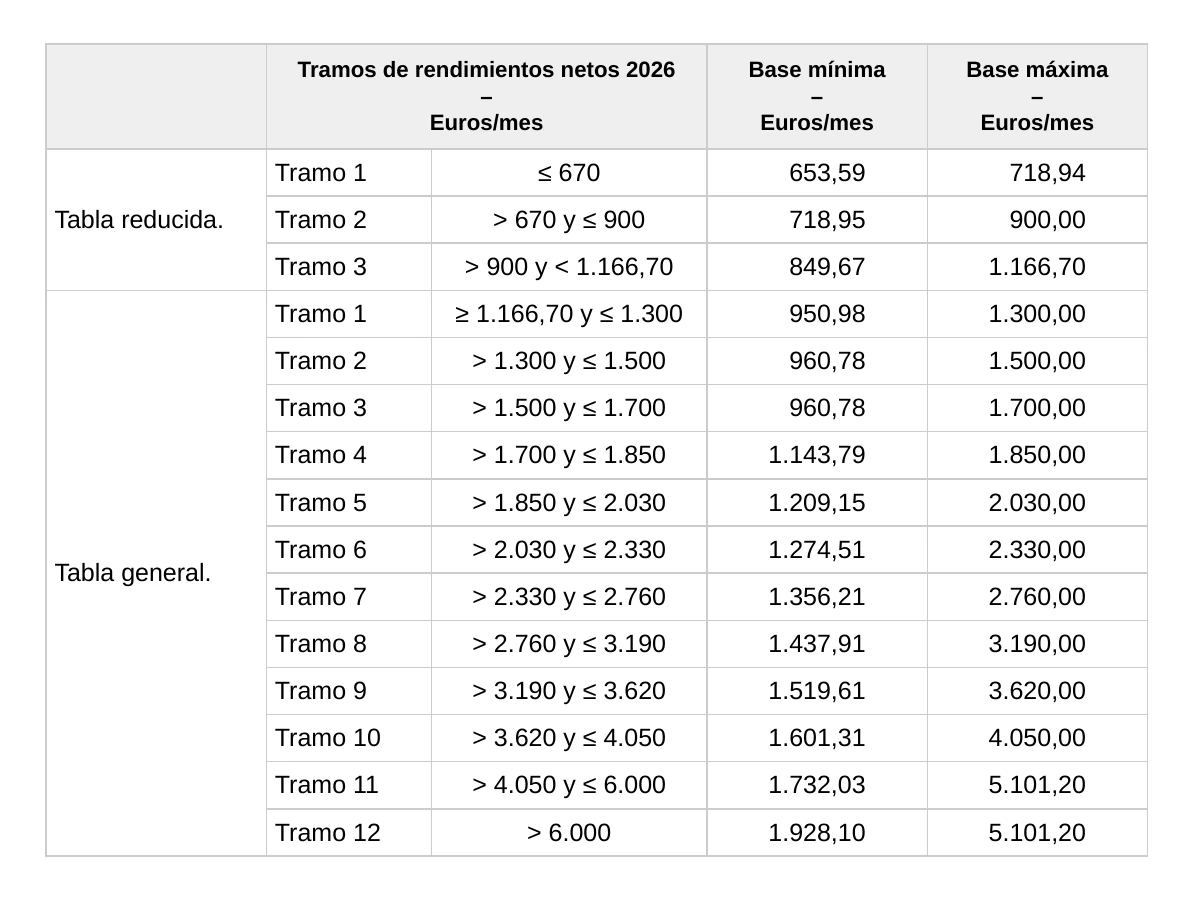
- When you register you choose a contribution base according to your expected average monthly earnings. There are 15 brackets: twelve in the general table and three in the reduced table, which is for earnings below €1.166,70 a month.
- Each month you pay 31,5% of that base: 28,3% for common contingencies, 1,3% for professional contingencies, 0,9% for cese de actividad, 0,1% for vocational training and 0,9% for the intergenerational equity mechanism (articles 18 and 37 of Orden PJC/297/2026).
- You can change base during the year if your forecast changes (article 308.1.a, rule 3).
- The following year it is adjusted. Hacienda tells Social Security what you actually earned and Social Security refunds what you overpaid or charges what was missing (article 308.1.c).
How your earnings are worked out
The starting point is your net business income as calculated for IRPF (income minus deductible expenses). Your autónomo contributions are added back and a 7% allowance for general expenses is deducted, or 3% if you are a company director with control of the company (article 308.1.c, rules 1 and 2). The result, turned into a monthly average, sets your bracket.
The 2026 table
In 2026 the 2025 tables apply, as ordered by article 3.4 of Real Decreto-ley 3/2026. Orden PJC/297/2026 sets them out in its article 18.1. These are the minimum bases and the monthly contribution that results from applying 31,5% to them. Within your bracket you can choose a higher base.
| Bracket | Net earnings per month | Minimum base | Contribution at the minimum base |
|---|---|---|---|
| Reduced 1 | Up to €670 | €653,59 | €205,88 |
| Reduced 2 | €670 to €900 | €718,95 | €226,47 |
| Reduced 3 | €900 to €1.166,70 | €849,67 | €267,65 |
| General 1 | €1.166,70 to €1.300 | €950,98 | €299,56 |
| General 2 | €1.300 to €1.500 | €960,78 | €302,65 |
| General 3 | €1.500 to €1.700 | €960,78 | €302,65 |
| General 4 | €1.700 to €1.850 | €1.143,79 | €360,29 |
| General 5 | €1.850 to €2.030 | €1.209,15 | €380,88 |
| General 6 | €2.030 to €2.330 | €1.274,51 | €401,47 |
| General 7 | €2.330 to €2.760 | €1.356,21 | €427,21 |
| General 8 | €2.760 to €3.190 | €1.437,91 | €452,94 |
| General 9 | €3.190 to €3.620 | €1.519,61 | €478,68 |
| General 10 | €3.620 to €4.050 | €1.601,31 | €504,41 |
| General 11 | €4.050 to €6.000 | €1.732,03 | €545,59 |
| General 12 | Over €6.000 | €1.928,10 | €607,35 |
The maximum base in any bracket is €5.101,20 a month in 2026. An example: if you expect net earnings of €1.600 a month, you are in general bracket 3 and your minimum contribution is €302,65. If your real average for the year turns out to be €2.100, the adjustment will ask you for the difference up to the minimum base of general bracket 6. There are more examples in Social Security contributions for autónomos.
Step 5: your digital certificate
Almost everything you do as an autónomo goes through the online offices of Hacienda and Social Security. There are two main ways to identify yourself there:
- Cl@ve, the public administration's identification system, which works with your phone.
- The personal digital certificate, a file you install on your computer that identifies you and lets you sign documents.
The certificate from the Spanish Royal Mint (FNMT) is open to Spanish and foreign adults with a DNI or NIE. The FNMT states that it is issued free of charge. To prove your identity it offers several routes: at an office, by video identification, with an electronic DNI or with your phone. The types of certificate and what each is for are in what you need to know about digital certificates in Spain. To sign with it you will need AutoFirma, the government's signing program; here is how to install AutoFirma and use your digital certificate.
Step 6: your first invoice
From the start date on your registrations you can invoice. A complete invoice includes at least (article 6 of Real Decreto 1619/2012, the invoicing regulation):
- A number and, if you use series, a series. Numbers within each series run in order.
- The date of issue.
- Your full name and your client's, or the company name.
- Your NIF (tax number) and, in most cases, your client's.
- Your address and your client's.
- A description of what you are invoicing, with the details needed to work out the taxable base.
- The IVA rate applied and the IVA amount, shown separately.
- The date of the work or sale, if it differs from the invoice date.
IVA and income tax withholding
The standard IVA rate is 21% (article 90 of Ley 37/1992). If you are a professional and you invoice a business or another autónomo, your client withholds 15% IRPF from the invoice, or 7% in your first year and the two following ones, as long as you did not carry out any professional activity the year before (article 95.1 of the IRPF Regulation). To get the 7% you must tell your client in writing. How to choose each rate is in how to choose IVA and IRPF rates for your invoices. There is a full worked example in how to create your first invoice as an autónomo. The complete guide to invoicing is how to invoice as an autónomo.
Veri*Factu
Real Decreto 1007/2023 requires invoicing software to create a tamper-proof record of every invoice and to print a QR code on it. The dates in the BOE today are 01/01/2027 for companies that pay Corporate Tax and 01/07/2027 for autónomos (final provision four, as worded by Real Decreto-ley 15/2025). On 05/10/2026 Hacienda announced it wants to delay it to October 2028, but as of 05/11/2026 that change has not been published in the BOE. We cover it in Verifactu's delay to October 2028.
What comes next: your taxes
With your first invoice your regular obligations begin. The basics under the general IVA scheme and direct assessment:
- Modelo 303, every quarter: the IVA you charged minus the IVA you paid on business expenses.
- Modelo 130, every quarter: an advance payment of income tax on your profit for the year. You do not file it if in the previous year at least 70% of your professional income had tax withheld (article 109.2 of the IRPF Regulation).
- Every year: modelo 390 (the annual IVA summary) and your income tax return (modelo 100).
- Record books (libros registro) of income, expenses and capital assets (article 68 of the IRPF Regulation).
Which taxes you pay, when and with which form is in autónomo taxes in Spain. Which expenses you can deduct is in how to deduct expenses as an autónomo.
Summary: the order of the steps
- Gather your ID, your Social Security number, your certificate or Cl@ve and a bank account.
- Decide your activity and your start date.
- File modelo 036 before that date.
- Request RETA registration on Import@ss, at most 60 days before and always before your first working day. Tick the tarifa plana if it applies and choose your contribution base.
- Prepare your invoice and, if the 7% withholding applies to you, tell your clients in writing.
- Put your first modelo 303 and your first modelo 130 in your calendar.
If you would rather we did it
At Facturaz our team prepares your registration with Hacienda and Social Security, with your activity codes chosen with you, for €49 + IVA as a one-off payment: you sign the registration document from your account and we file it. It is all in autónomo registration with Facturaz. If you do not have a digital certificate yet, you can request one remotely with your ID and a selfie for €84 + IVA, in the digital certificate service. After that, the app keeps your invoices, expenses and tax returns: with Autónomo Go (€24 + IVA a month) you file them yourself with everything calculated. With Autónomo Plus (€44 + IVA a month) our team files them. Both plans are on pricing for autónomos, with a 14-day free trial.
Every guide on becoming an autónomo
Each step has its own guide:
- Modelo 036: registering with Hacienda with your activity, your taxes and your tax address.
- Modelo TA.0521: registering in the RETA with Social Security.
- The autónomo contribution: what you pay each month, based on your net income.
- Tarifa plana: the reduced contribution for new autónomos and how to apply.
- Digital certificates: what it is and why you need one.
- AutoFirma: how to install AutoFirma and use your certificate.
- Autónomo or SL: when a limited company suits you better.
- Foreigners in Spain: NIE, Social Security and tax if you come from abroad.
You may also need: Autónomo taxes in Spain: what you pay, when and how and How to invoice as an autónomo: IVA, IRPF and Veri*Factu.