
A deductible expense (gasto deducible) is a cost of your activity that you can subtract from your income before working out IRPF, Spanish personal income tax. If it also carries IVA (Spanish VAT), that IVA can be subtracted from what you owe each quarter. These are two separate questions with separate rules. One expense can pass one test and fail the other.
This guide is part of Autónomo taxes in Spain: what you pay, when and how, which covers every tax you pay in one guide.
This guide explains what makes an expense count, which expenses are the usual ones, which have limits and which can never be deducted, with the article of law each rule comes from. If you would rather see it through concrete cases, read the most common tax deductions with examples.
What a deductible expense is and how much it saves you
Under IRPF you pay tax on your profit, which the law calls net income (rendimiento neto): your income minus the expenses of your activity. It is worked out with the corporate income tax rules plus the special IRPF rules (article 28.1 of Ley 35/2006, the IRPF Act). If you earn €30.000 in the year and have €6.000 of deductible expenses, you are taxed on €24.000.
A deductible expense does not give you back what it costs. It saves you the tax you would have paid on that amount. If your marginal IRPF rate is 30%, an expense of €100 saves you about €30 of IRPF. Buying something you do not need to pay less tax always leaves you with less money.
The four requirements of a deductible expense
For an expense to count it must meet four conditions at once.
- Be linked to your activity. It must serve to earn your income. Assets you use both for the business and in your private life are not treated as business assets, unless the private use is incidental and clearly minor (article 29 of the IRPF Act and article 22 of its Regulation, Real Decreto 439/2007). For IVA the rule is stricter: the goods or service must be used directly and exclusively for the activity (article 95 of Ley 37/1992, the IVA Act).
- Be supported by evidence. Expenses are proven, as a priority, with the invoice from whoever sells to you (article 106.4 of the Ley General Tributaria, the General Tax Act). Always ask for the invoice in your name with your NIF (tax ID).
- Be recorded. If you are a professional under estimación directa (direct assessment), you keep libros registro of income, expenses, capital assets and client funds and outlays (article 68.5 of the IRPF Regulation). An asset that is not in your records is presumed not to be used for the activity (article 22.2 of the Regulation).
- Go in the right year. Expenses are allocated under the corporate income tax rules (article 14.1.b of the IRPF Act): generally to the period in which they accrue, not when you pay.
IRPF and IVA: two separate questions
An expense that lowers your IRPF does not mean you can deduct its IVA, or the other way round. This table covers the cases that confuse people most:
| Expense | IRPF | IVA |
|---|---|---|
| Supplies, software and services for your activity | Yes | Yes, with an invoice in your name |
| Cuota de autónomo (self-employed Social Security contribution) | Yes | Carries no IVA |
| Your own meal on a working day away | Yes, with daily limits | Only if deductible under IRPF |
| Meals and gifts for clients | Yes, up to 1% of your turnover | No |
| Car with mixed use | No, with some exceptions | 50% presumed |
| Your own health insurance | Up to €500 per person | Carries no IVA |
| Fines and surcharges | No | Carries no IVA |
Each row is explained in the sections below.
The usual expenses of an autónomo
The law does not give a closed list. Any expense that meets the four requirements counts. These are the ones that come up in almost any activity:
- Rent of your premises or office and its utilities.
- Office supplies and consumables.
- Software, subscriptions and cloud services you use for work.
- Your business phone and internet line.
- Advertising, your website and its hosting.
- Training linked to your activity.
- Advisers and professional services you hire.
- Business insurance, such as professional liability.
- Fees on the bank account you use for the activity.
- Salaries and Social Security of your employees.
- Travel and accommodation on work trips.
- Depreciation of things you buy to use for several years, explained below.
The cuota de autónomo is also deductible under IRPF: the Agencia Tributaria (the Spanish tax agency) includes it among the Social Security costs borne by the owner of the activity. Contributions to a mutualidad (a professional mutual insurer) only count when it replaces the self-employed scheme, up to the maximum common-contingencies contribution of that scheme (article 30.2.1.ª of the IRPF Act).
If you work from home
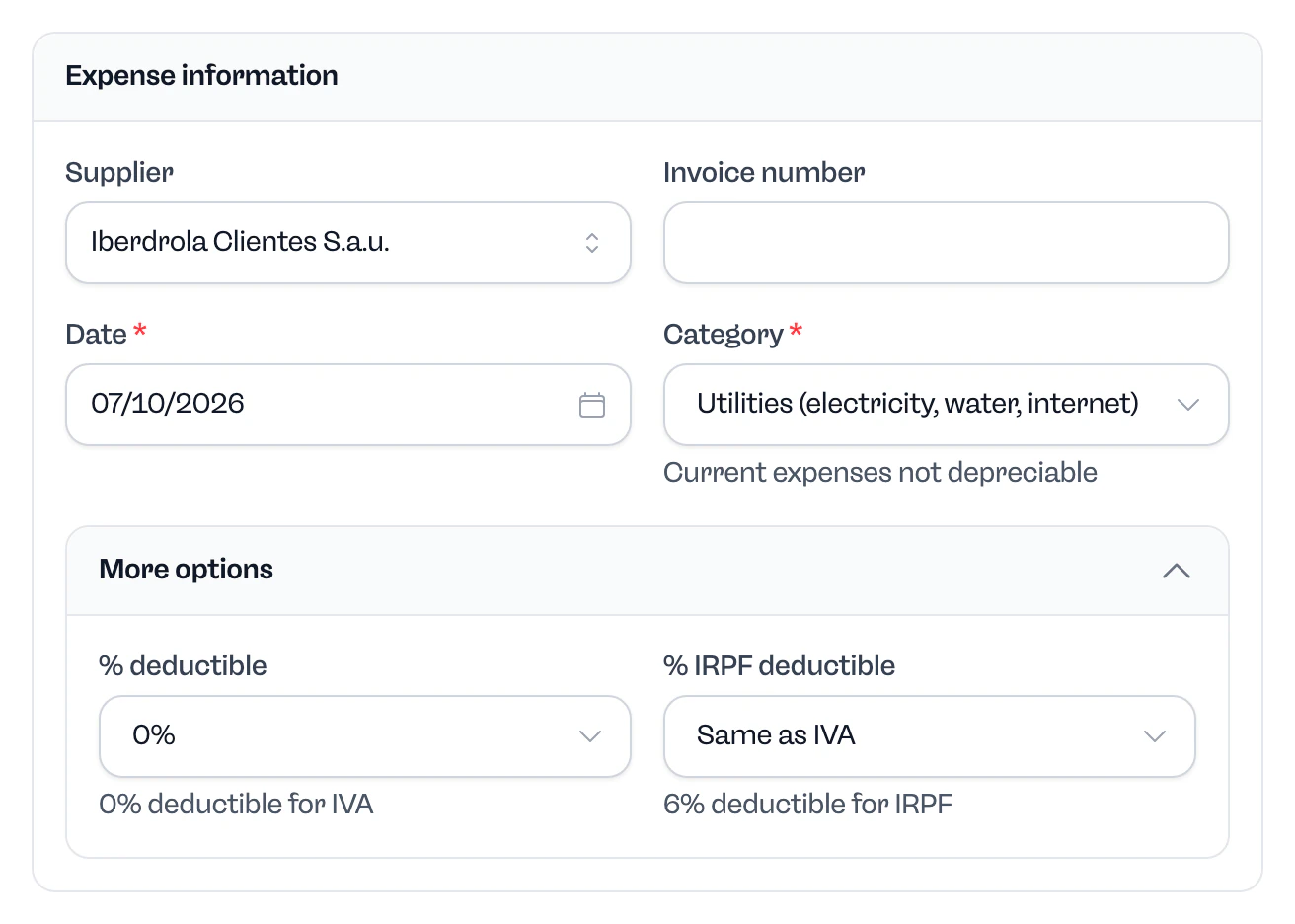
If you use part of your main home for work, you can deduct part of its utilities, such as water, gas, electricity, phone and internet. The law sets the formula: 30% of the share of square metres you use for work over the total floor area of the home, unless you prove a different percentage (article 30.2.5.ª.b of the IRPF Act).
An example. Your flat is 90 m² and you work in a room of 18 m², 20% of the area. 30% of that 20% is 6%. From an electricity bill of €60, you can deduct €3,60.
Meals, travel and client hospitality
Your own meal when working away is deductible if you pay at a restaurant or hospitality business, by card or another electronic method, within the limits the regulation sets for employees' allowances (article 30.2.5.ª.c of the IRPF Act). Those daily limits are (article 9.A.3 of the IRPF Regulation):
| Situation | In Spain | Abroad |
|---|---|---|
| No overnight stay | €26,67 | €48,08 |
| With an overnight stay | €53,34 | €91,35 |
The IVA on those meals and on hotels and travel is only deductible if the expense is deductible under IRPF (article 96.Uno.6.º of the IVA Act).
Taking a client out or giving them a gift counts as client hospitality. Under IRPF it is deductible up to 1% of your turnover for the year (article 15.e of Ley 27/2014, the Corporate Income Tax Act, which applies through article 28.1 of the IRPF Act). Its IVA is never deductible (article 96.Uno.5.º of the IVA Act).
The car
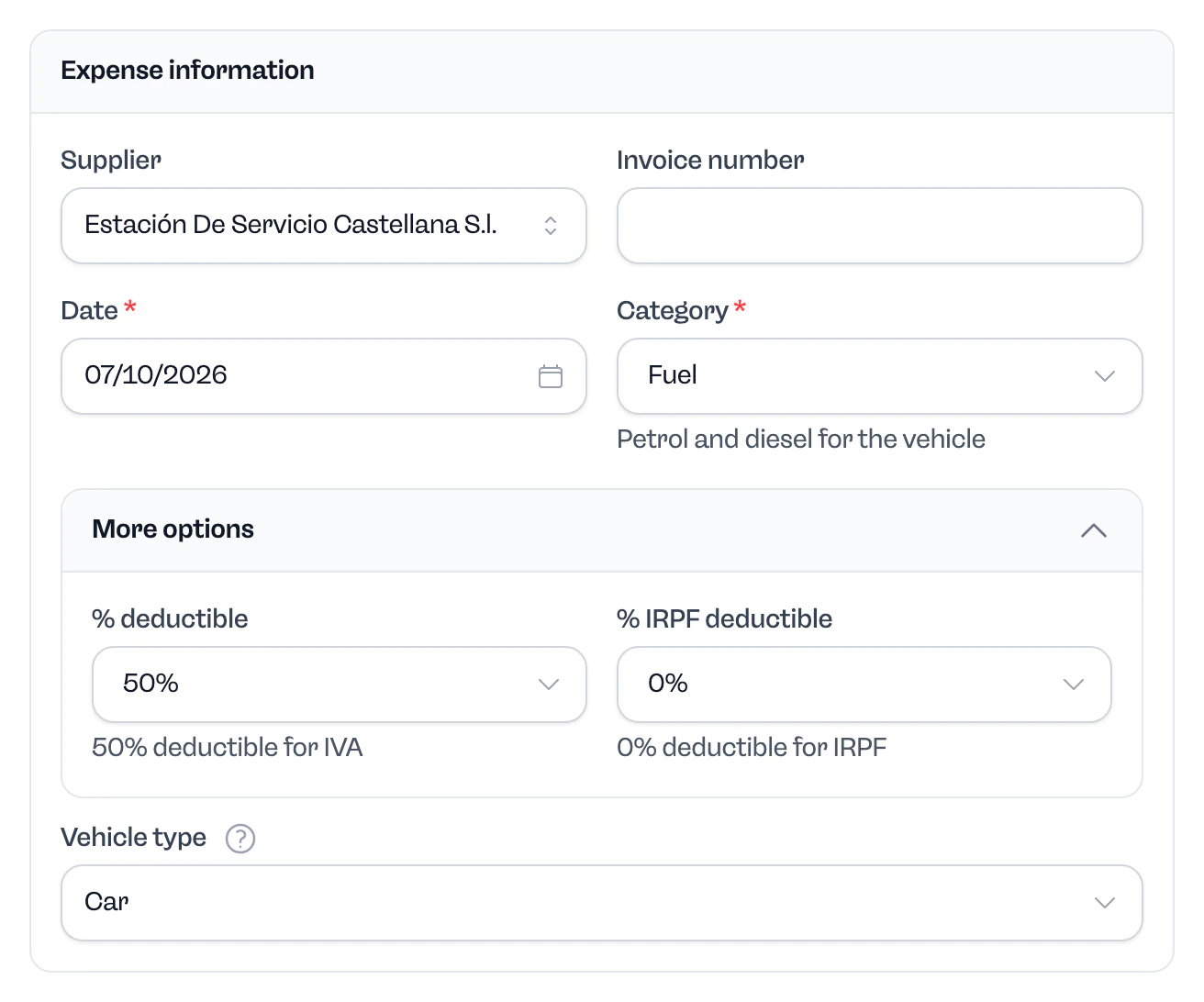
Under IRPF, a car you also use in your private life is not treated as a business asset, so neither its purchase nor its running costs are deductible (article 22.4 of the IRPF Regulation). The exceptions are mixed-use vans for carrying goods, vehicles for passenger transport, driving-school cars, those of sales representatives or agents on business trips and vehicles regularly rented out.
Under IVA the rule is different: the IVA on a passenger car is presumed to be 50% business use, unless another percentage is proven. It is presumed to be 100% in the same transport, driving-school and sales-agent cases, plus security vehicles and those a manufacturer uses for testing or promotion (article 95.Tres of the IVA Act). The same proportion applies to the IVA on fuel, repairs, tolls and parking (article 95.Cuatro).
Health insurance
Health insurance premiums are deductible up to €500 a year per person: you, your spouse and your children under 25 who live with you. The limit is €1.500 for each person with a disability (article 30.2.5.ª.a of the IRPF Act).
Hard-to-prove expenses
Some small expenses are hard to document. If you are under estimación directa simplificada (simplified direct assessment), the law lets you subtract 5% of your net income for provisions and hard-to-prove expenses, with no receipts, up to €2.000 a year (article 30.2.ª of the IRPF Regulation and article 30.2.4.ª of the Act). With net income of €24.000, you subtract €1.200. You cannot use it if you claim the reduction for economic activities in article 32.2 of the IRPF Act, because the two are incompatible.
What you cannot deduct
- Fines and penalties, enforcement surcharges and the surcharge for filing late (article 15.c of the Corporate Income Tax Act).
- Donations and gifts, except client hospitality within the 1% limit (article 15.e).
- Your private living costs, even if you pay them from the business account.
- Assets you use both for the business and for yourself, except where the law makes an exception (article 22 of the IRPF Regulation).
Under IVA, in addition, you can never deduct the IVA on jewellery, food and drink, tobacco, entertainment or client hospitality, unless they are the goods or services you sell (article 96 of the IVA Act).
Expenses of the year and depreciation: large purchases
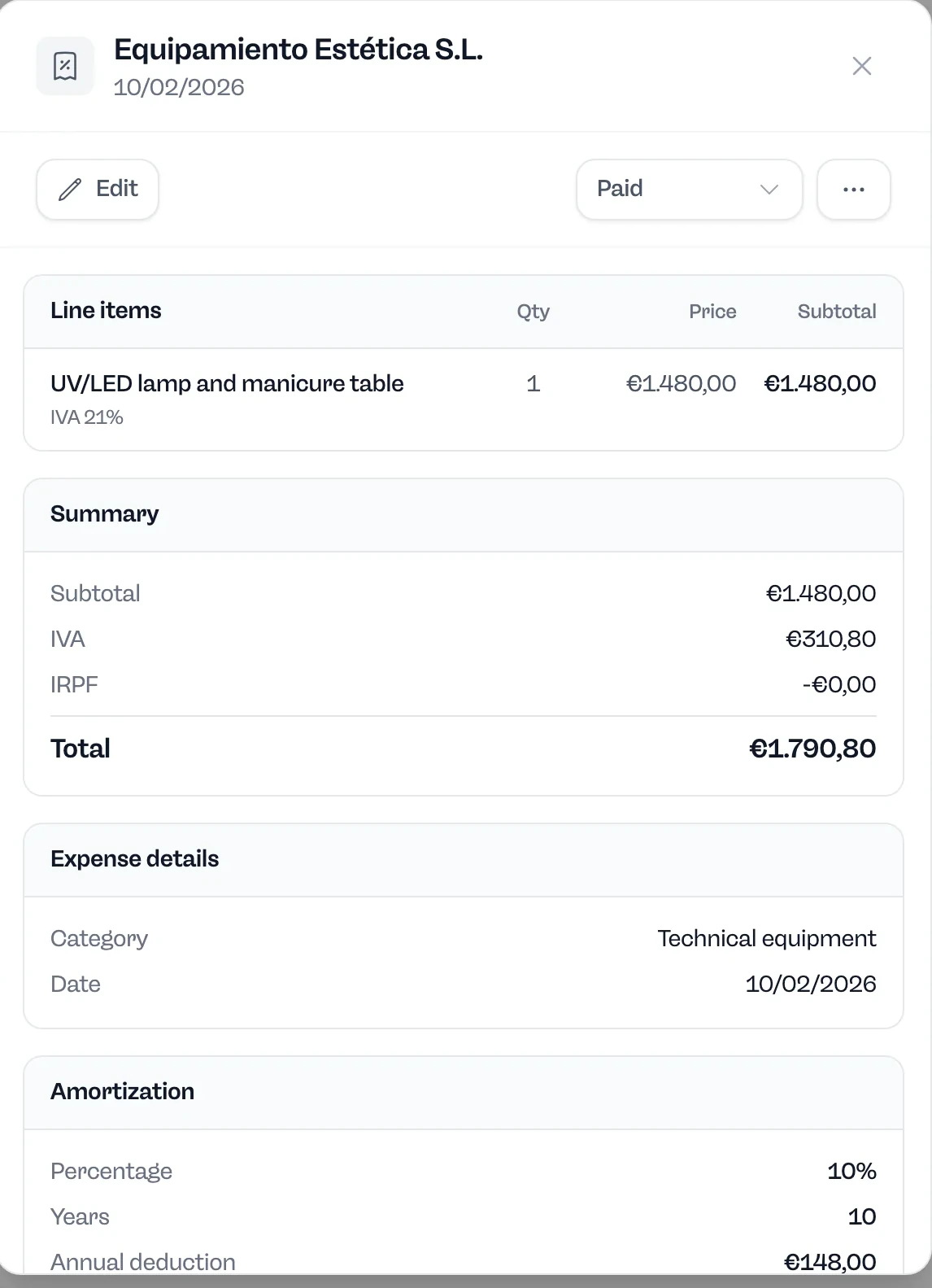
Not everything you buy for the business is deducted in full in the year you buy it. What is used up straight away, such as supplies, electricity or a monthly subscription, is an expense of the year. What you will use for several years, such as a computer, a camera, furniture or machinery, is a capital asset: its cost is spread over its useful life through depreciation (amortización).
For example, if you buy a laptop for €1.200 and depreciate it over four years, you deduct €300 a year (€1.200 ÷ 4). In the first year the amount is reduced in proportion to the time the asset has been in use.
The law sets, for each type of asset, a maximum percentage per year and a maximum number of years. Under estimación directa simplificada you use the table in the Order of 27 March 1998 (article 30.1.ª of the IRPF Regulation). Under the normal method, the table in article 12.1.a of the Corporate Income Tax Act. These are the most common values:
| Asset | Simplified direct assessment | Normal direct assessment |
|---|---|---|
| Computers and IT equipment | 26%, 10 years | 25%, 8 years |
| Software | 26%, 10 years | 33%, 6 years |
| Furniture | 10%, 20 years | 10%, 20 years |
| Tools | 30%, 8 years | 25%, 8 years |
| External transport (vehicles) | 16%, 14 years | 16%, 14 years |
The laptop in the example, at 25% a year, fits both tables. Small purchases have their own rule: new items costing no more than €300 each can be deducted in full in the year of purchase, up to a total of €25.000 a year (article 12.3.e of the Corporate Income Tax Act). How this works in practice is covered in assets and depreciation made automatic.
Common mistakes
- Deducting a capital asset in full. A €1.200 computer is not an expense of the year: it is depreciated.
- Using a period the table does not allow. Depreciating faster than the maximum rate is not deductible.
- Forgetting the partial first year. If the asset starts working mid-year, that year's amount is proportional.
- Not keeping the invoices. Without proof, the expense may be rejected in a tax review.
IVA on your expenses
The IVA you pay on purchases is subtracted on your modelo 303 (the quarterly IVA return) if three things hold: you have the invoice in your name (article 97 of the IVA Act), the expense is used directly and exclusively for your activity (article 95) and it is not on the exclusion list in article 96. You can deduct it in the quarter you bear it or in later ones, up to four years (article 99.Tres).
An ordinary till receipt is not enough for IVA. If your supplier gives you a simplified invoice, ask them to add your NIF, your address and the IVA amount shown separately, as article 7.2 of the Invoicing Regulation (Real Decreto 1619/2012) provides. If your activity is IVA-exempt, you do not recover the IVA on your purchases. How all of this fits into your returns is explained in the guide to autónomo taxes in Spain.
Keep your receipts
You must keep your invoices and receipts for the limitation period (article 68.1 of the IRPF Regulation), which is four years counted from the day after the deadline of the return they belong to (articles 66 and 67 of the General Tax Act). The easiest way is to store them on the day you pay. One way never to lose one is to forward receipts from your inbox.
How Facturaz helps
You take a photo of the receipt, forward the supplier's email or drop in the PDF. Facturaz reads the supplier, date, amount and IVA for you to check. Each new supplier's NIF is checked against the tax agency census. EU suppliers are checked against VIES. Purchases over €300 are spread over their useful life with the tax agency's tables. Your libros registro download to Excel. Autónomo Go costs €24 + IVA a month and Autónomo Plus €44 + IVA a month, with 14 days free. It is all in expenses in Facturaz.