
Setting up a sociedad limitada (SL, the Spanish limited company) has two kinds of cost. You pay those of incorporation once. Those of running it come back every year. The first are lower than many people think if you choose the online route. The second are the ones that decide whether the company is worth it.
That decision is explained in autónomo vs SL: when a limited company makes sense. Here you have, item by item, what it costs to set up an SL in 2026 and what it costs to keep it going, with the rule that sets each amount. We only give figures that are in the BOE (the Official State Gazette).
Share capital: from €1
Since Ley 18/2022, the capital of an SL cannot be lower than €1 (article 4.1 of the Capital Companies Law, Ley de Sociedades de Capital or LSC). Before, the minimum was €3.000. Capital is not an expense: it is the company's money, which you can use in the business. While the capital is below €3.000, two rules apply:
- The company must set aside at least 20% of its profit as a legal reserve until that reserve and the capital add up to €3.000.
- If the company is wound up and its assets are not enough to pay its debts, the shareholders are jointly liable for the difference between €3.000 and the capital they subscribed.
Cash contributions are proved to the notary with a bank certificate of the deposit in the company's name, valid for two months. In an SL this is not needed if the founders state in the deed that they are jointly liable for those contributions being real (article 62 LSC).
Notary and Registro Mercantil
What you pay the notary for the deed and the registrar for registering the company depends on the route you choose.
| Incorporation route | Notary | Registro Mercantil | Rule |
|---|---|---|---|
| Online with standard articles and capital up to €3.100 | €60 | €40 | Article 5.Dos.c of Real Decreto-ley 13/2010 |
| Online with a standardised deed in other cases | €150 | €100 | Article 5.Uno.g of Real Decreto-ley 13/2010 |
| Incorporation outside the online route | General fee scale, based on the amount | General fee scale, based on the amount | Real Decreto 1426/1989 and Decreto 757/1973 |
Real Decreto 421/2015, which regulates the standardised deed and the standard articles (estatutos tipo), refers to those two fixed amounts (second additional provision). The online route uses the Single Electronic Document (Documento Único Electrónico, DUE) and the CIRCE system and starts at an Entrepreneur Service Point (Punto de Atención al Emprendedor), which can be a public office, a notary's office or an online point (articles 13 and 15 of Ley 14/2013). With standard articles the law sets short times: the appointment with the notary cannot be more than 12 working hours after the procedure starts and the registrar registers the company within 6 working hours of receiving the deed (article 15.3.c and 15.5.a).
Publishing the registration in the Official Gazette of the Companies Register (BORME) carries no fee (article 15.9 of Ley 14/2013).
The name certificate
Before signing you must bring the notary a certificate from the Central Companies Register (Registro Mercantil Central) showing that nobody is using the name you have chosen. The name in the deed must match the certificate exactly (article 413 of the Companies Register Regulation, Reglamento del Registro Mercantil). The certificate is valid for three months for signing (article 414) and the name is reserved for six months from the date it is issued (article 412). Online you can ask for up to five alternative names and the Central Register replies within 6 working hours (article 15.3.b of Ley 14/2013).
The NIF
On the online route you do not apply for it yourself. The notary requests a provisional NIF (tax identification number) from the tax agency when sending it the deed and, once the company is registered, the registrar requests the definitive one (article 15.4.b and 15.5.c of Ley 14/2013).
Taxes on incorporation
Setting up a company is exempt from transfer tax and stamp duty (Impuesto sobre Transmisiones Patrimoniales y Actos Jurídicos Documentados) under article 45.I.B.11 of the consolidated text approved by Real Decreto Legislativo 1/1993. Contributing the capital costs you no tax.
Incorporation at a glance
| Item | Amount |
|---|---|
| Share capital | From €1, which stays the company's money |
| Notary, with capital up to €3.100 | €60 |
| Registro Mercantil, with capital up to €3.100 | €40 |
| Publication in the BORME | No fee |
| Transfer tax and stamp duty | Exempt |
| Name certificate | The Central Companies Register fee |
What it costs to run each year
This is where the real cost of an SL lies. These are the fixed items:
- Your autónomo contribution. If you run the company and control it, you contribute to the RETA (the self-employed scheme) as an autónomo societario (company autónomo) and you cannot choose a base below the minimum for group 7 of the Régimen General (articles 305.2.b and 308.1.a of the General Social Security Law). In 2026 that base is €1.424,40 a month (article 3 of Orden PJC/297/2026), so your minimum contribution is €448,69 a month. The tarifa plana (reduced start-up contribution) also applies to shareholders of capital companies (article 38 ter.9 of Ley 20/2007). Full details in the autónomo societario.
- Bookkeeping. The SL keeps proper accounts with a journal and an inventory and annual accounts book (article 25 of the Commercial Code). The books are legalised online within four months of the year end (article 18 of Ley 14/2013).
- Annual accounts. They are prepared, approved at the shareholders' meeting and filed every year with the Registro Mercantil. We cover it in the annual accounts of an SL.
- Corporate income tax. Every year you file modelo 200 within the 25 calendar days following the six months after the year end (article 124.1 of Ley 27/2014). Depending on your case, also the modelo 202 payments on account in the first 20 calendar days of April, October and December (article 40.1).
- IVA and withholding. Like any business, modelo 303 every quarter and, if the company pays you a salary or pays professionals, modelo 111. How to get paid by your company is in the salary of an SL director.
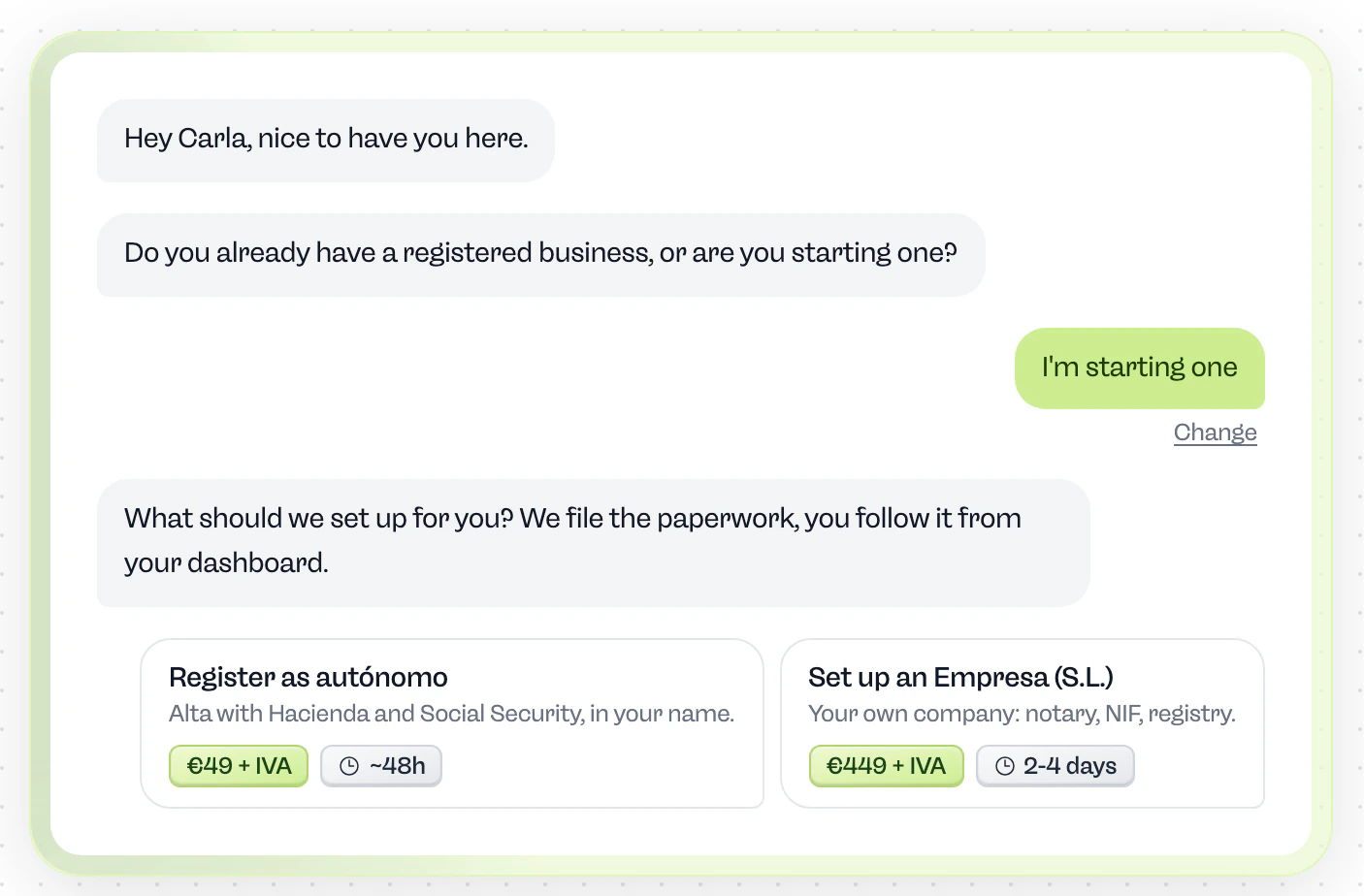
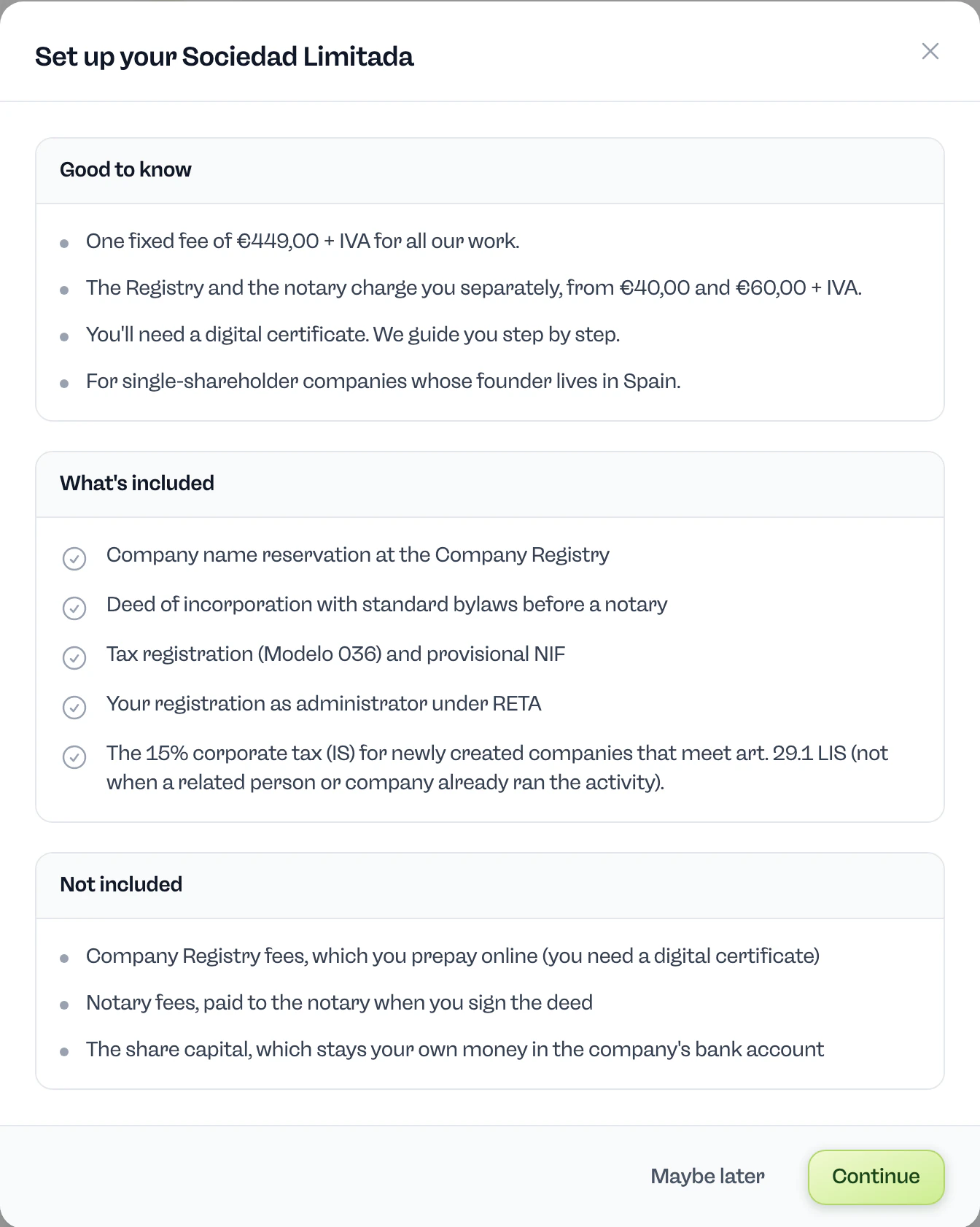
At Facturaz we set up your SL for €449 + IVA. That is our fee and it includes the name certificate. You pay the notary's and the Registry's fees directly to them, never through Facturaz. You have it in setting up your SL with Facturaz. For the day to day, Empresa Go (€44 + IVA a month) leaves everything ready for you to file and with Empresa Plus (€84 + IVA a month) our team files every modelo, including 200 and 202, legalises the books and files the annual accounts (the external fees for those two steps are billed separately) (the external fees for those two steps are billed separately). Both plans come with 14 days free on the plans for companies.