
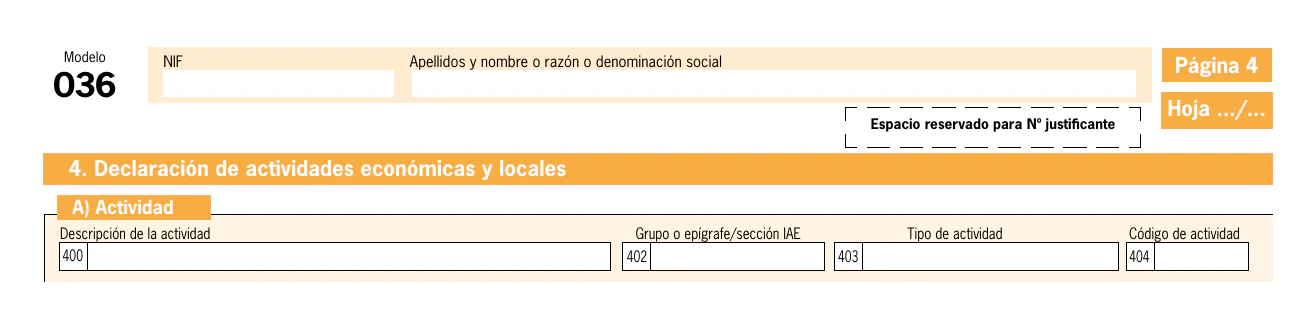
When you register with Hacienda, the Spanish tax agency, modelo 036 asks what activity you are going to carry out, with its code in the Impuesto sobre Actividades Económicas (IAE, the business activity tax). That code is the epígrafe. This article expands the first step of how to become an autónomo in Spain, the guide that covers the whole registration.
Here you have what the IAE is, how its tariffs are organised, why you do not pay it yet your epígrafe still matters, what the CNAE code is, how to change your epígrafe and a table of common epígrafes checked against the text of the tariffs.
What the IAE is
The Impuesto sobre Actividades Económicas is a local tax charged by town councils (article 59.1 of Real Decreto Legislativo 2/2004, the Local Finance Law). It taxes the mere carrying out in Spain of business, professional or artistic activities, whether or not in premises and whether or not they appear in the tariffs (article 78). Articles 78 to 91 of that law regulate it. The tariffs describe each activity with its code. They are in Real Decreto Legislativo 1175/1990 together with the Instrucción (instructions) for applying them (article 85).
The three sections: business, professional and artistic
The tariffs are split into three sections (rule 3 of the Instrucción):
- Section 1, business activities: mining, industrial, commercial and service activities. A hair salon, a shop or a photography studio belong here.
- Section 2, professional activities: those carried out by individuals as professionals, such as lawyers, translators, programmers or physiotherapists. If a company carries out one of these activities, it registers under the equivalent activity in section 1.
- Section 3, artistic activities: film, theatre and circus, dance, music, sport and bullfighting.
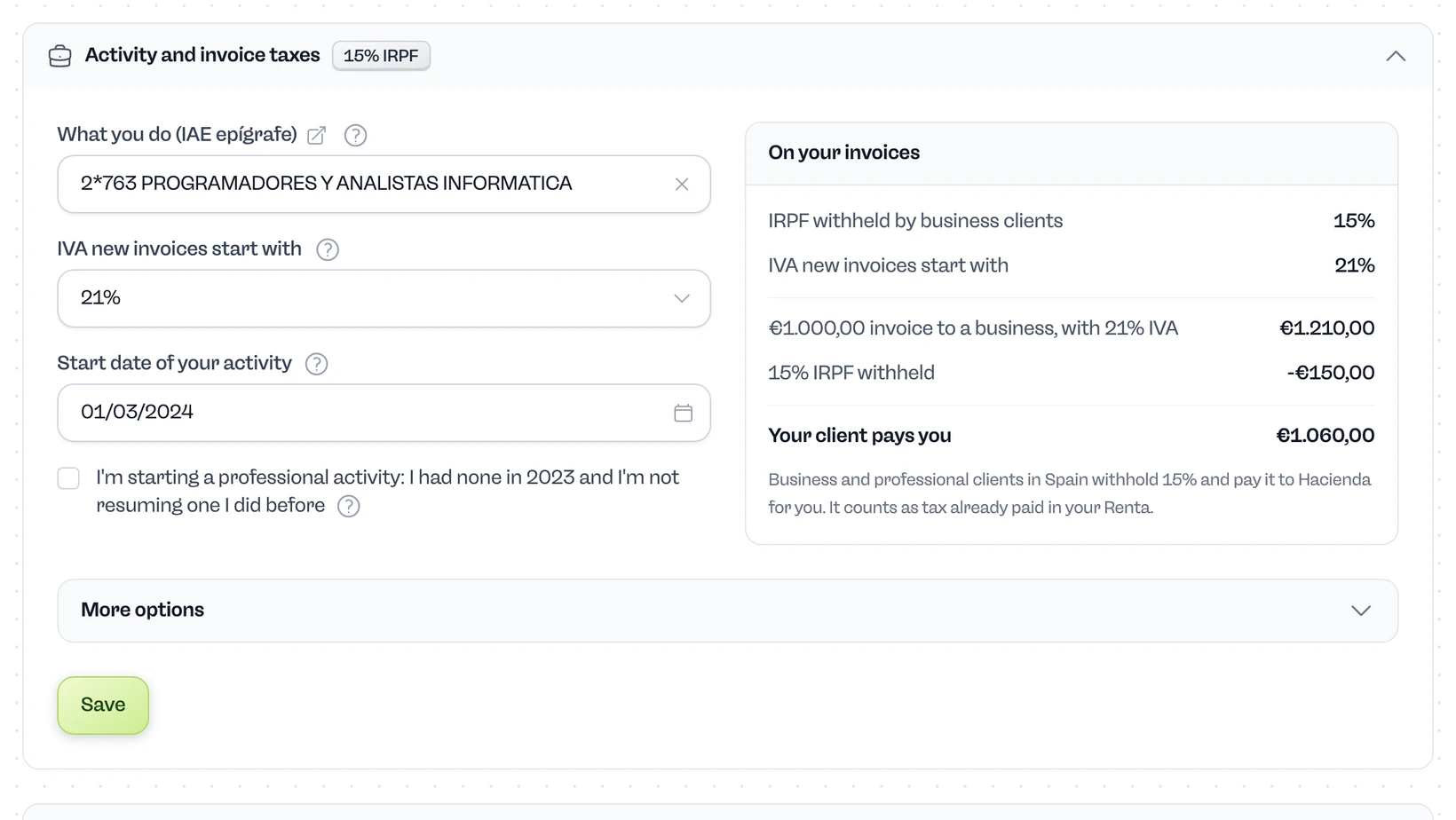
Within each section, activities are arranged in divisions, agrupaciones, groups and epígrafes. That is why some codes have three digits, like group 763 for programmers. Others have a decimal, like epígrafe 972.1 for hairdressing. In everyday use all of them are called epígrafe.
Why you do not pay the IAE
All individuals are exempt from the tax, resident or not. So are companies and other entities with net turnover below €1.000.000. On top of that, anyone starting an activity in Spain is exempt for the first two tax periods (article 82.1.b and c of the Local Finance Law).
As an autónomo you do not file separate IAE returns either: for those who are exempt, the census declaration, which is modelo 036, replaces them (article 14.3 of Real Decreto 1065/2007). If you are considering a company, we compare the two in autónomo or SL.
Why your epígrafe matters even though you do not pay
The epígrafe decides how IRPF (personal income tax) treats you. Income from the activities in sections 2 and 3 of the tariffs is professional income (article 95.2.a of the IRPF Regulation, Real Decreto 439/2007). That has direct consequences:
- Withholding on your invoices. If your activity is professional and you invoice a company or another autónomo, they withhold 15%, or 7% in your start year and the two following years if you carried out no professional activity in the previous year (article 95.1 of the Regulation). Business activities under estimación directa (direct assessment) carry no withholding (article 75.1.c). It is detailed in IRPF withholding on invoices.
- 7% for some cultural activities. Groups 851, 852, 853, 861, 862, 864 and 869 of section 2 and agrupaciones 01, 02, 03 and 05 of section 3 can apply 7% if their income from those activities in the previous year was below €15.000 and more than 75% of their business and employment income. You have to tell whoever pays you in writing (article 95.1.d).
- Modelo 130. If you carry out a professional activity and in the previous year at least 70% of its income carried withholding, you do not file the modelo 130 advance payment for it (article 109.2 of the Regulation). The rule only covers professional activities.
The CNAE code
The tax census also records the classification of your activities under the Clasificación Nacional de Actividades Económicas, the CNAE (Spain's national classification of economic activities) (article 5.b.11.º of Real Decreto 1065/2007). That is why modelo 036 also asks for a CNAE code. They are two different systems, so do not copy the number from one into the other. The Agencia Tributaria's activity finder gives you the IAE epígrafe and, as a guide, its CNAE, as the preamble to Orden HAC/1526/2024 notes.
Common epígrafes for autónomos
These are frequent epígrafes among autónomos, with the name given to them in Real Decreto Legislativo 1175/1990 and a short English gloss. We checked each number against the consolidated text of the tariffs.
| Code | Activity in the tariffs | Section |
|---|---|---|
| Group 763 | Programadores y Analistas de Informática (programmers and IT analysts) | 2 |
| Group 751 | Profesionales de la Publicidad, relaciones públicas y similares (advertising and PR professionals) | 2 |
| Group 774 | Traductores e Intérpretes (translators and interpreters) | 2 |
| Group 731 | Abogados (lawyers) | 2 |
| Group 741 | Economistas (economists) | 2 |
| Group 411 | Arquitectos (architects) | 2 |
| Group 432 | Decoradores-Diseñadores de interiores (interior designers) | 2 |
| Group 776 | Psicólogos and other social science graduates (psychologists, anthropologists, historians and similar) | 2 |
| Group 826 | Personal docente de enseñanzas diversas (teachers of sports, languages, exam preparation and similar) | 2 |
| Group 836 | Ayudantes Técnicos Sanitarios y Fisioterapeutas (nurses and physiotherapists) | 2 |
| Group 864 | Escritores y guionistas (writers and scriptwriters) | 2 |
| Group 887 | Maquilladores y Esteticistas (make-up artists and beauticians) | 2 |
| Epígrafe 972.1 | Servicios de peluquería de señora y caballero (hairdressing) | 1 |
| Epígrafe 973.1 | Servicios fotográficos (photography services) | 1 |
| Group 032 | Intérpretes de instrumentos musicales (musicians) | 3 |
The section tells you the withholding: sections 2 and 3 invoice companies and autónomos with withholding, while section 1 under direct assessment does not. If you hold a degree or diploma in computing, the tariffs also have groups 762 and 764.
If your activity is not in the tariffs, the Instrucción says to classify it in the group or epígrafe for activities not classified elsewhere (n.c.o.p.) that it most resembles. If that is not possible, it goes under the most similar activity (rule 8). If you carry out several activities, you register for each one: the Instrucción ties each registration to the activity it describes (rule 4).
How to change or add an epígrafe
Any change to your registration data, such as starting another activity or changing the one you carry out, is reported with a census amendment return, which is the same modelo 036 (article 10.1 and 10.2.b of Real Decreto 1065/2007). The general deadline is one month from the change (article 10.4). If you add an activity, also check whether your withholding changes. We explain it section by section in modelo 036 to register as an autónomo.
If you would rather we do it
With Facturaz's autónomo registration, for €49 + IVA, we file your modelo 036 and your Social Security registration and choose the activity code that fits you. It is on autónomo registration with Facturaz. Afterwards, your epígrafe is stored in the app's settings. Autónomo Go (€24 + IVA a month) and Autónomo Plus (€44 + IVA a month) come with 14 days free on Facturaz pricing.