
You can charge a client who cancels late or does not show up. Spain's consumer law allows it on three conditions: you told them before they booked, what you charge is not disproportionate and the rule also works when you cancel. If your policy fails one of them, that part is void and you cannot apply it.
This applies to any service by appointment or by spot: yoga and pilates classes, training, nails, dog grooming. Here is each condition with its article of Real Decreto Legislativo 1/2007. If you want students to book their spot and see your terms before booking, see Bookings for pilates and yoga teachers.
What you have to say before they book
Before the client is bound, you have to give them clear information on the legal and financial terms of the contract (article 60.1). For a cancellation policy, that means:
- The total price with IVA included (article 60.2.c). Also how much the deposit is if you ask for one.
- Until when they can cancel or change for free, for example up to 24 hours before.
- What happens if they cancel late or do not come: whether they lose the deposit, whether the pack's session is used or whether they pay a fee and how much.
- Whether a pack or membership has a minimum term and the fee for leaving early (article 60.2.f).
If there is ever a complaint, it is you who has to prove you gave that information (article 60.5). That is why it belongs on your booking page and in the confirmation email, not just said out loud.
How much you can charge
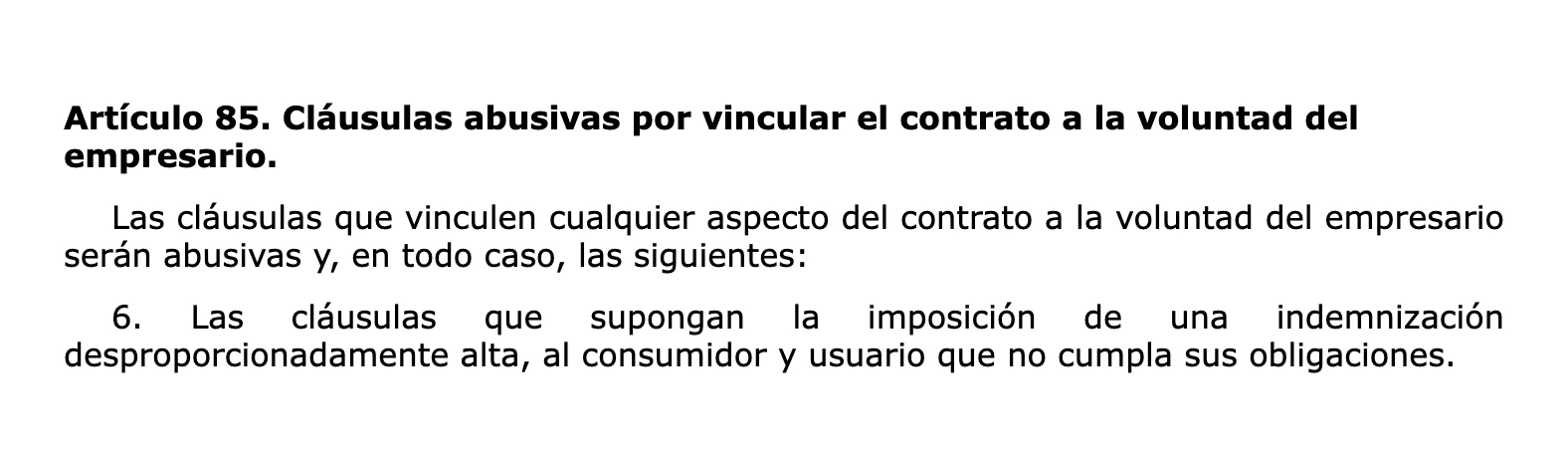
A clause that imposes a disproportionately high compensation on a consumer who does not fulfill their side is abusive (article 85.6). The law gives no figure. What you lose with an empty appointment is, at most, what you would have charged for it. A fee that stays within the price of the service is easy to justify. One above it, hard.
Keep in mind what you really lose too. In a group class with a waitlist, if the spot a student leaves is taken by another, the class is still full.
The rule has to work the other way
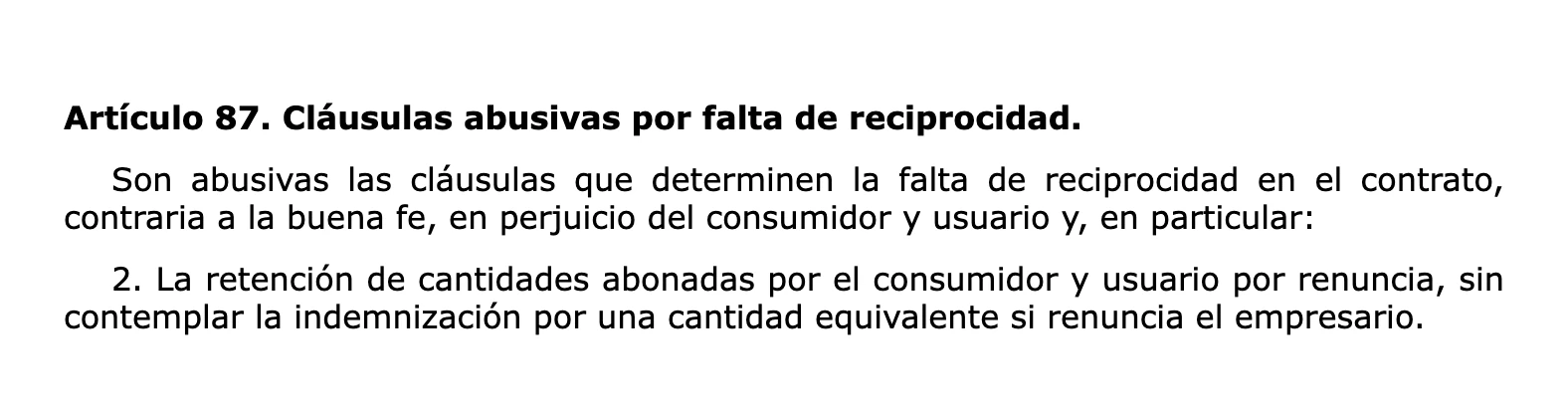
Keeping what the client paid when they withdraw, with no equivalent compensation if you withdraw, is abusive (article 87.2). If your policy says the client loses the deposit when they cancel late, it should also say what the client gets if you cancel late: at least a refund of what they paid and an equivalent compensation.
If part of it is abusive
An abusive clause is void and treated as never written. The rest of the contract still stands (article 83). In practice, if your fee is disproportionate, you cannot charge even the part that would have been reasonable.
Packs, memberships and minimum terms
Using up a pack session when the client does not come means keeping something they already paid for, so the same rules apply: told in advance and proportionate. For monthly memberships, the law also treats onerous or disproportionate obstacles to leaving as abusive, such as excessive minimum terms or demanding steps to cancel that differ from the ones used to sign up (article 87.6). The client can cancel the same way they signed up. The fee for leaving before the minimum term ends has to be proportional to the days left (articles 62.3 and 62.5).
If the client books or buys online
A distance contract gives the consumer 14 calendar days to withdraw without giving a reason (article 102). There are two exceptions that may apply to you:
- Services related to leisure activities with a specific date (article 103.l). It is not clear that a class or an appointment counts as leisure. A beauty or dog grooming appointment probably does not.
- A service already fully provided, if the client expressly asked for it to start and knew they lost the right that way (article 103.a).
A pack bought online with no date usually does have those 14 days. If the client asked to start using it earlier and then withdraws, they pay for the part already provided (article 108.4). Mention the withdrawal right in your information before the contract (article 60.2.h).
The IVA on what you charge for not coming
A deposit you keep or a fee has its own IVA treatment. We explain it in how to take a deposit when clients book.
With Bookings you choose on your page how far ahead clients book, what a late cancellation costs and whether you charge a fee for not coming. Your clients get a confirmation with a calendar invite and a reminder email 24 or 48 hours before.