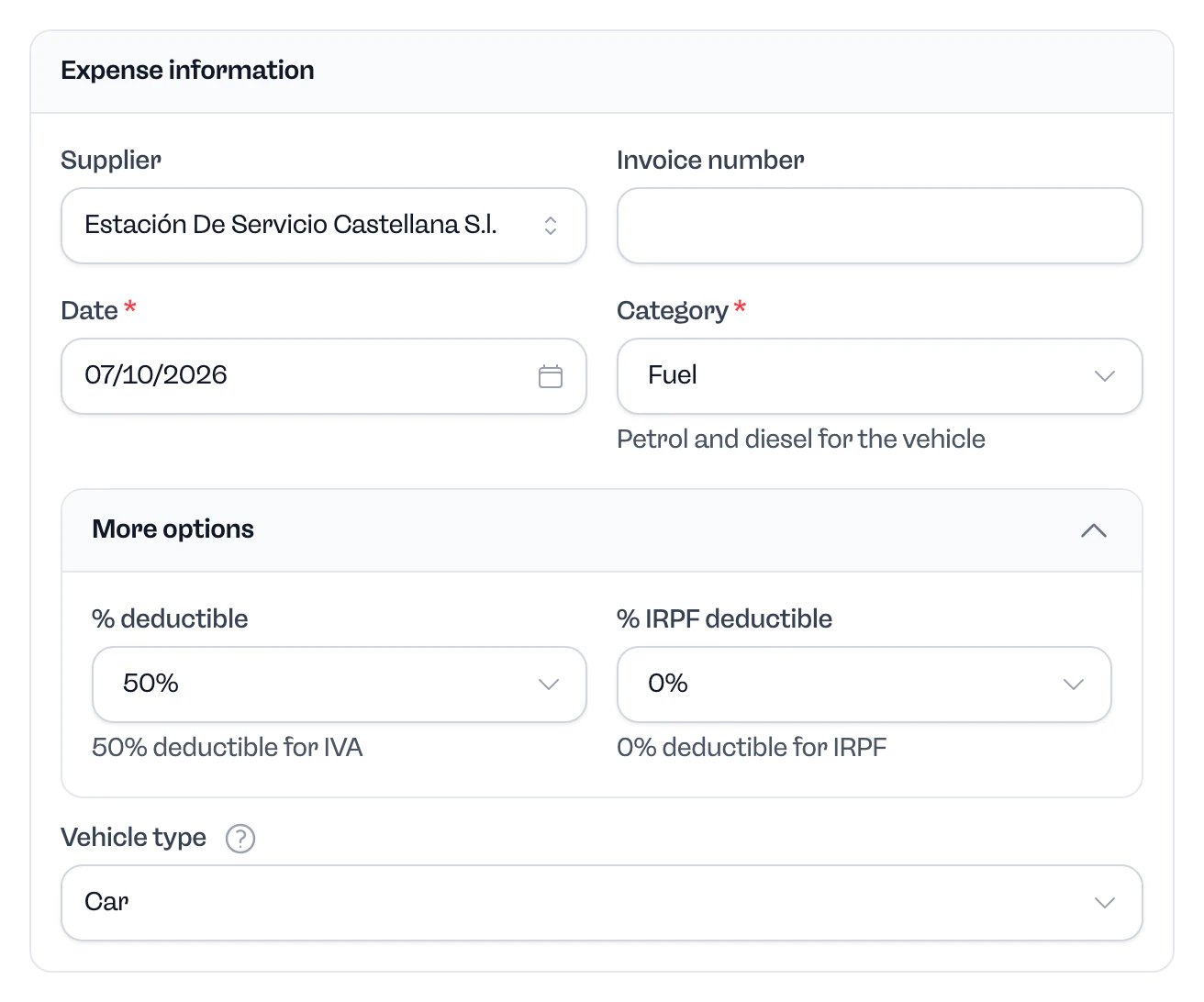
The car is the expense where IRPF (personal income tax) and IVA (Spanish VAT) get mixed up most. The two laws treat it differently: IVA accepts that you also use it privately and IRPF almost never does. This article expands the car section of how to deduct expenses as an autónomo, the guide that covers every deductible expense.
Here you have both rules, the cases the law treats at 100%, what happens with fuel, insurance, repairs, tolls and parking, how the car is depreciated, what changes with renting or leasing and where the road tax fits. Each rule cites its article.
For IRPF: only if you use it exclusively for work
An asset you use both for the business and in your private life is not considered assigned to the business (afecto), unless the private use is incidental and clearly irrelevant (article 22.2 of Real Decreto 439/2007, the IRPF Regulation). Article 22.4 explains what that irrelevant use is: using a business asset for yourself on days or at hours when you are not working. But it adds that this tolerance does not apply to passenger cars (turismos) and their trailers, mopeds, motorcycles, aircraft and sports or leisure boats.
In practice, a passenger car you also use at weekends is not assigned to the business. Then neither its purchase nor its running costs are deductible for IRPF. The Dirección General de Tributos (DGT, the tax policy directorate) repeats it in its answers: exclusive business use is required (binding rulings V0117-21 and V0520-20). The car also has to appear in your capital assets register (libro registro de bienes de inversión), because what is not in your records is presumed not to be assigned (article 22.2.2.º).
The same article 22.4 lists five exceptions where private use outside working hours is tolerated:
- Mixed-use vehicles used to carry goods.
- Vehicles used to carry passengers for a fare, such as a taxi.
- Vehicles used to teach driving or piloting for a fee.
- Vehicles used for the business travel of sales representatives or agents.
- Vehicles you lend for use habitually and for a fee, in other words those you rent out as a business.
A cargo van that is neither a passenger car nor a mixed-use vehicle is outside the list of vehicles without tolerance. The general rule applies to it: if you only use it for yourself on days or at hours when you are not working, it is still assigned to the business.
For IVA: 50% is presumed
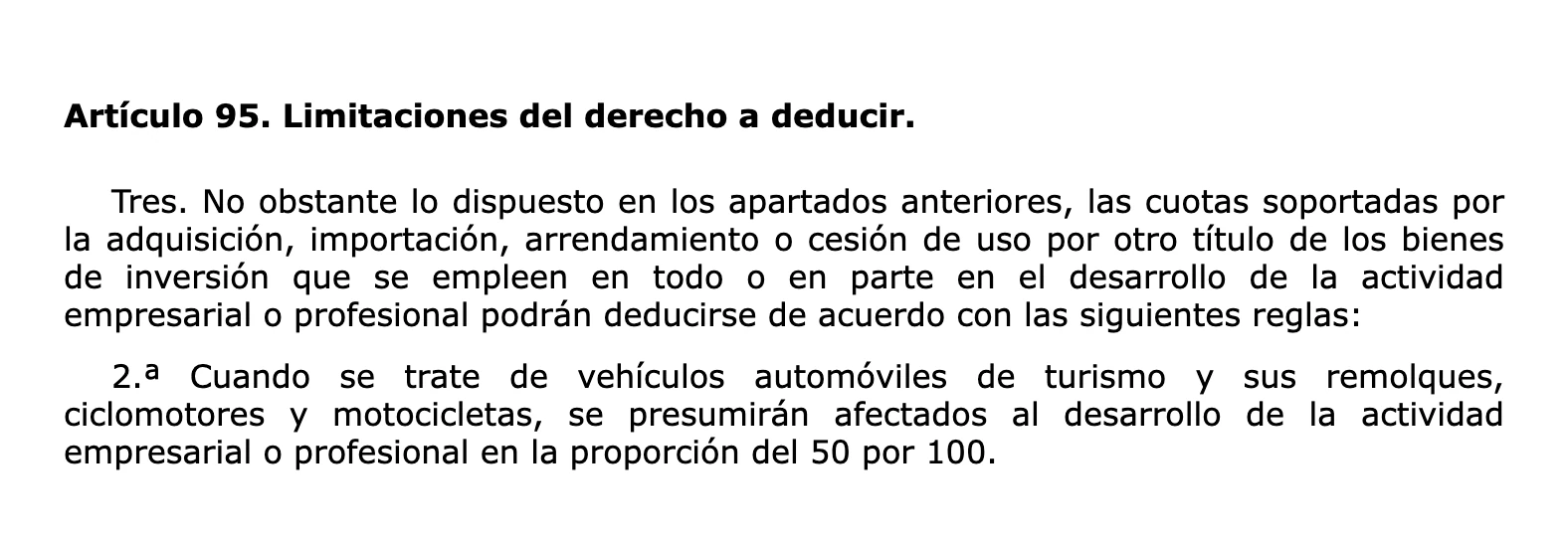
For IVA, buying, hiring or renting a passenger car and its trailers, a moped or a motorcycle is presumed to be 50% for the business (article 95.Tres.2.ª of Ley 37/1992, the IVA Law). You deduct half the IVA even if you also use the car privately. Mixed-use vehicles and four-wheel drives count as passenger cars for this rule.
The same rule presumes 100% in six cases:
- Mixed-use vehicles used to carry goods.
- Vehicles used to carry passengers for a fare.
- Vehicles used to teach driving or piloting for a fee.
- Vehicles used by their manufacturers for tests, trials, demonstrations or sales promotion.
- Vehicles used for the business travel of sales representatives or agents.
- Vehicles used in security services.
You can deduct more than 50% if you prove a higher use, with any evidence the law accepts. The law warns that declaring it that way or recording the car in your books is not enough (article 95.Tres.4.ª). If the real use turns out different from what you applied, you have to adjust the deduction (article 95.Tres.3.ª).
| Case | IRPF | IVA |
|---|---|---|
| Passenger car you also use privately | Not deductible | 50% |
| Passenger car used only for the business | Deductible, if you can prove it | 50%, or more if you prove the use |
| Sales agent on business travel | Deductible | 100% |
| Taxi or driving school | Deductible | 100% |
| Mixed-use vehicle carrying goods | Deductible | 100% |
Fuel, repairs, insurance, tolls and parking
For IRPF, the car's costs follow the car: if it is assigned to the business they are deductible; if it is not, they are not. For IVA, the car's percentage extends to its costs: accessories and spare parts, fuel, parking, tolls and repairs (article 95.Cuatro of the IVA Law). With a passenger car at 50%, you deduct half the IVA on each fill-up.
Car insurance carries no IVA, because insurance is exempt (article 20.Uno.16.º of the IVA Law). For IRPF it is one more car cost.
Without an assigned car you cannot deduct a per-kilometre amount either. The €0,26 per kilometre in Orden HFP/792/2023 is for what a company pays its employees. The DGT refuses to apply that rule to a professional (binding ruling V0117-21). Train, plane or taxi tickets for a work trip are business expenses: we explain them in meals and travel for autónomos.
Depreciating the car
If the car is assigned to the business, its purchase is not deducted in full in the first year: it is spread through depreciation. In estimación directa simplificada (the simplified direct assessment method), the table in the Orden of 27 March 1998 sets a maximum rate of 16% and a maximum period of 14 years for transport equipment (article 30.1.ª of the IRPF Regulation). In the normal method, the table in article 12.1.a of Ley 27/2014, the Corporate Tax Law, gives external transport equipment the same values.
An example. Marta is a sales agent and buys a car for €20.000 plus €4.200 of IVA. As she falls into one of the 100% cases, she subtracts the €4.200 in her modelo 303 and depreciates the €20.000 for IRPF, at most €3.200 a year. If Marta were a designer who also used the car privately, she would deduct €2.100 of IVA and nothing for IRPF. How each year is calculated is in capital assets and depreciation.
Renting and leasing
With renting the car is not yours, but the IRPF rule does not change: the DGT also requires exclusive business use to deduct the instalments (binding ruling V0520-20). For IVA, the 50% presumption applies in the same way to hiring or otherwise using a passenger car (article 95.Tres of the IVA Law).
If the contract is a lease with a purchase option (leasing, arrendamiento financiero) with a credit institution, article 106 of Ley 27/2014 allows deducting the finance charge and the part of the instalment that recovers the car's cost, the latter with a limit tied to the depreciation rate. Before any of that, the car has to be assigned to the business.
Road tax
Road tax is the Impuesto sobre Vehículos de Tracción Mecánica (IVTM), a municipal tax on owning vehicles fit to be driven (article 92 of Real Decreto Legislativo 2/2004, the Local Finance Law). It carries no IVA. For IRPF it is one more car cost: it counts if the car is assigned to the business.
How Facturaz handles it
In Facturaz, vehicle and fuel expenses take a vehicle type that decides how much is deductible. You take a photo of the fuel receipt and the AI fills in the supplier, date, base, IVA and total. A till receipt without your NIF (tax ID) does not let you deduct the IVA, so ask for the invoice. Autónomo Go costs €24 + IVA a month and Autónomo Plus €44 + IVA a month, with 14 days free, on Facturaz pricing.