Many clients ask for a "proforma" before they pay: a document that looks like an invoice and tells them what they are buying, at what price and with which taxes. It is useful, but it is not an invoice and does not replace one. This article is part of how to invoice as an autónomo, the guide with the invoicing rules.
No law defines the factura proforma (pro forma invoice). The Invoicing Regulation (Real Decreto 1619/2012) governs invoices and does not mention it. What the law does govern is everything around it: when you must invoice, what happens if you are paid in advance and which document your client needs to deduct IVA (Spanish VAT). That is what you will find here.
What a pro forma invoice is
It is a commercial document that previews the invoice for a specific sale. It usually carries the same details the invoice will have: your details and the client's, the items, the prices, the IVA and the total. The difference is the title and the effect: it says "factura proforma" and has no tax consequence at all.
It lets the client know exactly what they will pay, get it approved internally or make a bank transfer before receiving the work or the goods.
What a pro forma does not do
- It does not meet your obligation to invoice. You must issue an invoice for every sale and every advance payment received (article 2.1 of the Invoicing Regulation). The invoice is issued when the operation takes place or, if the client is a business or a professional, before the 16th of the following month (article 11.1).
- It creates no IVA to declare. IVA accrues when you deliver the goods or provide the service (article 75.Uno of Ley 37/1992 on IVA) or when you receive an advance (article 75.Dos), not when you send a pro forma. So it stays out of your record books and out of modelo 303, the quarterly IVA return.
- It cannot be used to deduct IVA. Your client can only deduct IVA with the original invoice (article 97.Uno of the IVA Law). Not with a pro forma.
Pro forma, quote and invoice
The law defines neither the quote (presupuesto) nor the pro forma, so the difference between them is one of use. This table sums up how they are normally used:
| Document | What it is used for | Tax effect |
|---|---|---|
| Quote (presupuesto) | Offering a job and its price before the client decides. If accepted, it sets what was agreed. | None |
| Pro forma invoice | Previewing the invoice for a sale already discussed, requesting payment or handling paperwork. | None |
| Invoice (factura) | Recording the sale or the advance payment. | Goes into your books and returns. Your client deducts the IVA with it. |
If you are paid in advance
This is where the most common mistake happens. When a client pays part of the price before you do the work, that advance already accrues IVA when you receive it, on the amount received (article 75.Dos of the IVA Law). And you must issue an invoice for that payment (article 2.1 of the Invoicing Regulation), stating the date you received it if different from the invoice date (article 6.1.i).
An example. Marta, a web designer, agrees a website for €2.000 + IVA with a company. She sends a pro forma for the total and the client pays 50% in advance in September. The work is delivered in November:
| Document | Base | IVA 21% | Effect |
|---|---|---|---|
| Pro forma (August) | €2.000,00 | €420,00 | None: information only |
| Advance invoice (September) | €1.000,00 | €210,00 | IVA in the third-quarter 303 |
| Final invoice (November) | €1.000,00 | €210,00 | IVA in the fourth-quarter 303 |
If you are a professional and your client is a company, the advance invoice also carries IRPF (income tax) withholding: the obligation to withhold arises when payment is made (article 78.1 of the IRPF Regulation). For the rate that applies, see IRPF withholding on your invoices.
There is one exception: advances on supplies of goods to businesses in another EU country, exempt under article 25 of the IVA Law, do not accrue IVA on receipt and need no advance invoice (articles 75.Dos of the Law and 2.1 of the Invoicing Regulation).
What a pro forma is used for
- Requesting payment before you start. The pro forma tells the client how much to transfer. As soon as you are paid, you issue the invoice for that payment.
- Shipping goods outside the EU. The carrier or customs may ask for a document with the value of the goods before the invoice exists, or when the shipment is not a sale, such as samples. If it is a sale, the export needs its invoice. See how to invoice a client abroad.
- Grants and financing. Some grant calls or lenders ask for quotes or pro formas for the investment you plan. To justify the expense later, they normally ask for the invoice.
- Payment platforms. If a platform such as Stripe produces its own documents while your software issues the invoice, marking the platform's documents as pro forma avoids duplicates. It is explained in how to set up Stripe as pro forma.
Mistakes to avoid
- Numbering the pro forma in your invoice series. Invoice numbering must be consecutive within each series (article 6.1.a of the Invoicing Regulation). If pro formas share a series with invoices, numbers appear that match no invoice. Use a different numbering and show "proforma" clearly.
- Changing the title of the pro forma and calling it an invoice. The invoice is a new document, with its own number in the series and its own date of issue.
- Forgetting the advance invoice. If you are paid before doing the work, the IVA on that amount goes in that quarter's 303, even if the final invoice comes later.
- Giving a pro forma to someone who needs an invoice. A business cannot deduct IVA with it. If you have already done the work, what you owe is the invoice. If an invoice you issued has an error, it is corrected with a factura rectificativa (corrective invoice).
How Facturaz does it
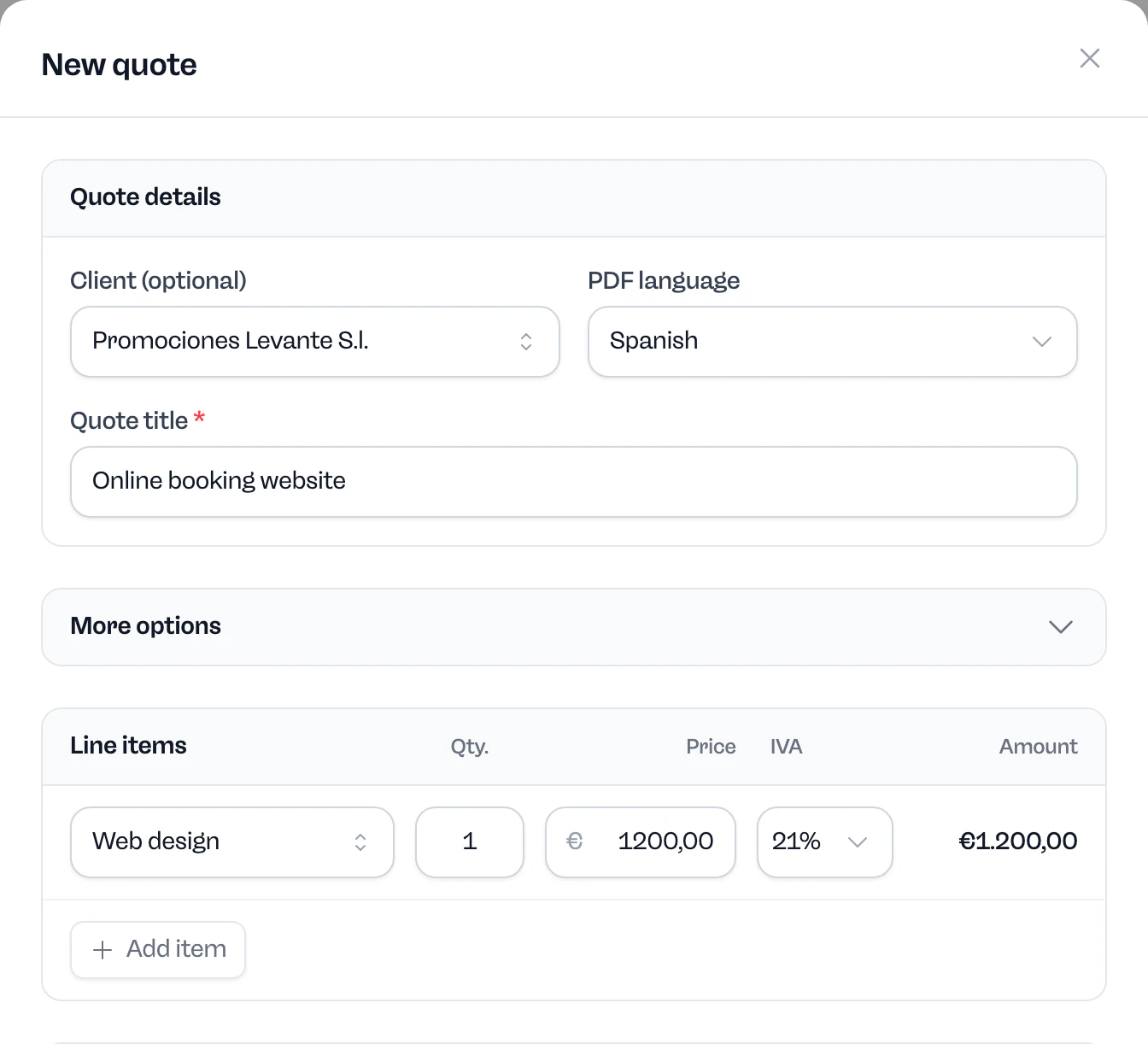
Facturaz has no pro forma document. For offers you have quotes, an app you switch on in Settings that your client signs online. When you do the work or get paid, you issue the invoice. If it needs correcting, that is done with a rectificativa that references the original. Facturaz is Verifactu compliant. Autónomo Go costs €24 + IVA a month and Autónomo Plus €44 + IVA a month, with 14 days free: see pricing.