
Pay in kind (retribución en especie) is the part of your salary the company pays with something other than money: health insurance, meal vouchers, a transport pass, a car or a home. The IRPF Law defines it as using, consuming or obtaining goods or services for private purposes, free or for less than their market price (article 42.1 of Ley 35/2006). It is taxed like the rest of your salary, except what the law itself exempts. Flexible pay (retribución flexible) is the agreement to take part of your salary in those exempt products and pay less IRPF.
In short: meals up to €11 a day, health insurance up to €500 a year per person and public transport up to €1.500 a year pay no IRPF. A car or a home does, with valuation rules of their own. Pay in kind cannot exceed 30% of the total and almost all of it counts for Social Security. If you have employees or an SL, what you pay in on this pay goes on modelo 111, one of the taxes of an autónomo. Every rule comes with its article.
What pay in kind is
There is pay in kind when the company pays for the good or the service and you enjoy it in your private life. It does not have to cost the company money (article 42.1 of the IRPF Law). Two boundaries are worth knowing:
- If they give you the money to buy it yourself, it is cash salary. The second paragraph of article 42.1 says so. That is why in a flexible pay plan the company contracts and pays for the product directly.
- Two things are not pay in kind. The training your job requires (article 42.2.a and article 44 of the IRPF Regulation) and the work accident or liability insurance the company takes out for you (article 42.2.b). They are not taxed and have no limit.
What flexible pay is
The law does not use that name. Flexible pay is the agreement between the company and the worker to swap part of the gross cash salary for products the IRPF Law exempts. Your total salary is the same. What goes down is the part you pay IRPF on, so your net pay is higher.
It is not extra salary. If the company gives you the insurance or the vouchers on top of your salary, it is a benefit: it is taxed the same way, but you give nothing up in exchange. The same exemptions and limits apply in both cases. The agreement changes how your salary is paid, so it is best put in writing.
What is exempt and up to how much
These are the most common kinds of pay in kind that pay no IRPF (article 42.3 of the IRPF Law). Anything above the limit is taxed as ordinary pay in kind.
| Product | Exempt limit | Where it is |
|---|---|---|
| Meals: company canteen, vouchers or restaurant card | €11 a day | Article 42.3.a of the law and article 45 of the regulation |
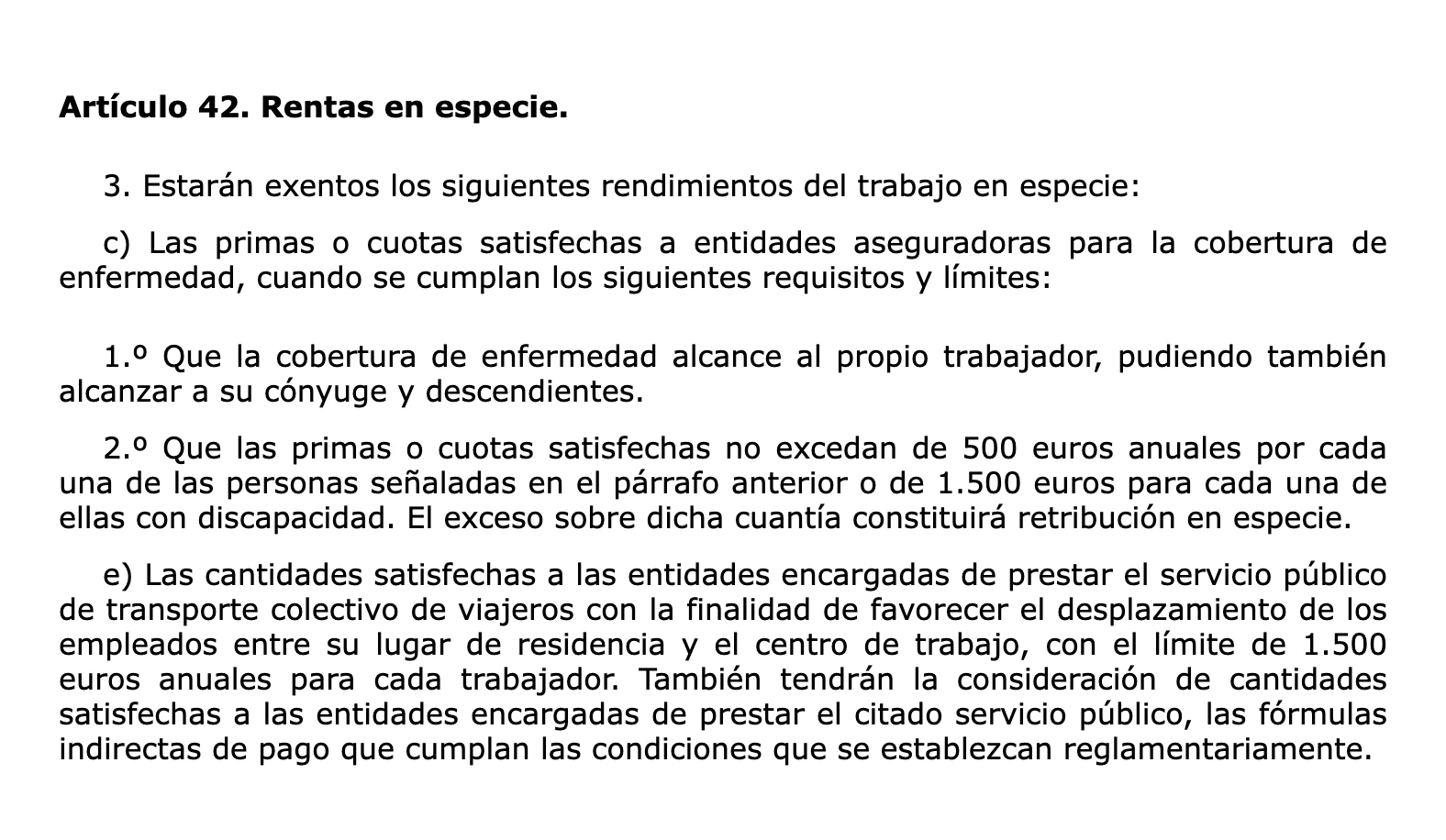
| Health insurance | €500 a year per person. €1.500 with a disability | Article 42.3.c of the law and article 46 of the regulation |
| Public transport | €1.500 a year. With a card, €136,36 a month | Article 42.3.e of the law and article 46 bis of the regulation |
| Nursery (first cycle of early years education) | The law sets no amount | Article 42.3.b of the law |
| Shares in the company | €12.000 a year. €50.000 in a startup (empresa emergente) | Article 42.3.f of the law and article 43 of the regulation |
Meals
Meal vouchers or a meal card are exempt up to €11 a day. They only count on your working days and not on days when you receive exempt meal allowances. They must be in your name, non-transferable and be used only in restaurants and other food outlets. They cannot be refunded. What you do not spend one day does not carry over to another (article 45 of the IRPF Regulation). Food you collect or have delivered on the days you work from home counts too (article 42.3.a of the law).
Health insurance
The policy must cover you. It can also cover your spouse and your descendants. The limit is €500 a year for each person covered, or €1.500 if that person has a disability. Anything above that is pay in kind (article 46 of the IRPF Regulation).
Transport
What the company pays to public transport operators so you can travel between home and work is exempt up to €1.500 a year. If it does so with a transport card, the card can only buy travel tickets, up to €136,36 a month. It must be in your name, non-transferable and non-refundable (article 46 bis of the IRPF Regulation).
Nursery
First cycle early years education for your children is exempt, in approved premises of the company itself or contracted with authorised third parties (article 42.3.b of the law).
Shares in the company
Shares in your company are exempt up to €12.000 a year if the offer is the same for every worker. You must keep them for three years and you cannot hold, together with your close family, more than 5% of the company (article 43 of the IRPF Regulation). In a startup under Ley 28/2022 the limit is €50.000 and the offer does not have to go to the whole staff.
What is taxed and how it is valued
All other pay in kind is taxed at its market value, with specific rules for the most common kinds (article 43.1 of the IRPF Law):
- Company car. If you are given the use of it, each year counts 20% of what it cost the company, taxes included. If the company does not own it, for example under a lease, the 20% applies to the market value of the car when new. A €30.000 car is €6.000 a year. Only private use counts (article 42.1). If the car is handed over to you as yours, the whole cost counts.
- Efficient car. That value drops by 15%, 20% or 30% depending on the car. The 30% is for battery electric cars, extended range electric cars and plug-in hybrids with a range of at least 15 kilometres and a value of up to €40.000 (article 48 bis of the IRPF Regulation).
- A home the company owns. 10% of the cadastral value, or 5% if the cadastral value was revised in the previous ten years. The result cannot exceed 10% of the rest of your salary.
- A home the company rents for you. What it costs the company, with the amount from the previous rule as a minimum.
- Cheap loan. The difference between the interest you pay and the legal interest rate for that year.
- Other insurance, travel, studies and board. What they cost the company, taxes included.
If the company sells what it gives you, for example a car dealer lending a car, the value cannot be lower than the price it offers the public (article 43.1.1.º f).
The payment on account: withholding on what is not money
From a cash salary the company withholds a part and pays it to Hacienda. From an insurance policy or a car there is nothing to withhold, so the company makes a payment on account (ingreso a cuenta): it applies your withholding rate to the value of the pay in kind (article 102.1 of the IRPF Regulation). Exempt pay in kind carries no payment on account (article 75.3.a). Neither do company contributions to your pension plan that reduce your tax base (article 102.2).
In your Renta you declare the value of the pay in kind plus the payment on account, unless the company has passed it on to you, that is, deducted it from your payslip (article 43.2 of the IRPF Law).
An example. The company pays health insurance of €900 a year for you alone. €500 are exempt and €400 are pay in kind. With a withholding rate of 15%, the payment on account is €60. If the company does not deduct it from you, your Renta shows €460 of income and €60 already paid.
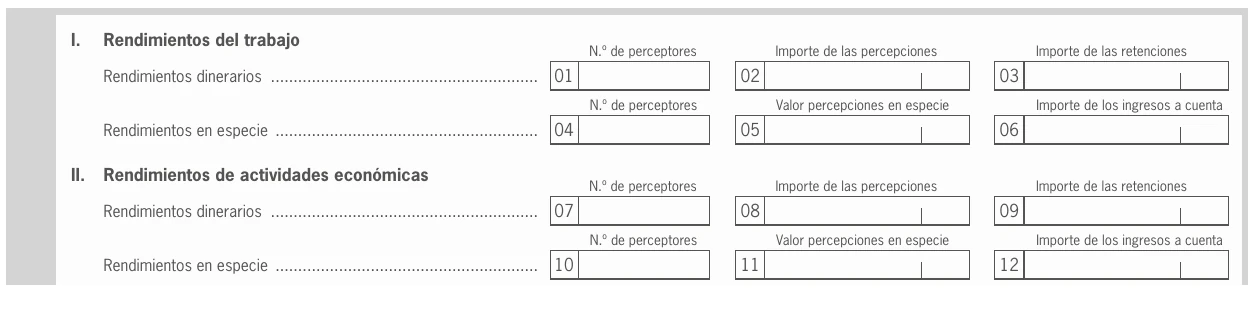
The company reports these amounts every quarter on modelo 111, in the row for income in kind: boxes 04, 05 and 06. In January it reports them again, worker by worker, on modelo 190.
The labour limits: 30% and the minimum wage
The Workers' Statute sets two limits (article 26.1 of Real Decreto Legislativo 2/2015):
- Pay in kind cannot exceed 30% of what you earn.
- It cannot reduce the minimum wage in cash. The minimum wage (salario mínimo interprofesional) is paid in full in money. If you earn the minimum wage, you cannot swap part of it for products.
It counts for Social Security too
The contribution base includes all your pay, in money and in kind (article 147.1 of the General Social Security Law). The list of what stays out is closed and does not include meal vouchers, health insurance or transport (article 147.2). Vouchers count for their full amount, as do insurance premiums (article 23.1.B of Real Decreto 2064/1995). Training your job requires does not count (article 147.2.d).
So flexible pay saves IRPF, not contributions. Your contribution base is the same as if you were paid everything in money. Your benefits do not change either.
An example with numbers
Ana earns €30.000 gross a year. She agrees with her company to receive in products:
- A meal card of €11 a day for 220 working days: €2.420.
- Health insurance for herself: €500.
- A transport pass: €1.500.
That is €4.420 in kind, 14,7% of her salary, below the 30%. All of it is within the exempt limits, so Ana pays IRPF on €25.580 instead of €30.000. If her marginal rate is 30%, she saves €1.326 a year (€4.420 × 30%). The marginal rate depends on your salary and your region: see the IRPF tax bands. Her Social Security contribution does not change.
If you are an autónomo
An autónomo does not pay themselves a salary, so there is no pay in kind of their own. What you pay for yourself counts, if it meets the requirements, as an expense of your business:
- Your health insurance. It is a deductible expense in estimación directa up to €500 a year for you, for your spouse and for each child under 25 who lives with you, or €1.500 with a disability (article 30.2.5.ª of the IRPF Law). It is the same limit as the employee's.
- Your meals. They have their own rule, explained in meal expenses for autónomos.
- Your car. See car expenses for autónomos.
If you have employees, you can pay them in kind under the rules in this article. You make the payment on account and report it on modelo 111 and modelo 190. What it costs you is a staff expense of your business.
If you have an SL
What your company pays for you for your private life is your pay in kind. The most common case is the autónomo contribution: if the company pays it and bears the cost, it is pay in kind with its payment on account. It is explained in the autónomo contribution as a deductible expense and in the salary of an SL director.
The exemptions in article 42.3 are written for employees and workers. If you are only paid as a director, with no employment contract, do not assume they reach you.
How Facturaz handles it
If you are an autónomo, you save your health insurance as an expense in the Health insurance category. Facturaz applies the €500 per person limit in your modelo 130 and your Renta. In an SL, the autónomo contribution the company pays counts as the director's pay in kind on its modelos 111 and 190, with its payment on account. Autónomo Go costs €24 + IVA a month and Autónomo Plus €44 + IVA a month, with 14 days free, on Facturaz pricing.